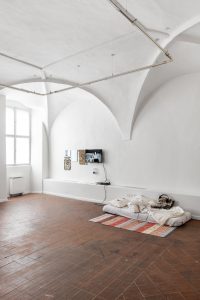
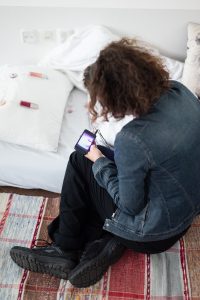
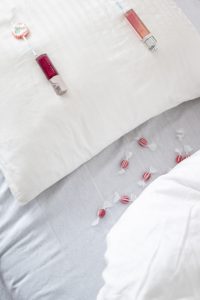
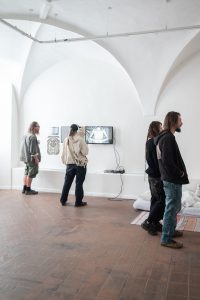
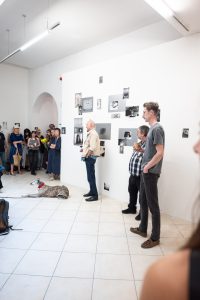
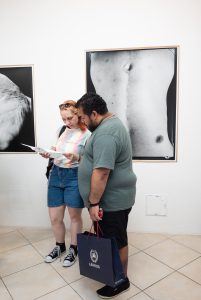
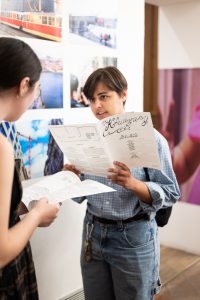
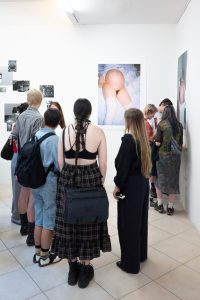
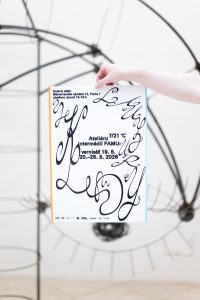
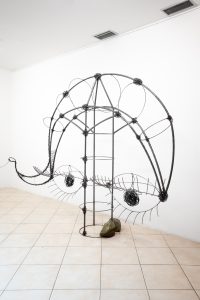
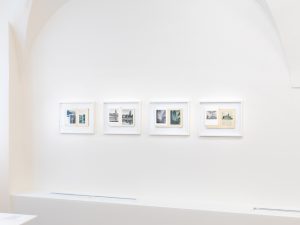
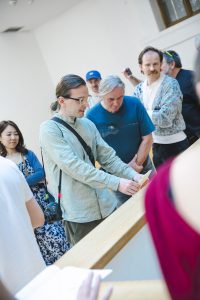
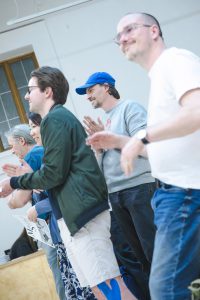
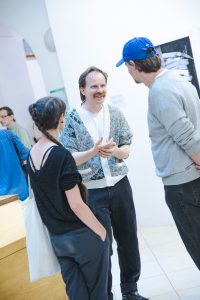
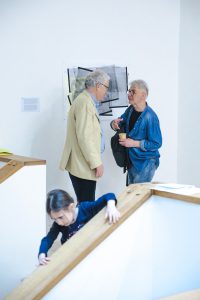
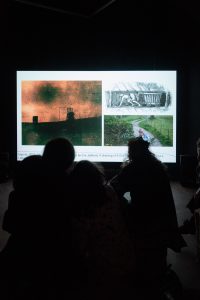
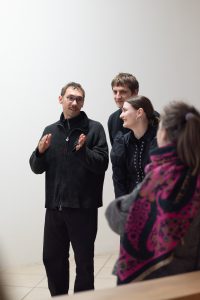
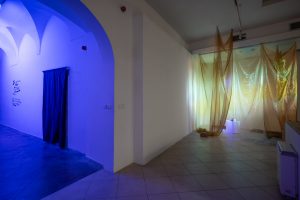
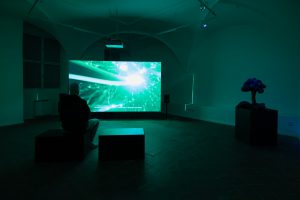
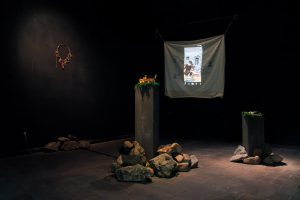
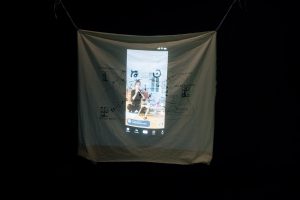
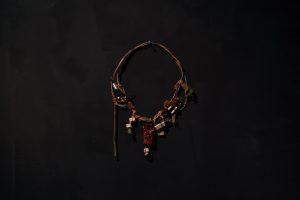
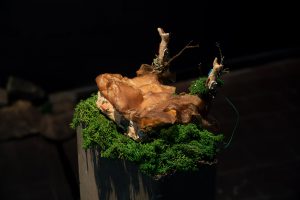
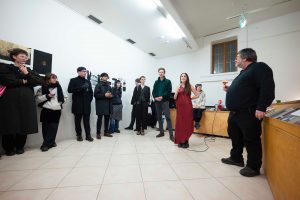
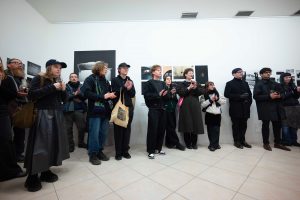
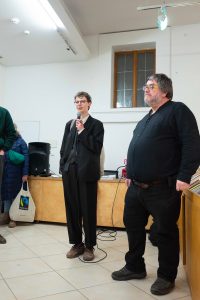
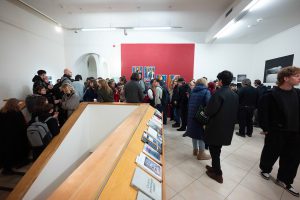
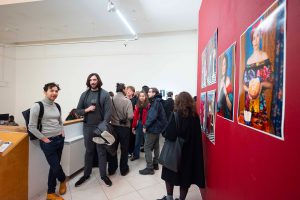
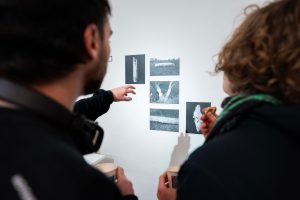
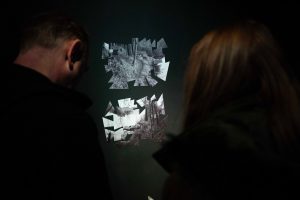
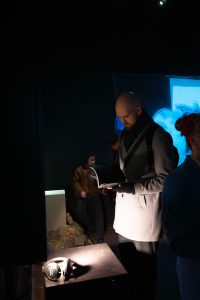
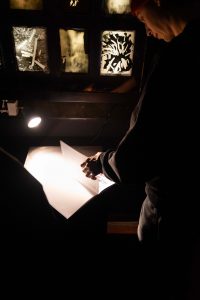
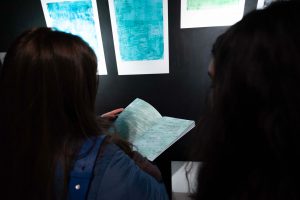
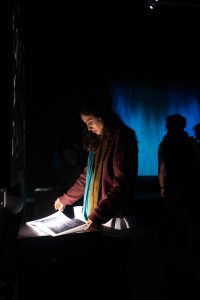
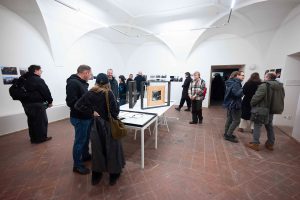
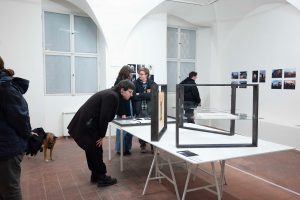
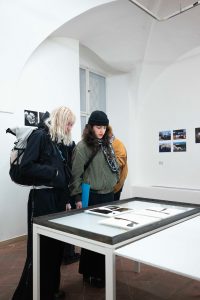
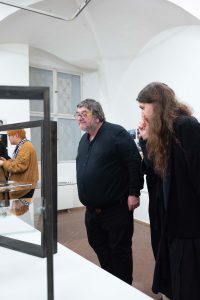
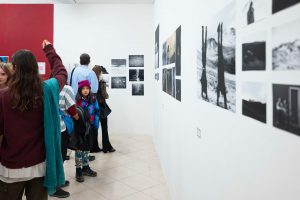
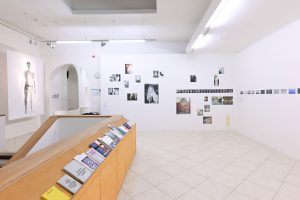
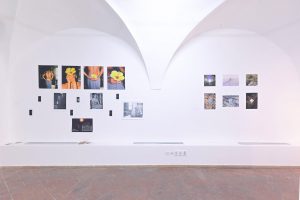
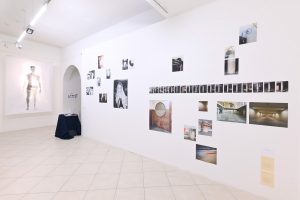
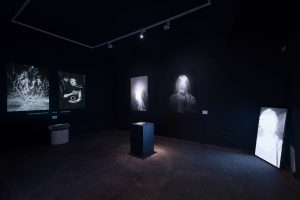
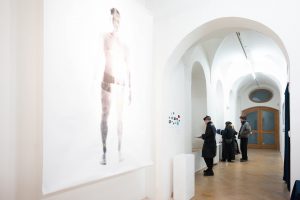
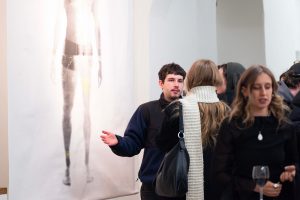
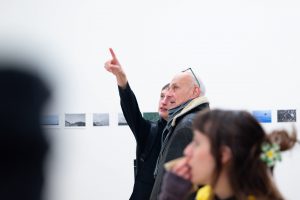
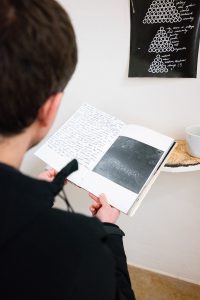
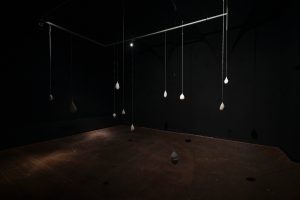
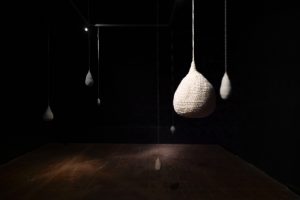
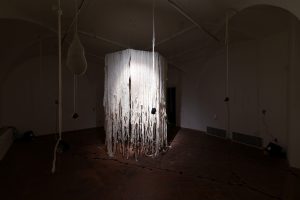
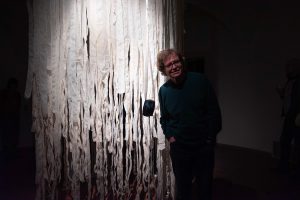
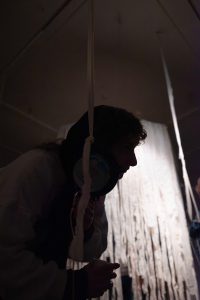
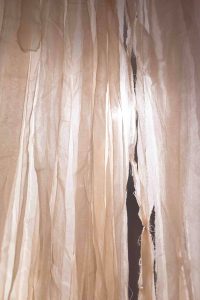
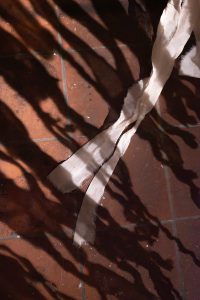
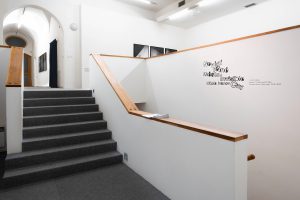
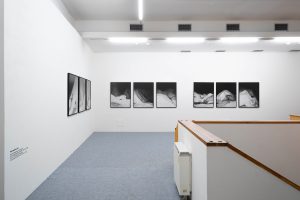
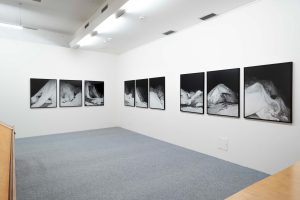
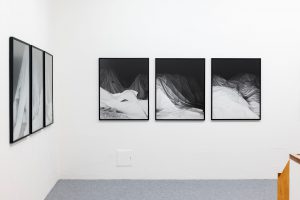
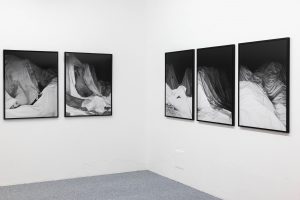
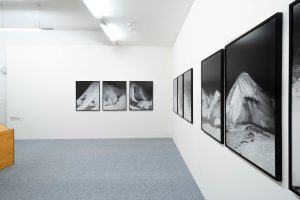
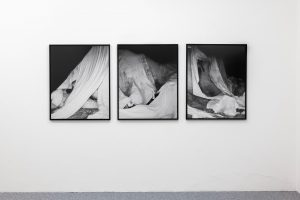
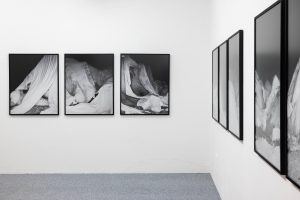
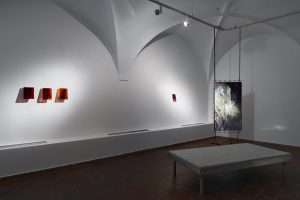
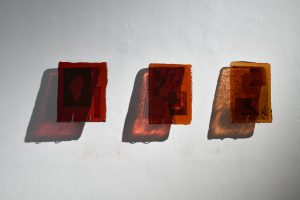
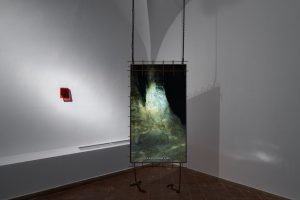
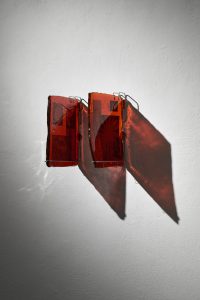
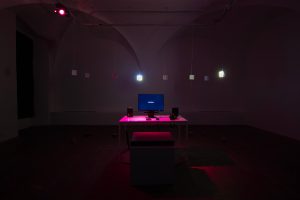
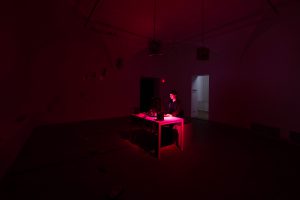
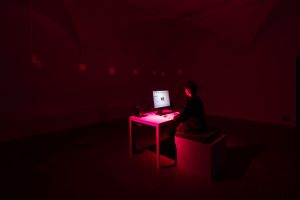
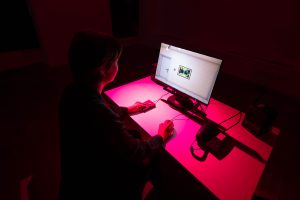
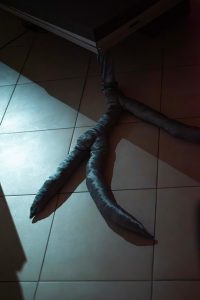
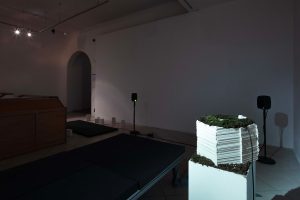
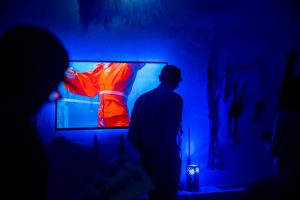
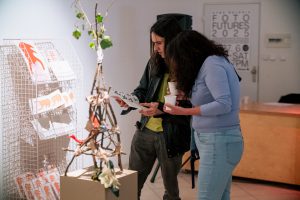
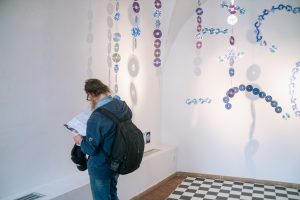
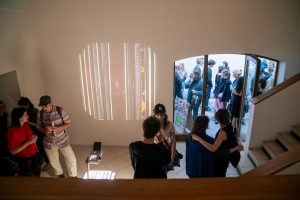
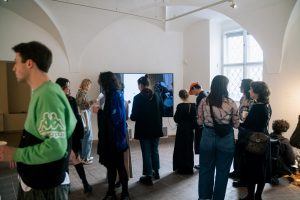
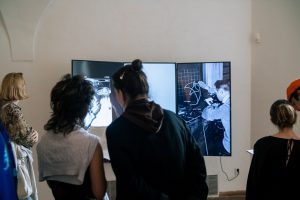
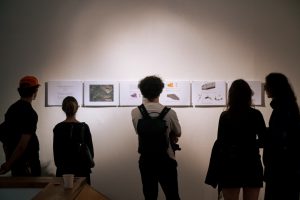
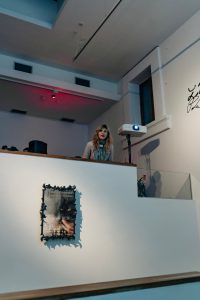
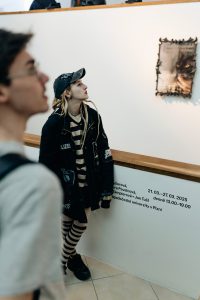
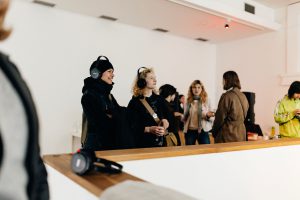
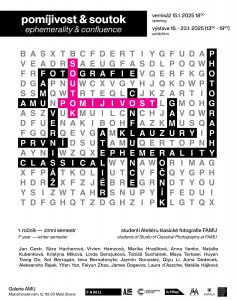
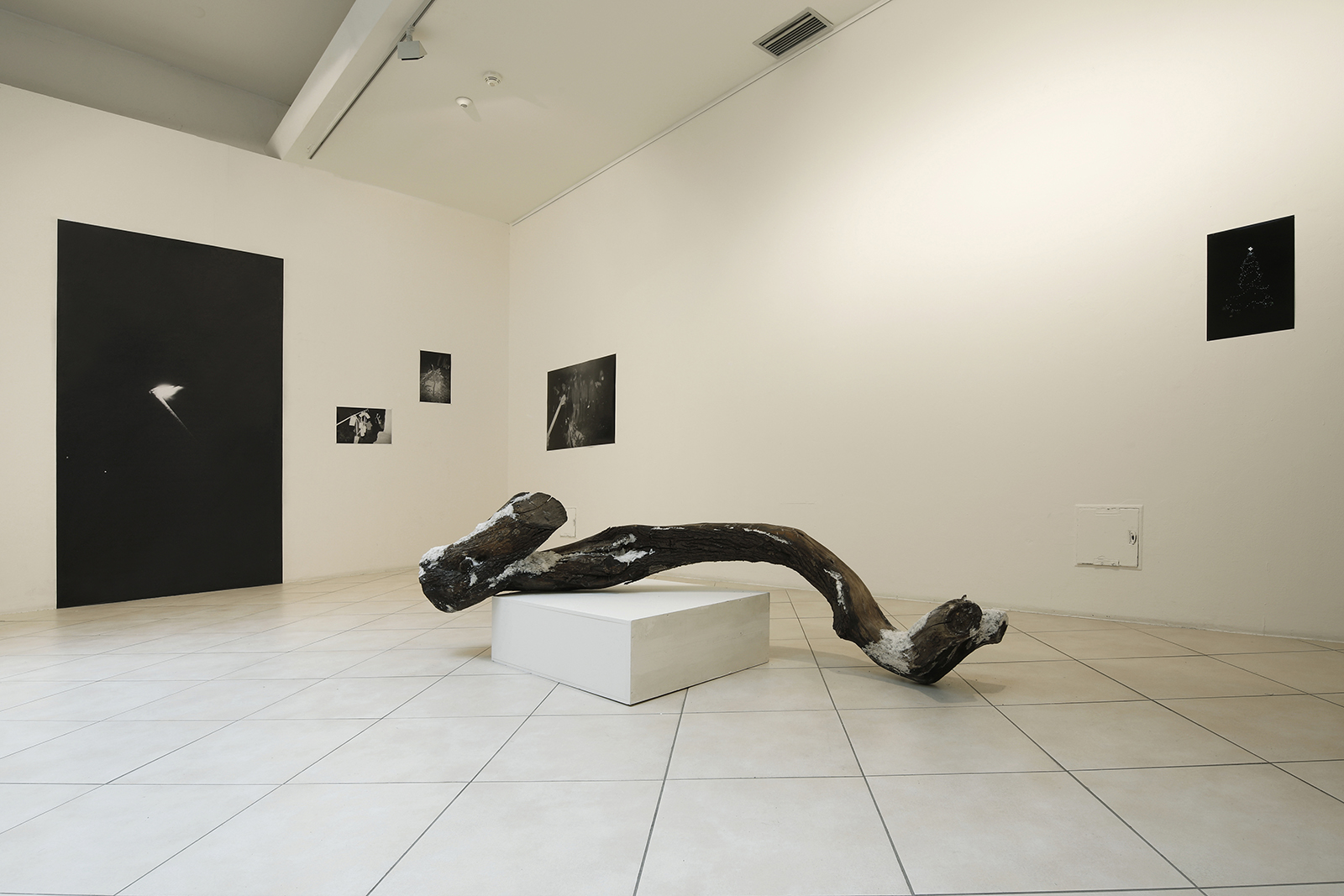
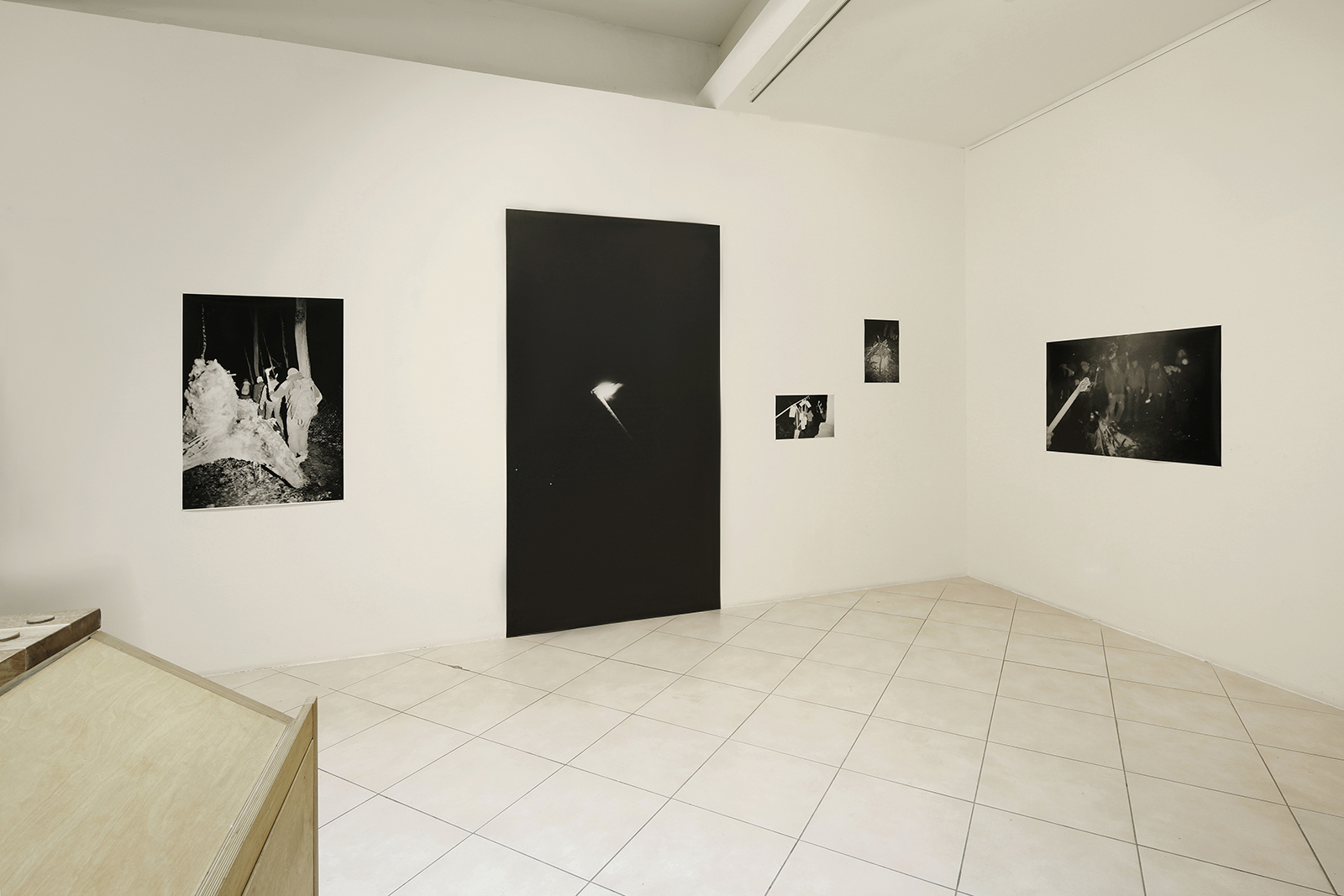
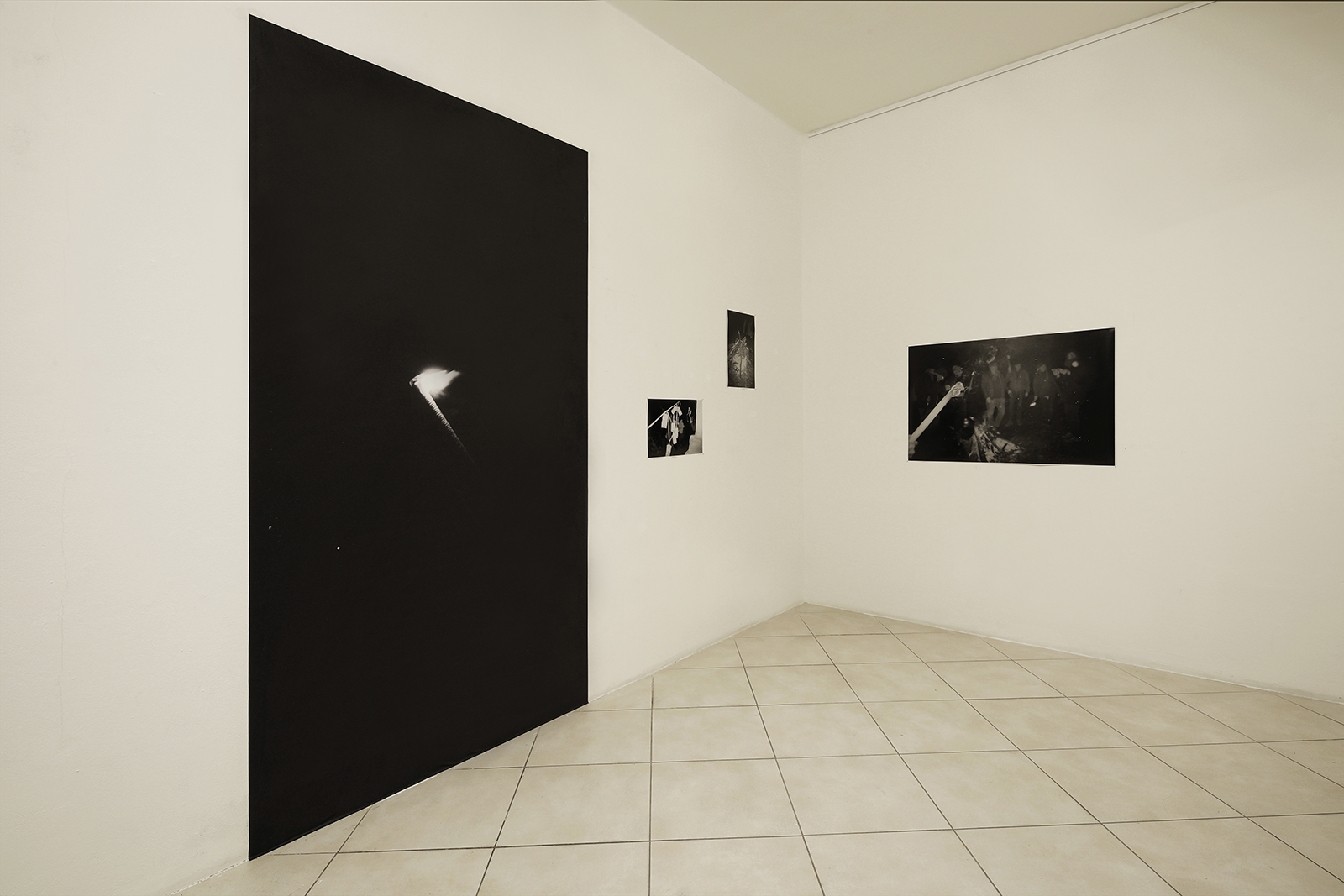
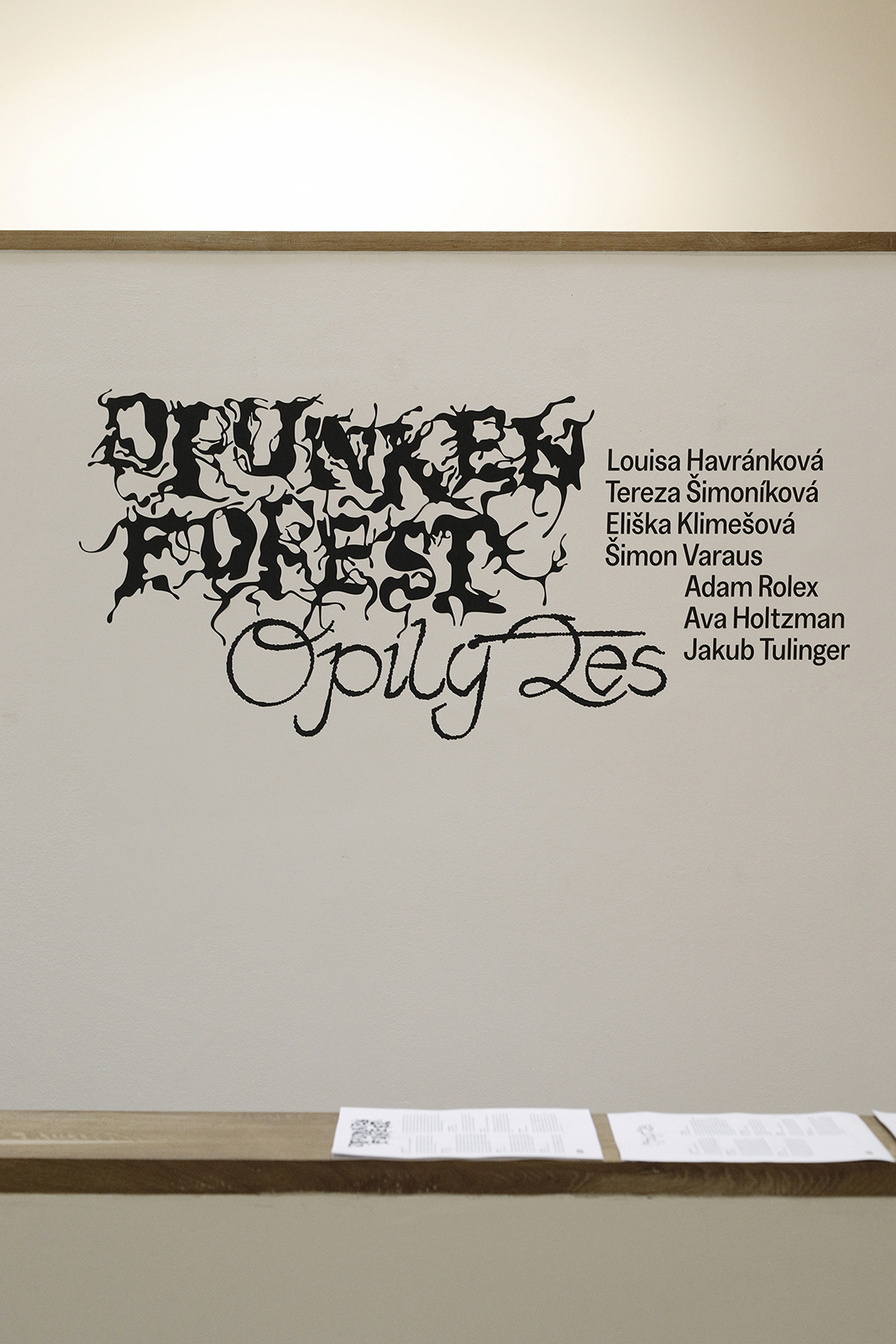
27 March – 25 April 2026 (opening: 26 March 2026, 6PM)

curated by: Tereza Rudolf

exhibition architecture: Space for Relational Research

graphic design: Pavla Nečásková & Žofia Fodorová

Opening hours: WED – SAT 1–7PM

Monologue Texts: Klára Vlasáková

Graphic design: Pavla Nečásková & Žofia Fodorová

Translation: Vít Bohal

Acknowledgments: Miroslav Pazdera, Jonáš Richter

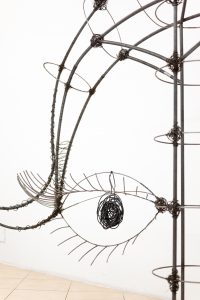
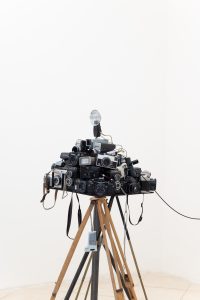
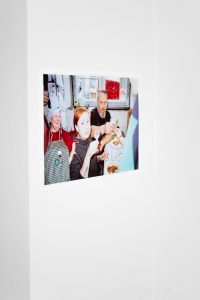
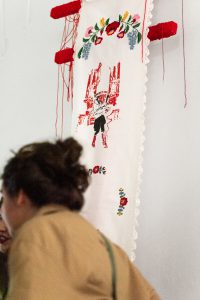
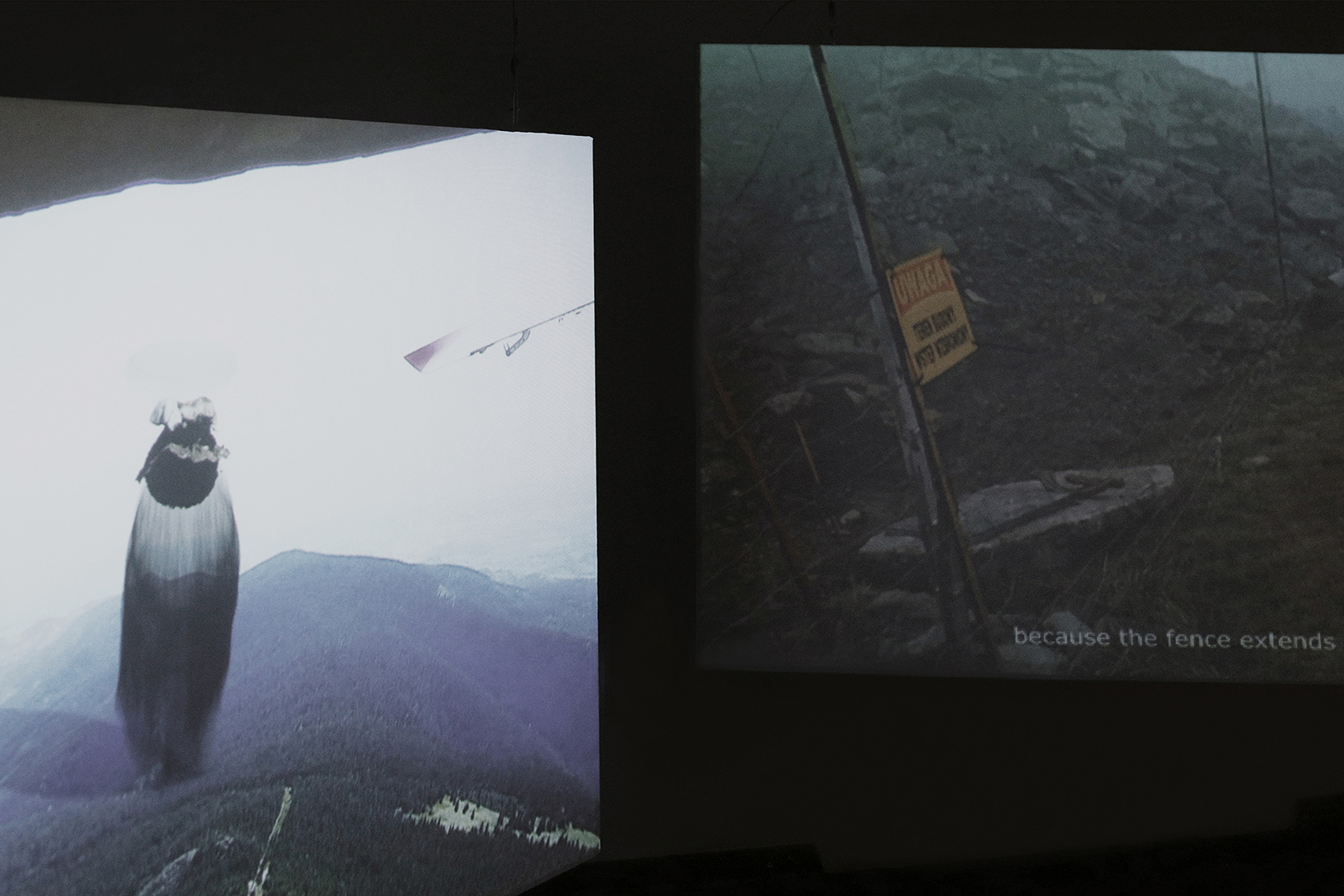
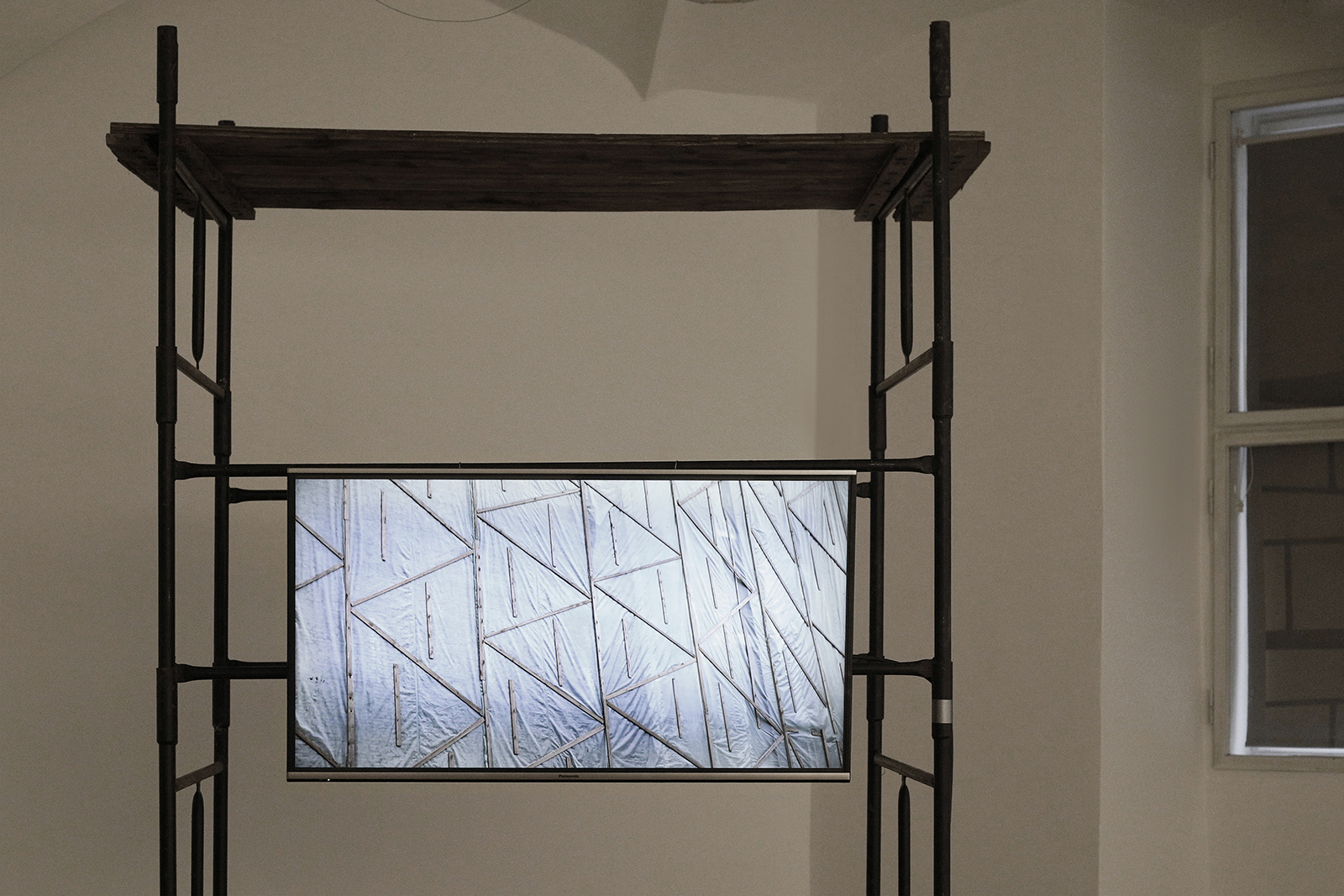
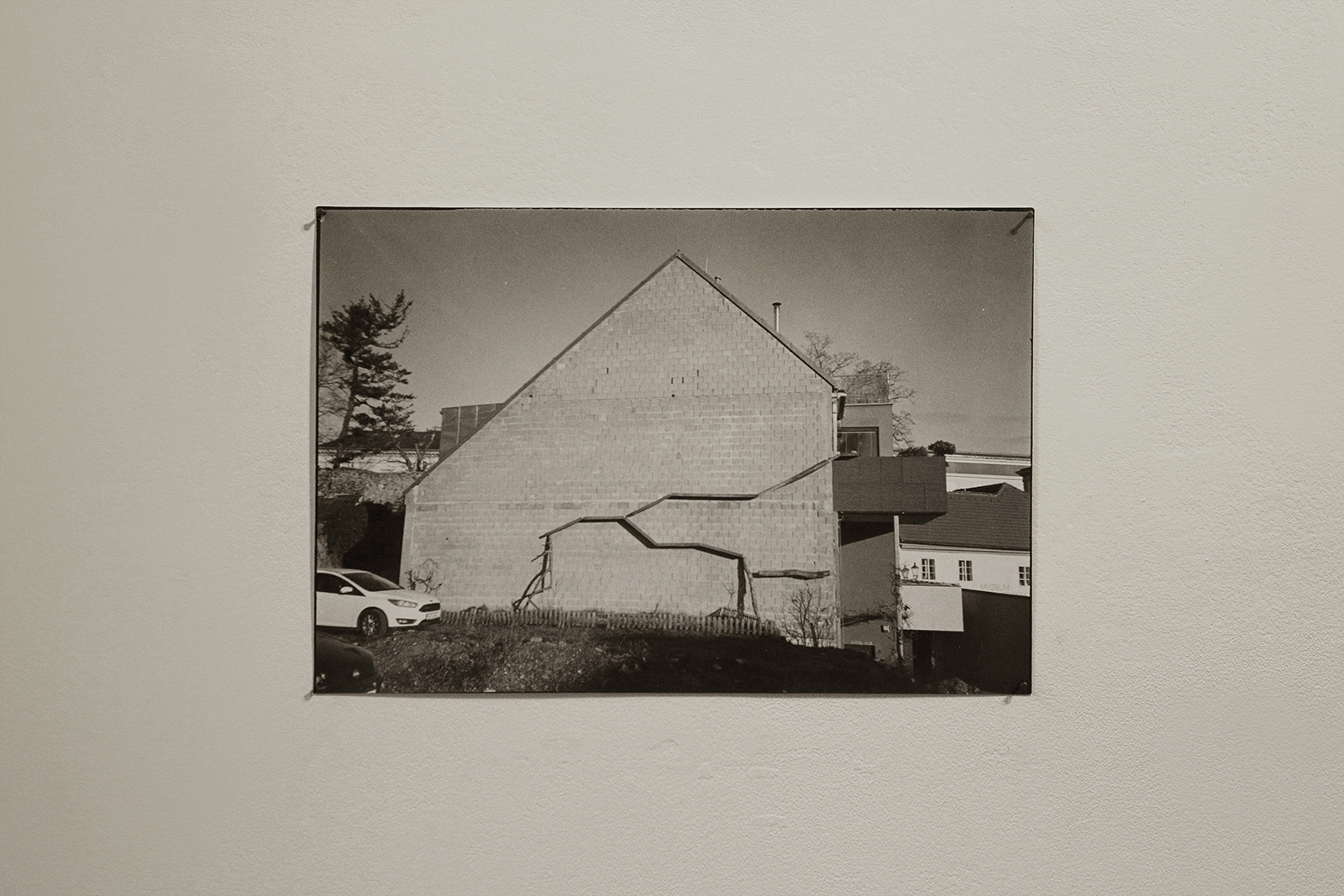
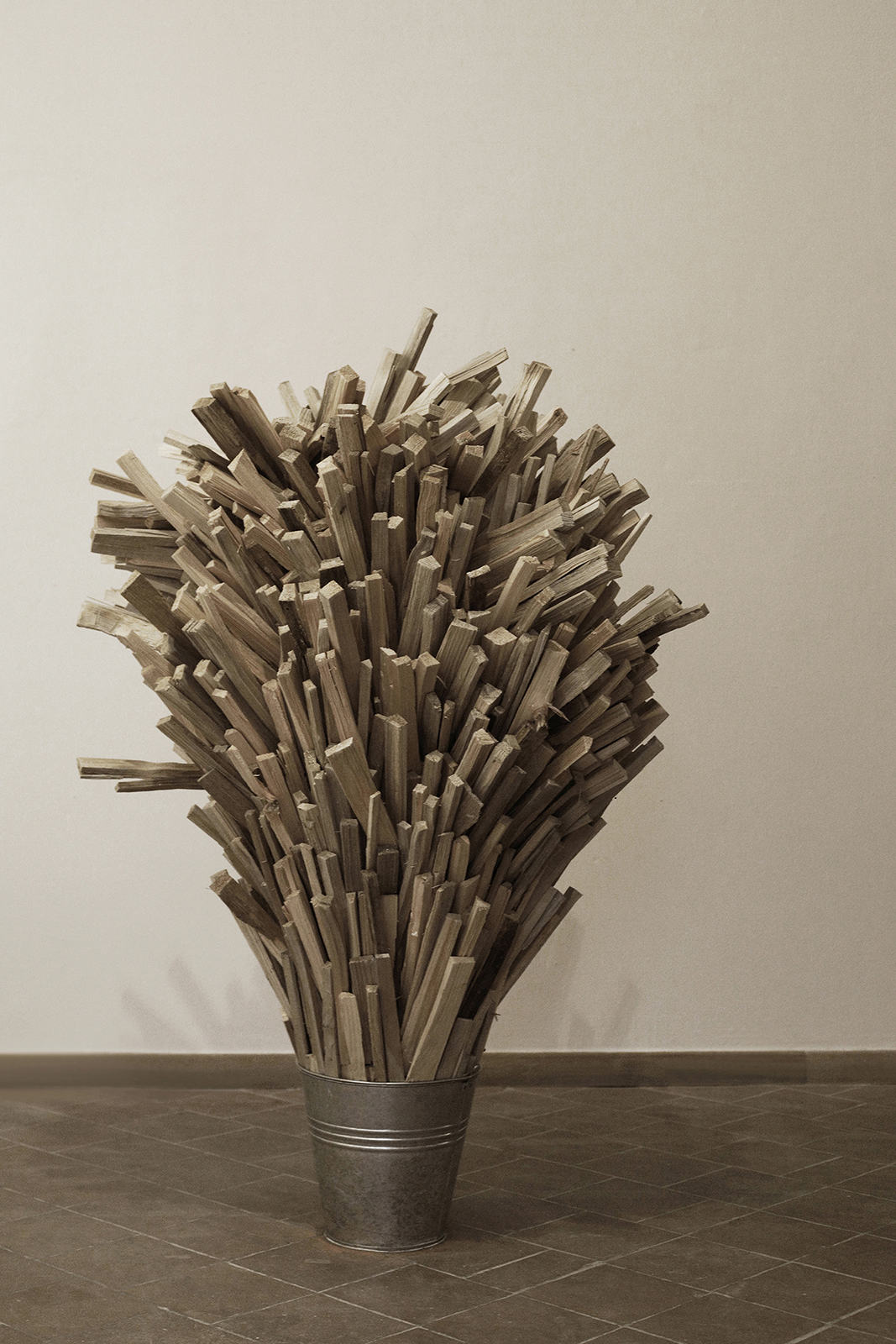
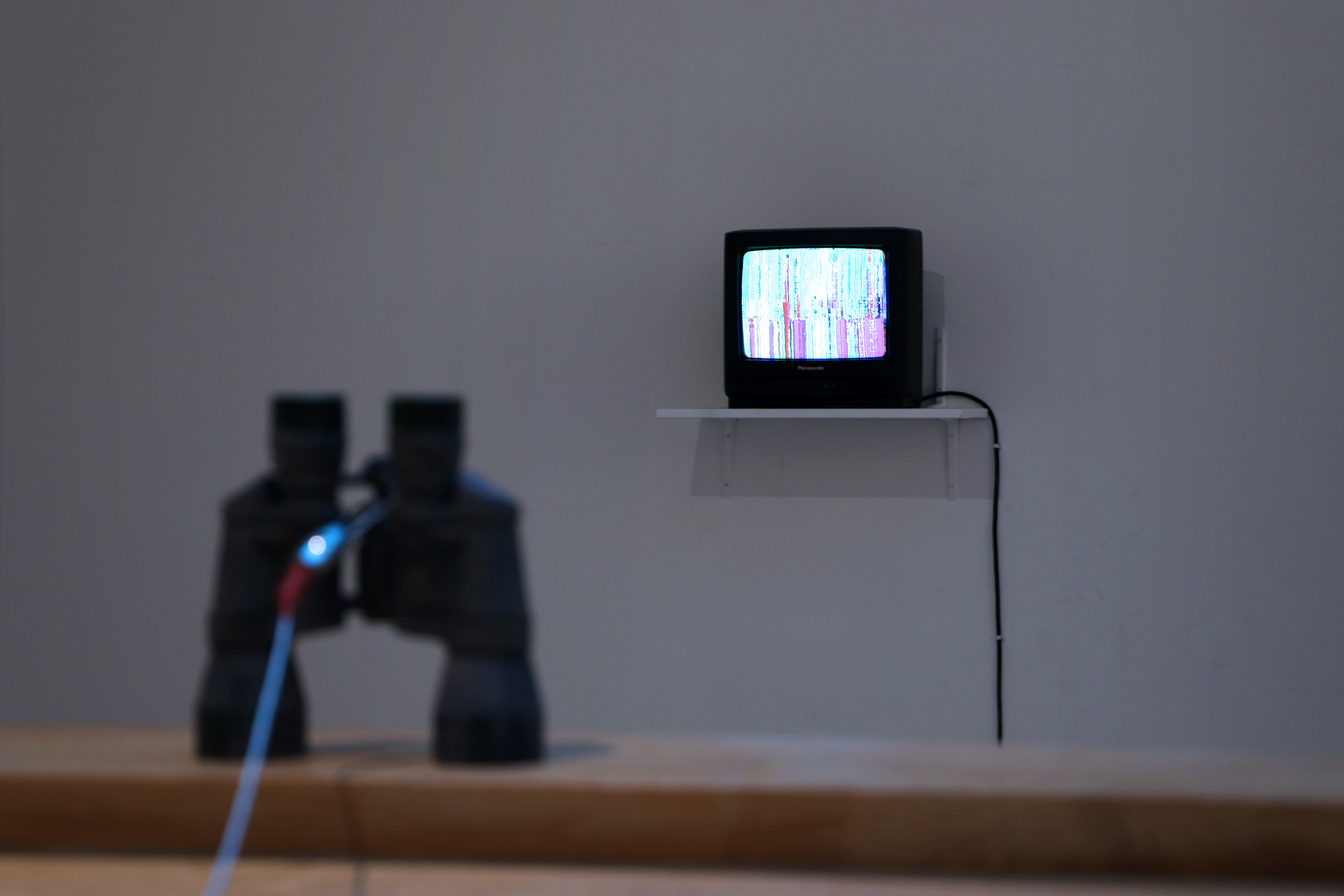
Despite mechanization, human work remains an integral factor in the smoothness and friction of all logistical movement.

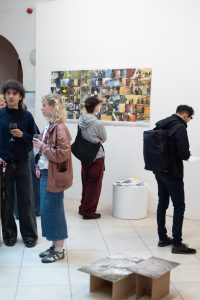
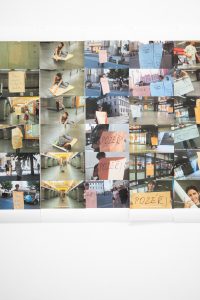
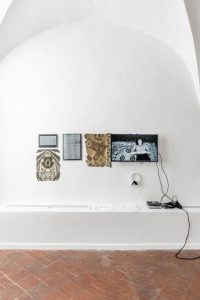
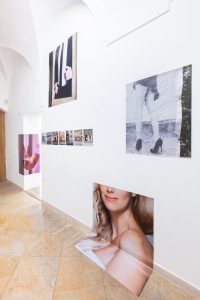
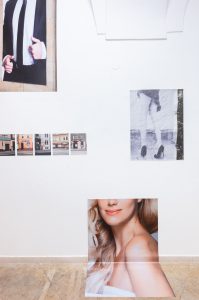
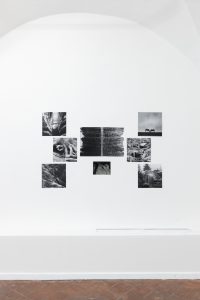
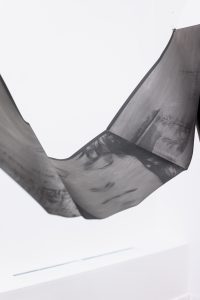
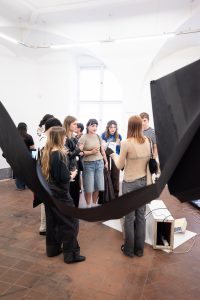
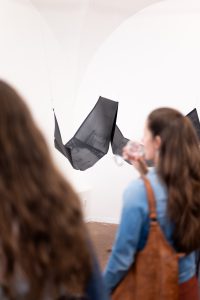
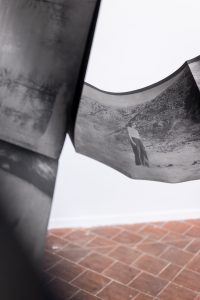
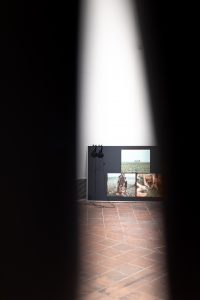
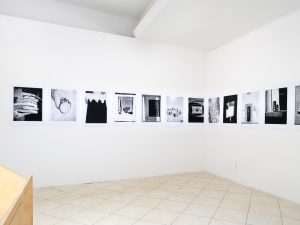
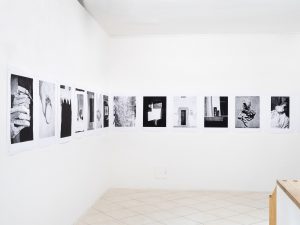
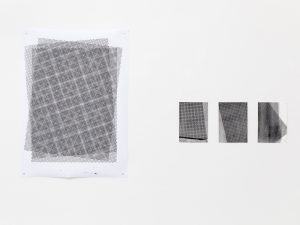
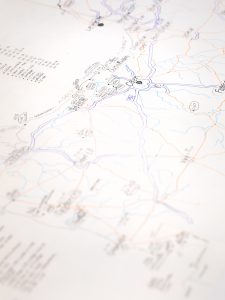
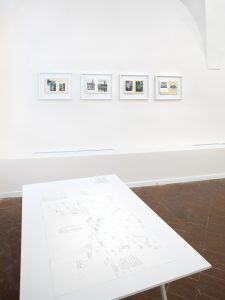
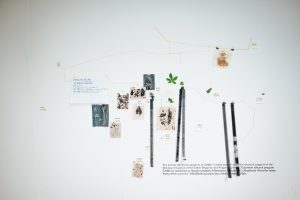
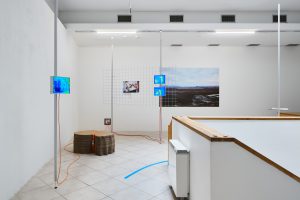
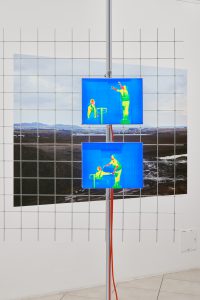
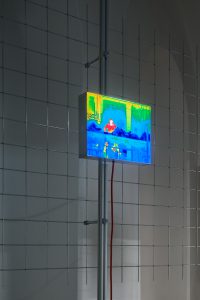
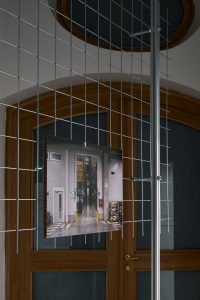
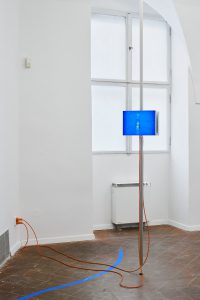
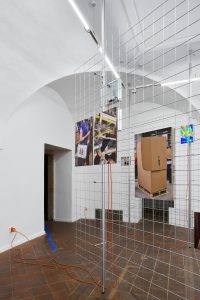
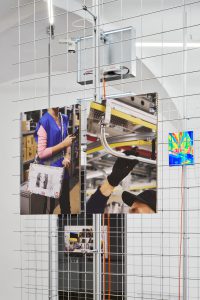
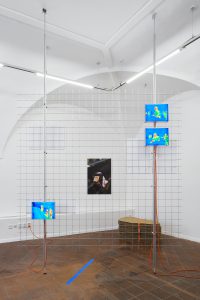
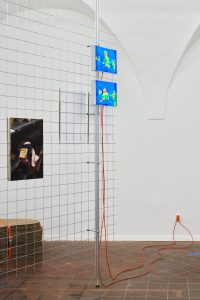
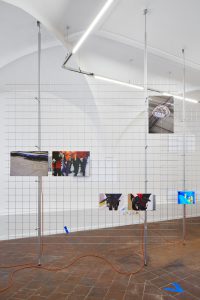
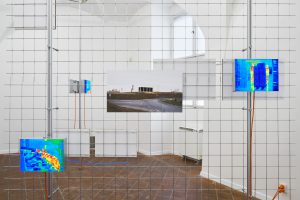
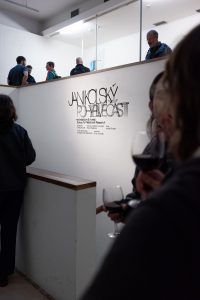
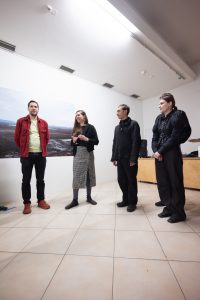
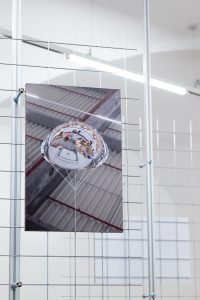
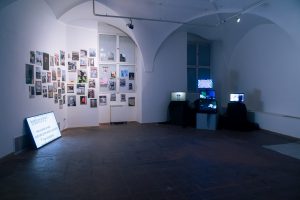
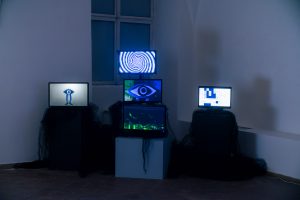
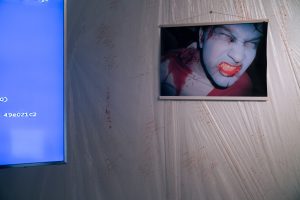
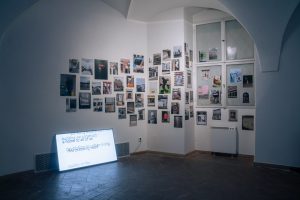
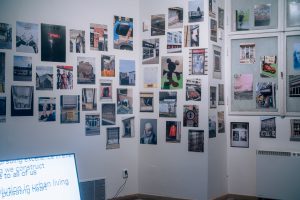
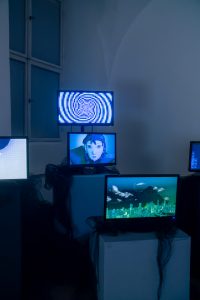
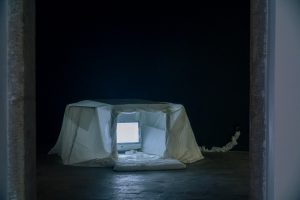
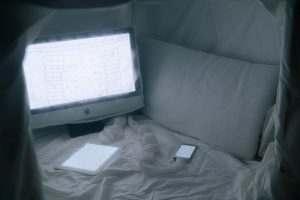
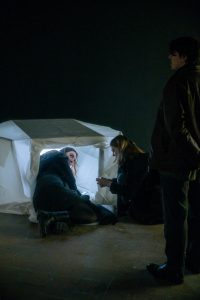
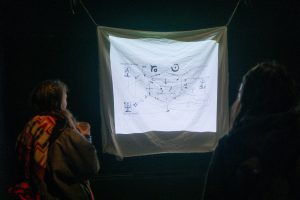
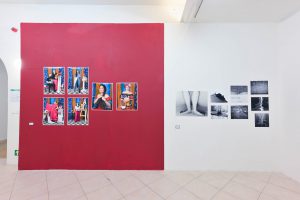
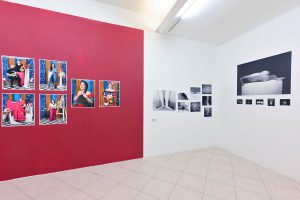
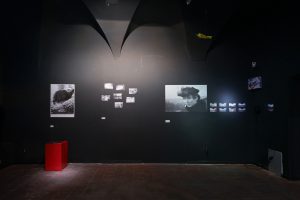
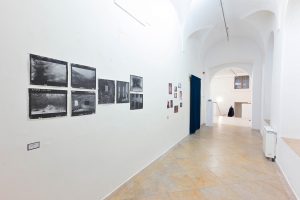
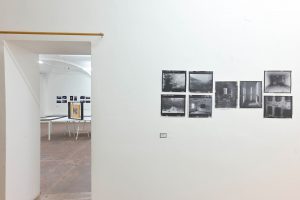
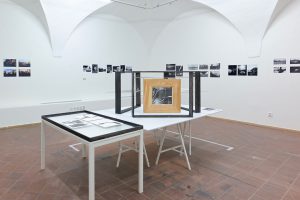
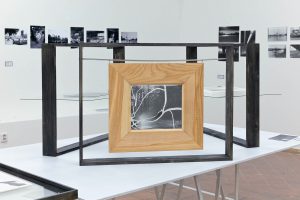
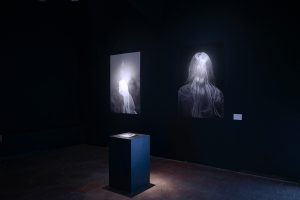
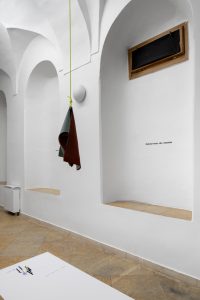
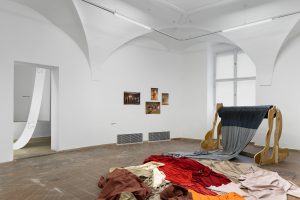
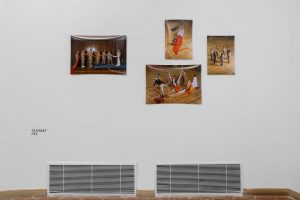
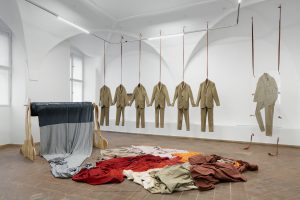
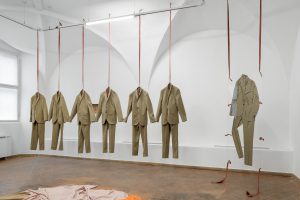
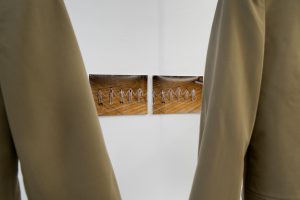
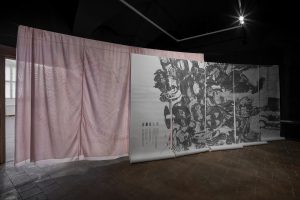
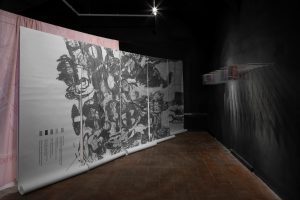
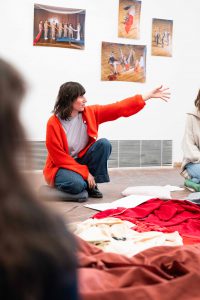
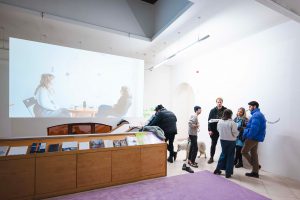
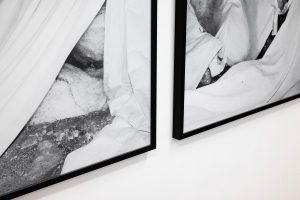
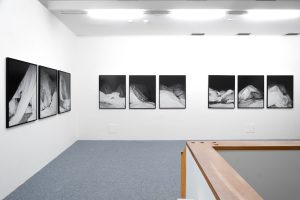
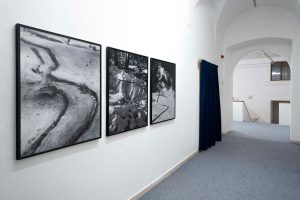
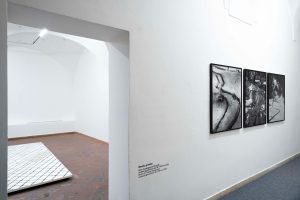
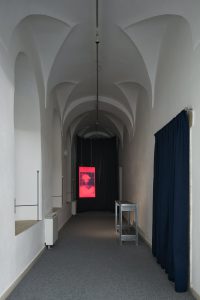
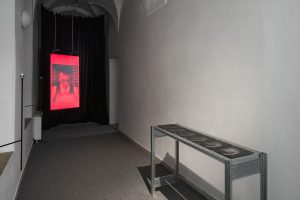
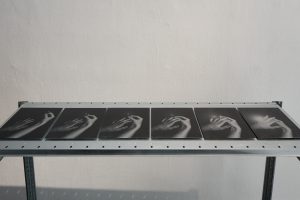
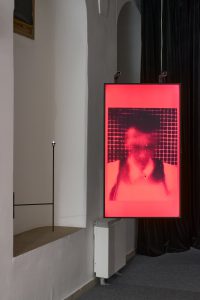
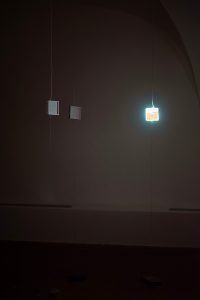
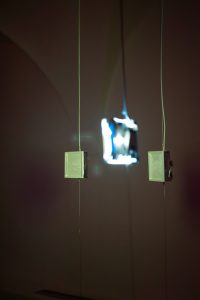
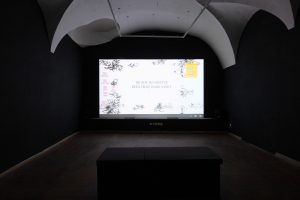
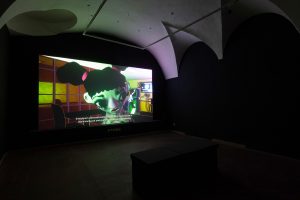
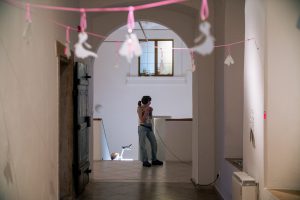
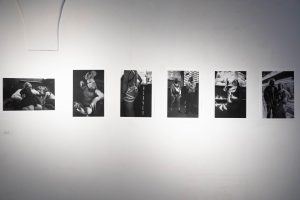
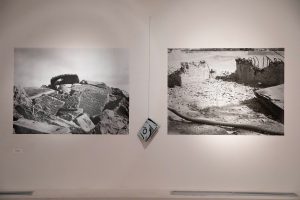
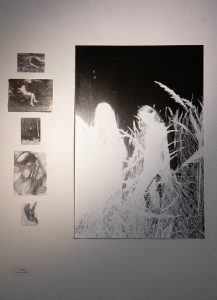
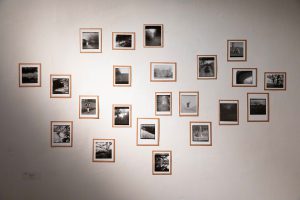
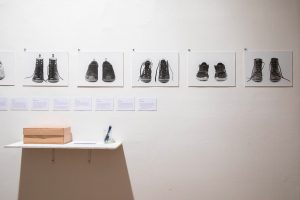
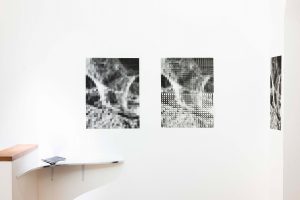
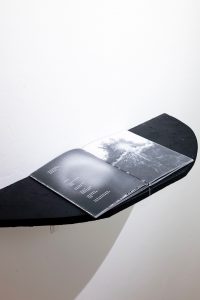
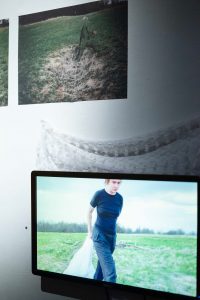
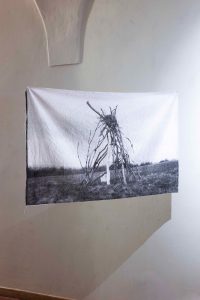
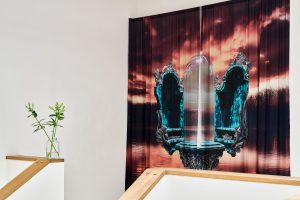
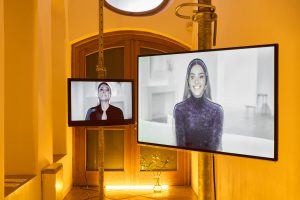
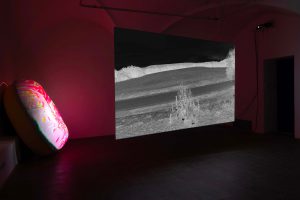
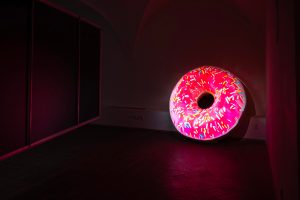
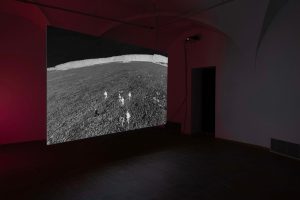
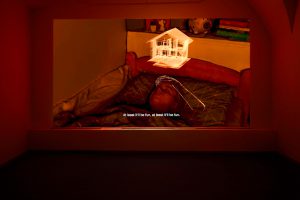
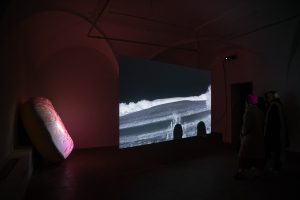
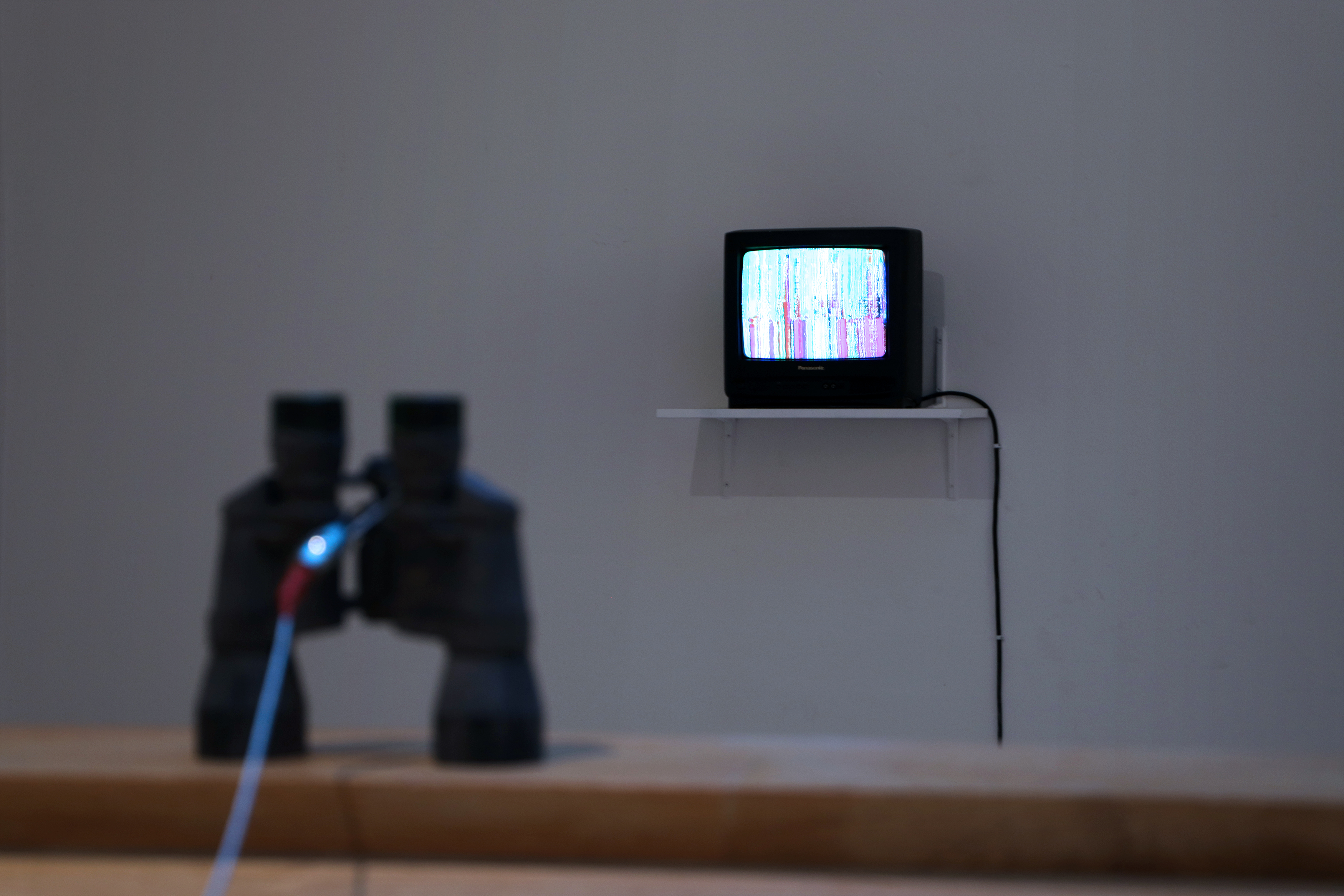
The imprint of working bodies and their contact with the spaces of transshipment halls. Traces left in the system of moving goods. Repeating sequences and the order that hopelessly tries to push out all remaining chaos. These are some of the examples of themes addressed in the (not only) photographic works of Jan Kolský (CZ) who is currently working in tandem with the architectural project Space for Relational Research (DE).

Moving Parts

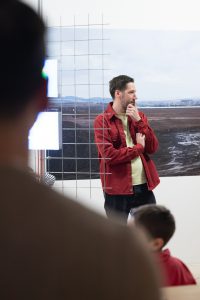
In Kolský’s photographs, the slowly rolling mass of consumer goods hidden inside cardboard boxes seems like a river full of ice floes. The ice breaks and glides on the surface, but in the critical places – bottlenecks and turns – the floes start bunching and jamming. One slides on top of the others, barring the flow and spilling onto the banks. Only warm weather dissolves this cold jam and releases the water’s current once more. But in logistic halls, such situations cannot wait for spring to come. The movement of packages must be smooth, constantly maintained and cared for by human hands. Despite mechanization, human work remains an integral factor in the smoothness and friction of all logistical movement.

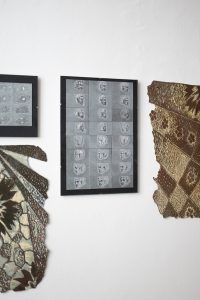
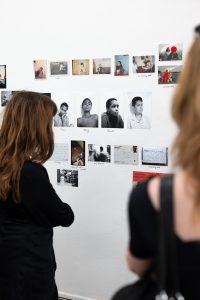
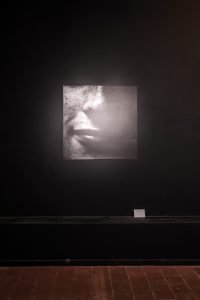
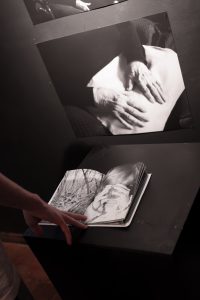
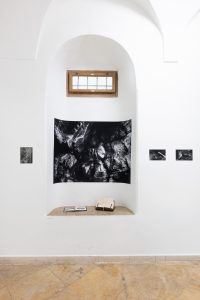
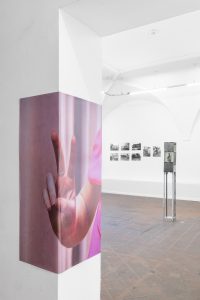
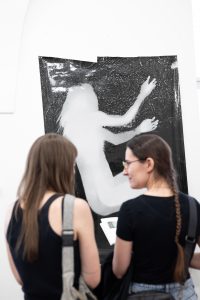
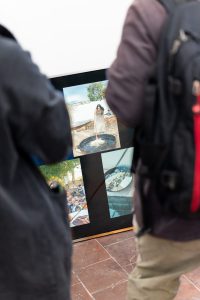
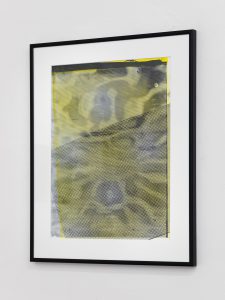
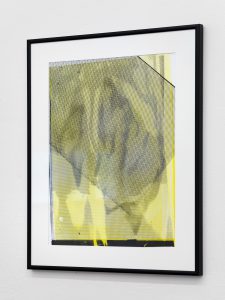
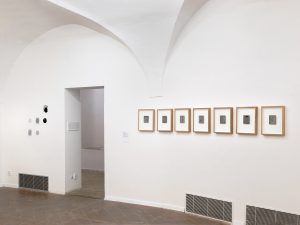
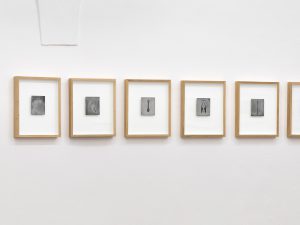
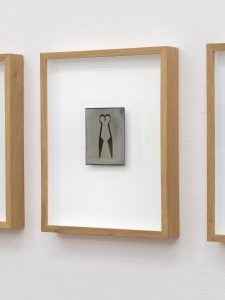
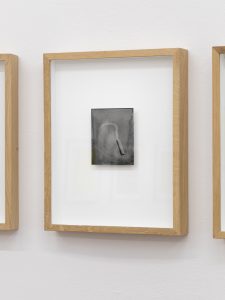
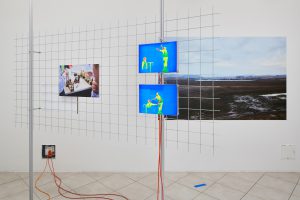
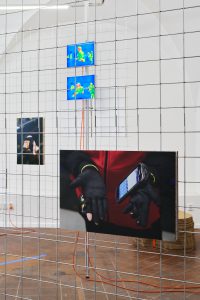
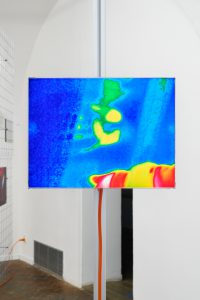
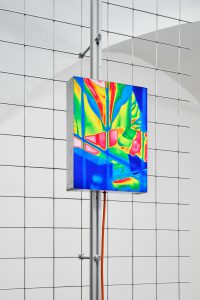
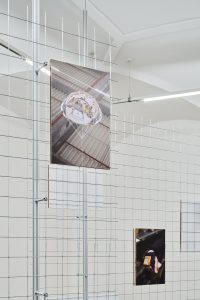
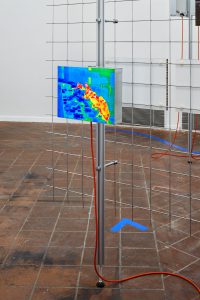
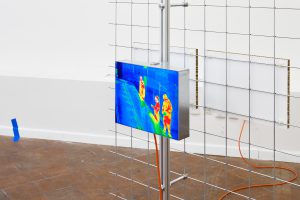
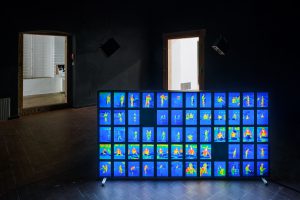
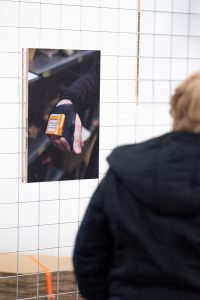
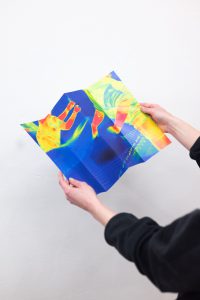
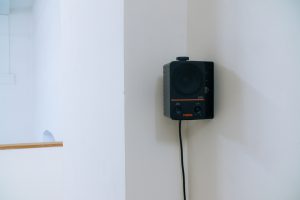
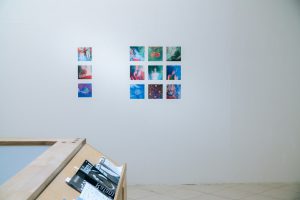
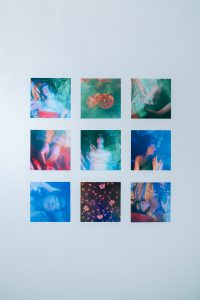
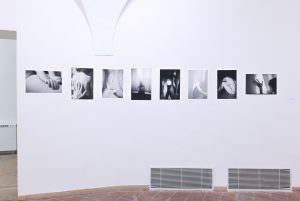
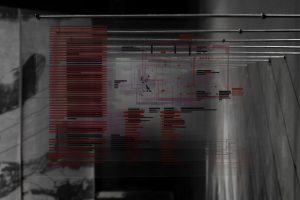
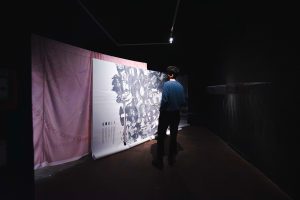
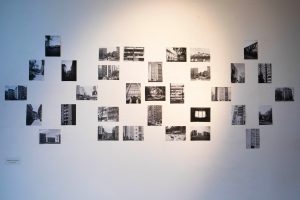
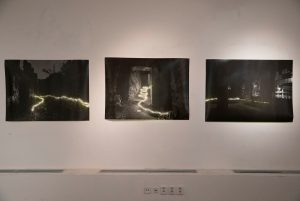
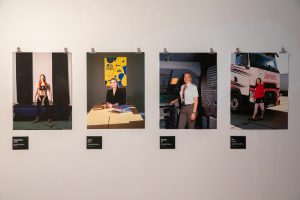
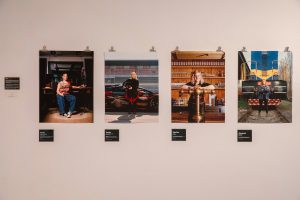
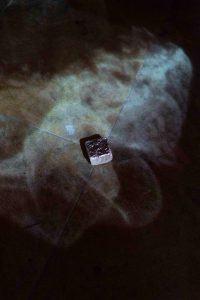
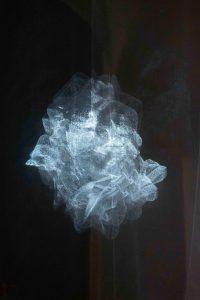
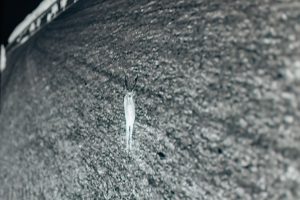
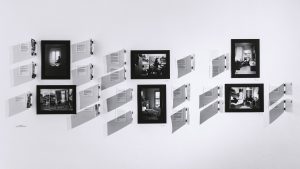
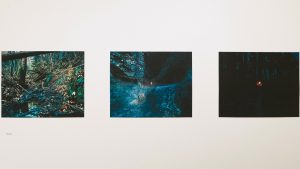
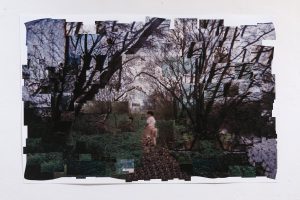
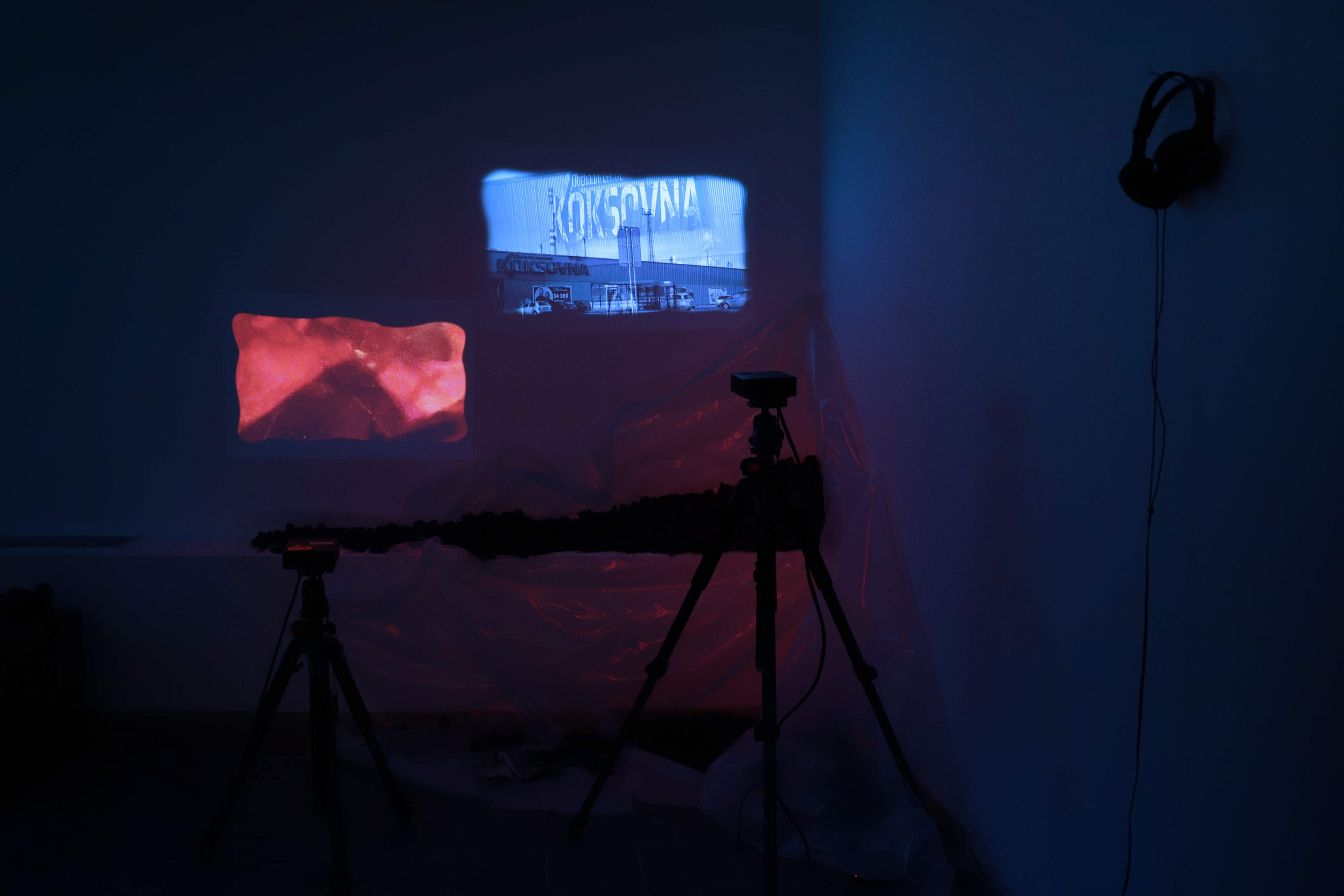
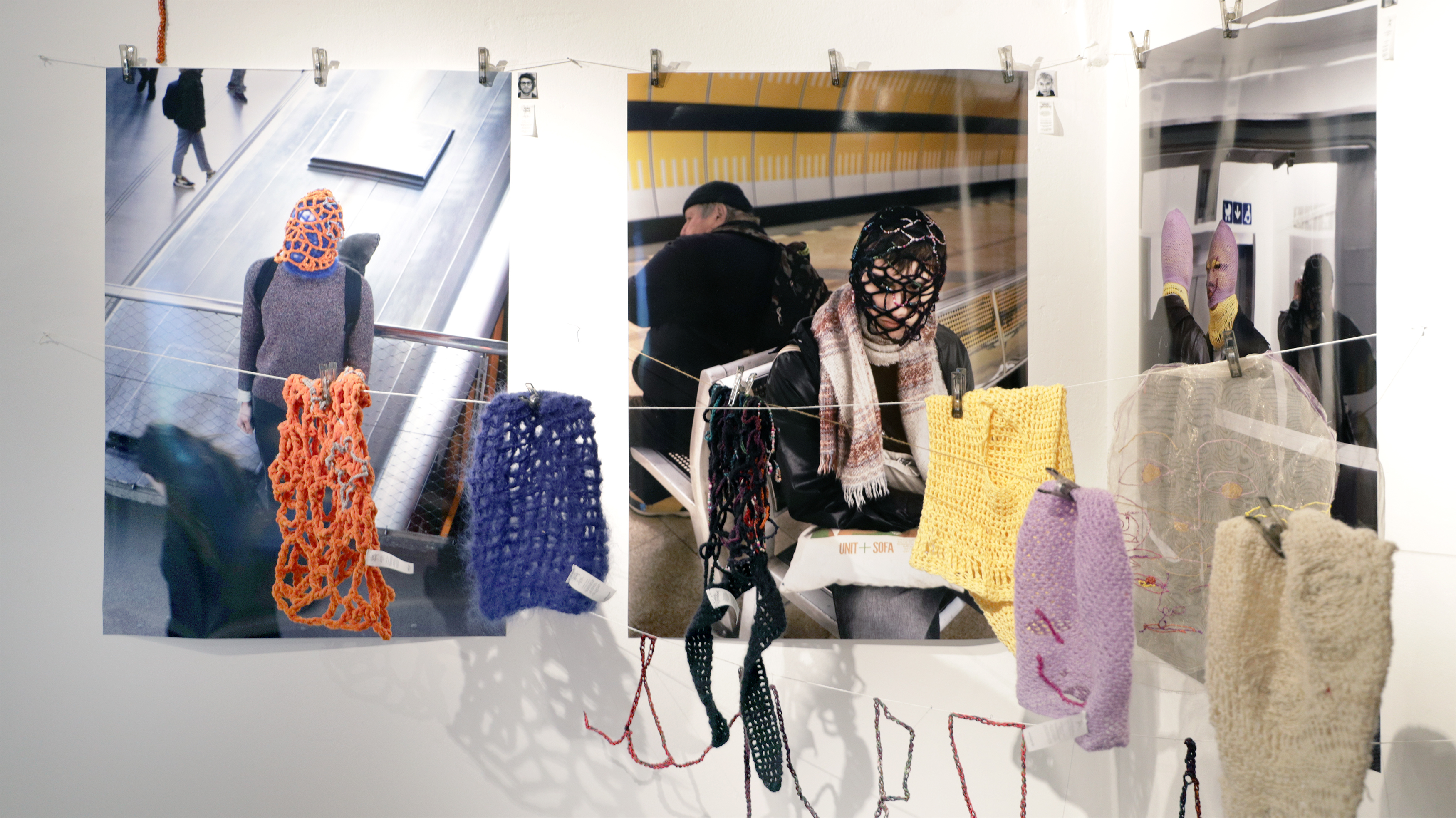
Logistic halls comprise critical nodes in logistics infrastructure, and they have become the focus of Jan Kolský’s work of the past years. Due to the constant surveillance to which the workers in the halls are subjected, it is not easy to take photographs or make any other documentary records within the operational spaces. But thermal imaging is standardly used in the halls as a means for the timely identification of potential malfunctions of the mechanical parts and conveyor belts. From the system’s perspective, the recording of thermographic records is an often used and less dangerous method for observing its own bowels. But instead of the overheating technical parts of the machine, Jan Kolský rather focuses on the heat emanating from human employees. Their repetitive gestures and attempts at guiding the cold mass of variously laden boxes in the right direction leave imprints on the cardboard. Photographs and thermographic images taken by Kolský in the shipment halls do not follow the movement of human bodies in a hostile environment but rather aim to record the proof their past presence. The touch of their hand, usually hidden from view, in fact remains on the cold surfaces and provides a homeopathic dose of tenderness in the otherwise maximally automated flow of goods being shipped from producer to consumer.

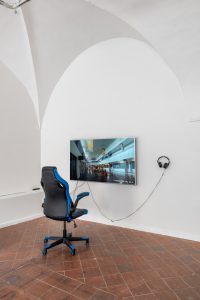
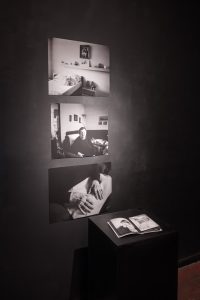
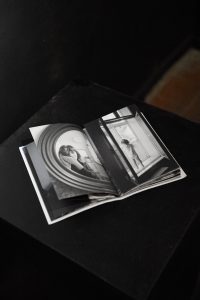
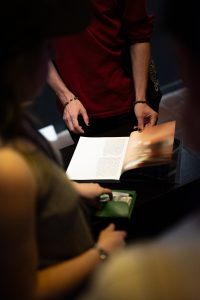
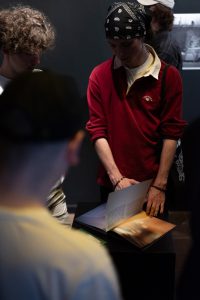
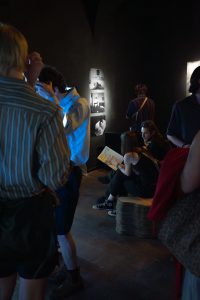
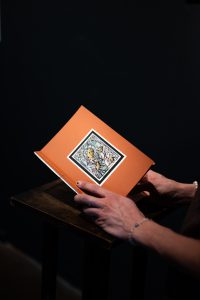
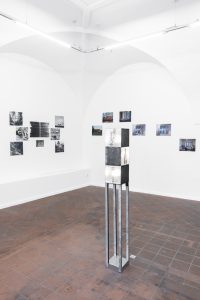
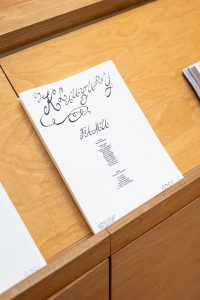
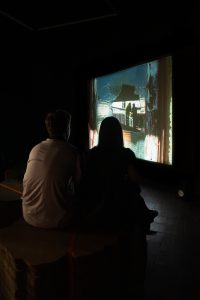
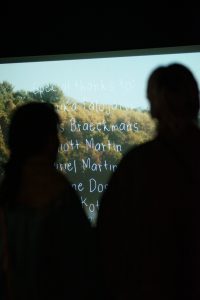
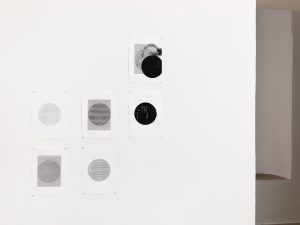
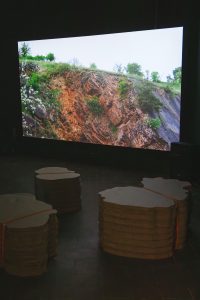
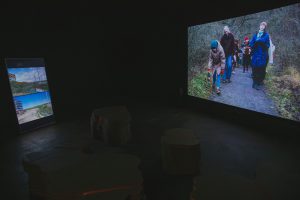
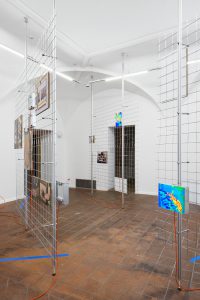
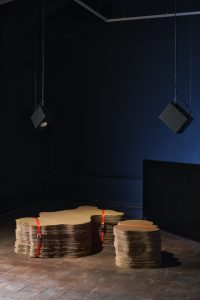
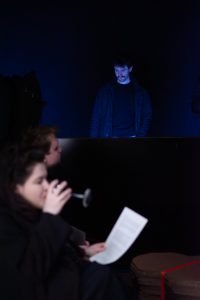
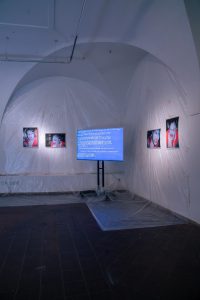
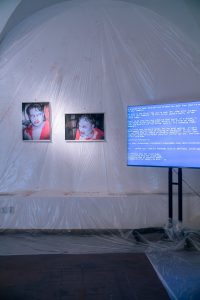
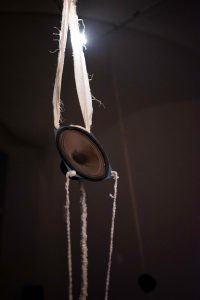
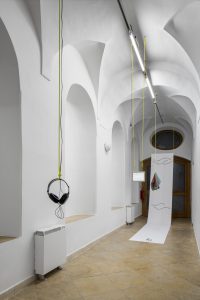
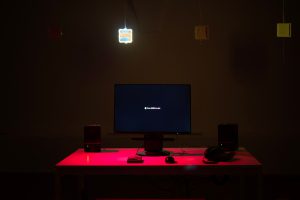
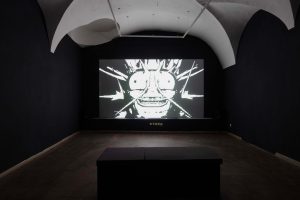
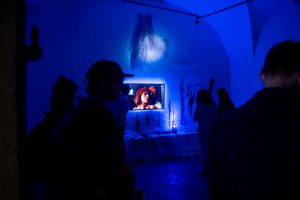
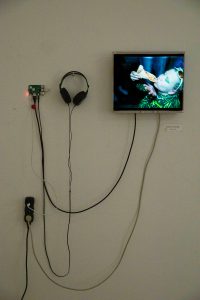
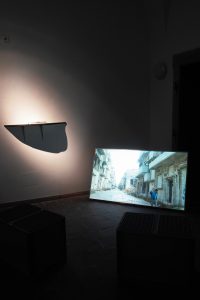
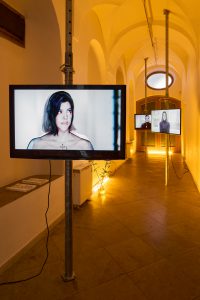
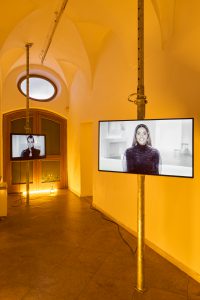
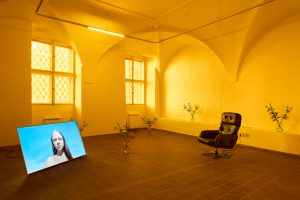
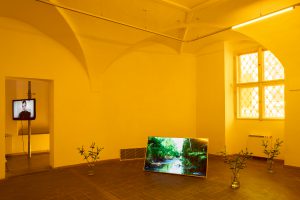
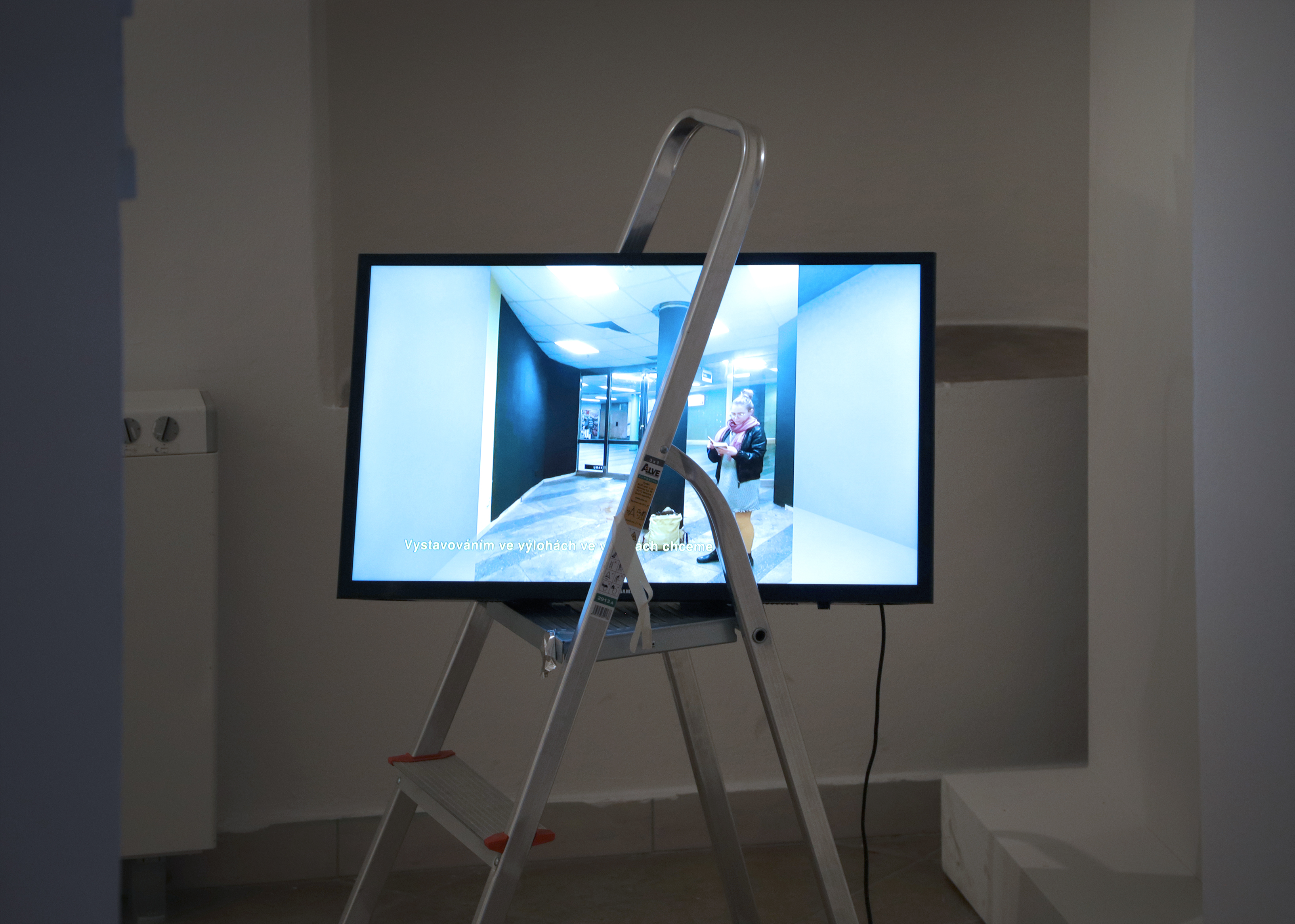
The exhibition presents only a fragment of Kolský’s overall oeuvre and focuses on documenting logistics halls, training rooms for new employees as well as a logistics trade fair. It does not include any views of the exterior. The massive blue boxes embedded into former fields completely silence the stories taking place within them. Allan Sekula, the American documentary photographer and theorist whose iconic work Fish Story (1996) followed the movement of transport containers, their shipments across the seas and the impacts of logistics chains on diverse places, has framed particularly important questions: “How do governments – and the actors who speak for governments – move cargo? How do they do it without stories being told by those who do the work? Could the desire for the fully automated movement of goods also be a desire for silence, for the tyranny of a single anecdote?” (Allan Sekula, Fish Story, p. 32, Richter Verlag, 2002). The view of the logistics hall from the outside provides us with just a single story: goods and the work force move in and out. In order to disrupt this singularity, Kolský uses the exhibition to platform narratives based on personal interviews with the employees of various operations, here loosely developed by writer and dramatist Klára Vlasáková. We hear the amplified voice of the soft and warm parts of an otherwise angular and cold system.

The ergonomization of spaces intended for the movement of packages thus converges towards the formulation of a singular being possessing all adequate characteristics and dimensions: an ideal being that is bald, without internal fluids, has a very stable posture, great strength in its strong arms and a clear, audible voice, one able to move quickly and safely between individual stations. The current work force is too human, too diverse. What is worse, it injects chaos into the smoothly revolving gears through variously bricolaging its work uniforms and protection gear, through its coughing or stuttering during the voice picking process, fatigue, emotions and occasional injuries.

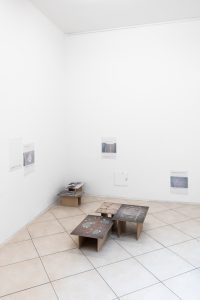
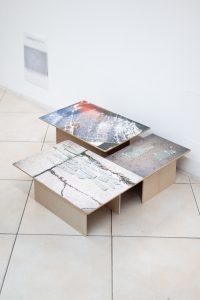
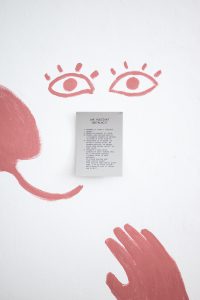
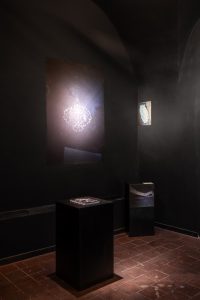
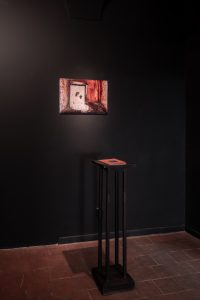
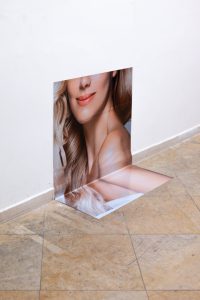
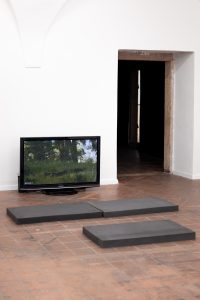
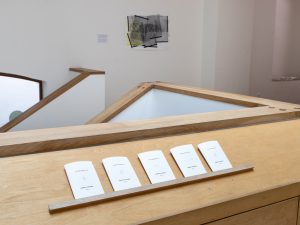
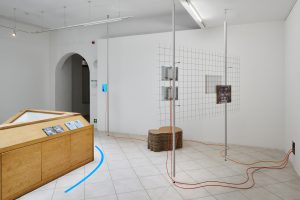
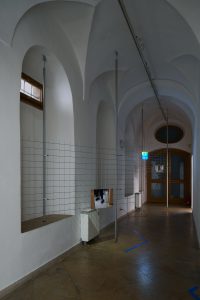
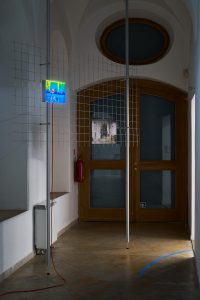
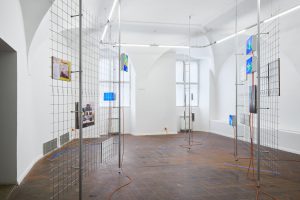
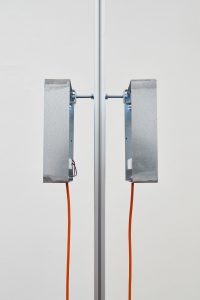
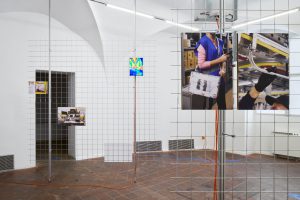
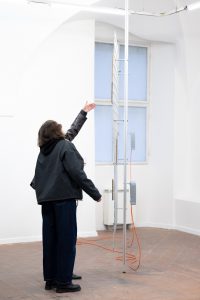
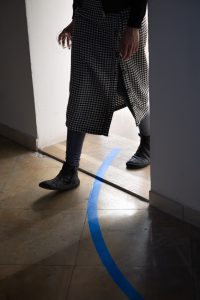
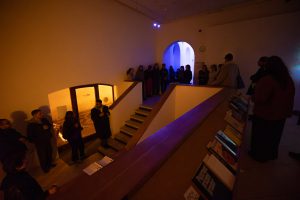
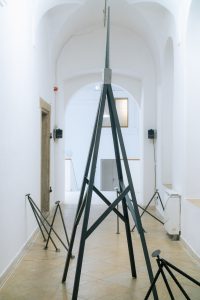
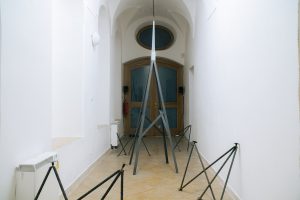
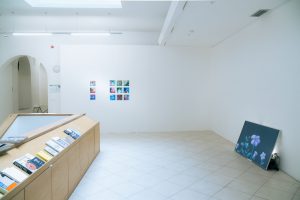
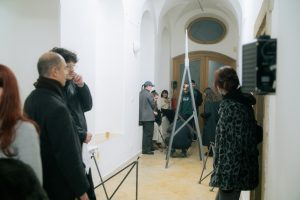
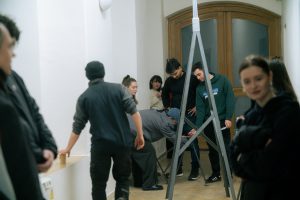
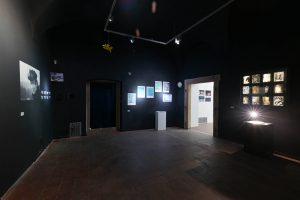
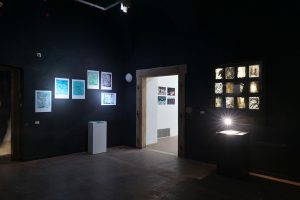
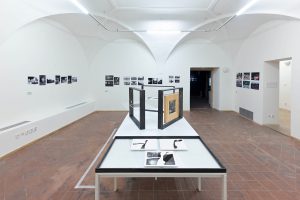
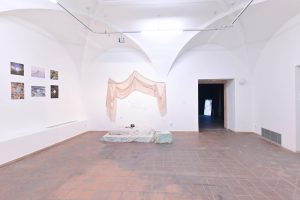
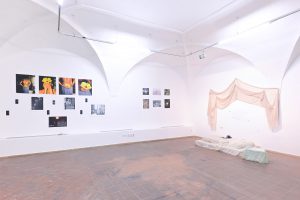
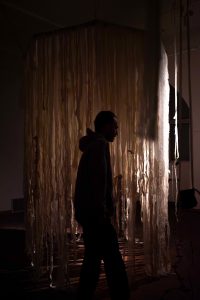
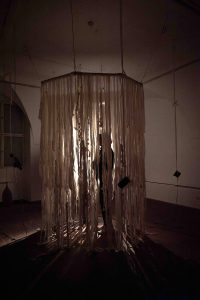
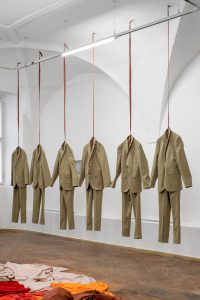
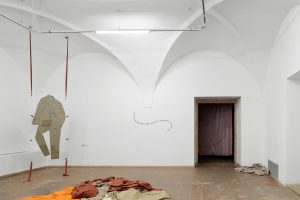
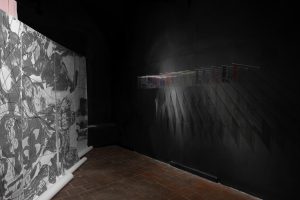
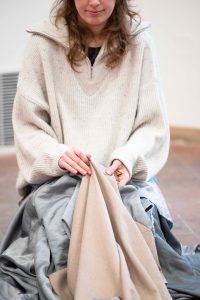
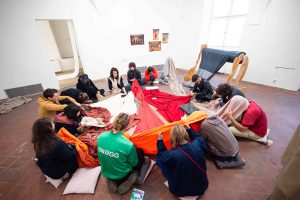
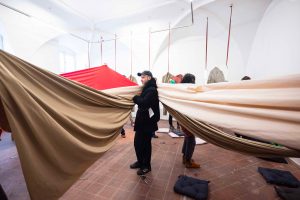
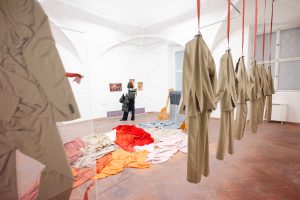
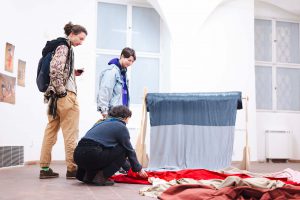
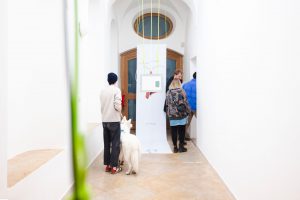
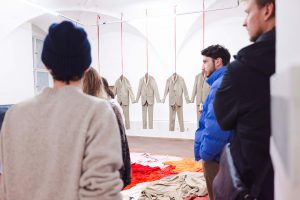
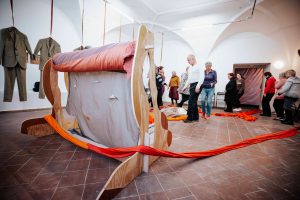
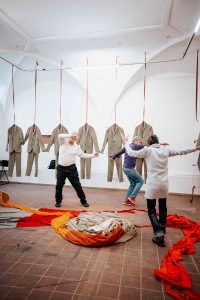
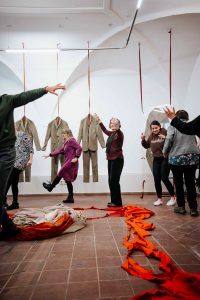
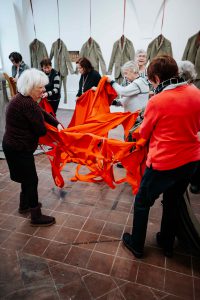
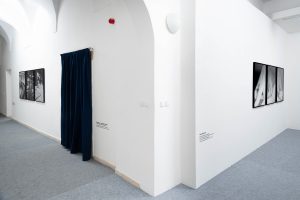
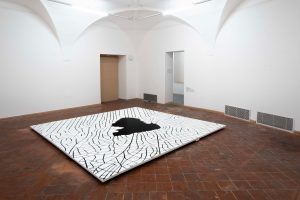
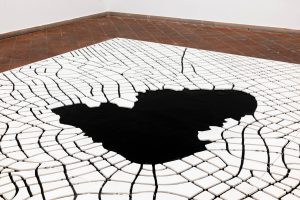
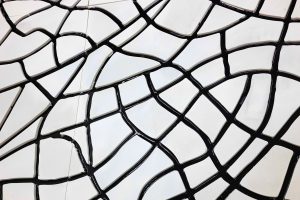
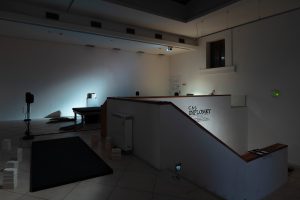
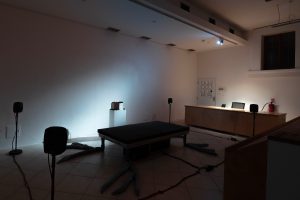
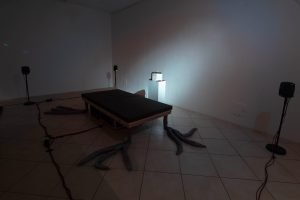
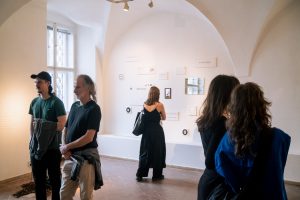
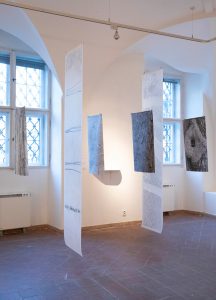
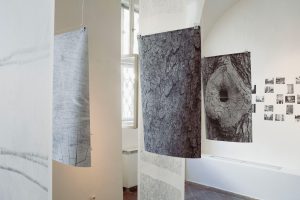
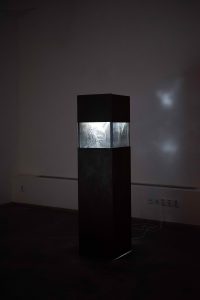
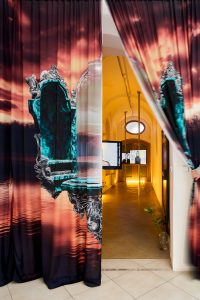
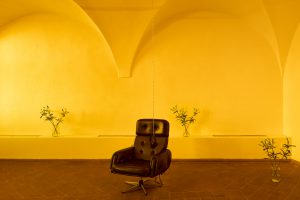
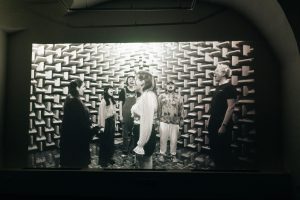
The relationships that are followed in the space of the logistics halls and subsequently translated into the spaces of the gallery led Kolský to approach the Berlin-based collective Space for Relational Research. Barbara Herschel, Kaspar Jamme, Felix Künkel and Justus Schweer use architecture in their work to aestheticize, politicize and transform spatial relations and established orders. The exhibition’s spatial solution relates to logistical halls as well as to relationships that take place within them. It is restrictive and instructive, tries to model the visitors’ movement and emphasize certain key moments of Jan Kolský’s work.


Jan Kolský is a Czech photographer focusing on the documentation of artistic projects and architecture. Apart from his professional practice, he also works on artistic projects exploring the overlaps between artificially created environments, work and technologies. Kolský graduated from the Academy of Arts, Architecture and Design in Prague with a project titled Here There Be Workers (2019) that was subsequently exhibited in the Fotograf gallery. The project focused on the organized employment of people within the grey zones of global digital network infrastructures as well as the topic of human work in automated systems. Kolský has been a long-term member of a collective research project focusing on the life and work of Ester Krumbachová that culminated in the exhibition Ester Krumbachová: Yeti – Wear the Amulet – Tangle Up the Archive (Tranzitdisplay, Prague, 2017) and the publication of an original book titled Green Fox Street. He was also member of the Extrasensory-Aesthetics Research Working Group that focused on the history and practice of Czech psychotronics in the 1970s and 1980s and was featured in 2020 as part of the Jindřich Chalupecký Award.

The project Moving Parts was realized by Jan Kolský in 2019 when it was initiated as part of the book Steel Cities: The Architecture of Logistics in Central and Eastern Europe (ed. Kateřina Frejlachová, Miroslav Pazdera, Tadeáš Říha, Martin Špičák, VIPER, Park Books, 2020) and the partial outcomes were published as part of the book Retail Apocalypse (F. Fischli ; N. Olsen ; A. Jasper eds., gta Verlag Zurich, 2021) and the ERA21 magazine  (#01/2020 Krajiny logistiky). All documentary materials were made between 2019 and 2024 in the logistical centers in western and central Bohemia and the LogiMat logistical trade fair in Stuttgart.

Space for Relational Research is a Berlin based spatial practice interested in aestheticising, politicising and transforming spatial relations. Barbara Herschel, Kaspar Jamme, Felix Künkel, and Justus Schweer studied architecture at the Bauhaus University in Weimar and the University of the Arts Berlin. For them, relational research is based on an understanding of space as a network of relationships between different actors, materials, and processes, which produce space in interaction with one another. Creating space for relational research means critically examining the conditions of spatial production, blurring the disciplinary boundaries of architecture, and establishing new forms of cooperation and transformation. A central aspect of this work involves developing transdisciplinary working methods that mediate between perspectives from architecture, urban planning, ecology, civil society, and public administration. Space for Relational Research recently published the book Troubled! Architecture of Ruinous Landscapes with adocs publishing. Together with Atelier Le Balto and Miroslav Pazdera, they received 3rd prize for their competition proposal on the re-ecologisation of Chotkovy sady. Over the past years, they have organised several exhibitions on ruinous landscapes, among them Troubled! at Adlerhalle and at UdK in Berlin. They have published numerous articles including A Greenhouse for Berlin in Art of the Working Class, reflecting on acts of upkeeping and care at Tempelhofer Feld; Auf dem Glatteis – zur Krisenhaftigkeit des Raumes in protocol magazine; and Architektur ruinöser Landschaften in Forum Stadt. They have contributed to the Fluid Interdisciplinarities Festival at HU Berlin and the Swamposium at Floating University, were guest critics at TU Berlin, and taught at Berlin International University and Hochschule München. Their work has been recognised with the Otto-Borst-Prize and the Max Taut Prize.

The exhibition has been supported by the grant program of the Ministry of Culture of the Czech Republic, the State Cultural Fund of the Czech Republic and by the Deutsch-Tschechischer Zukunftsfonds.

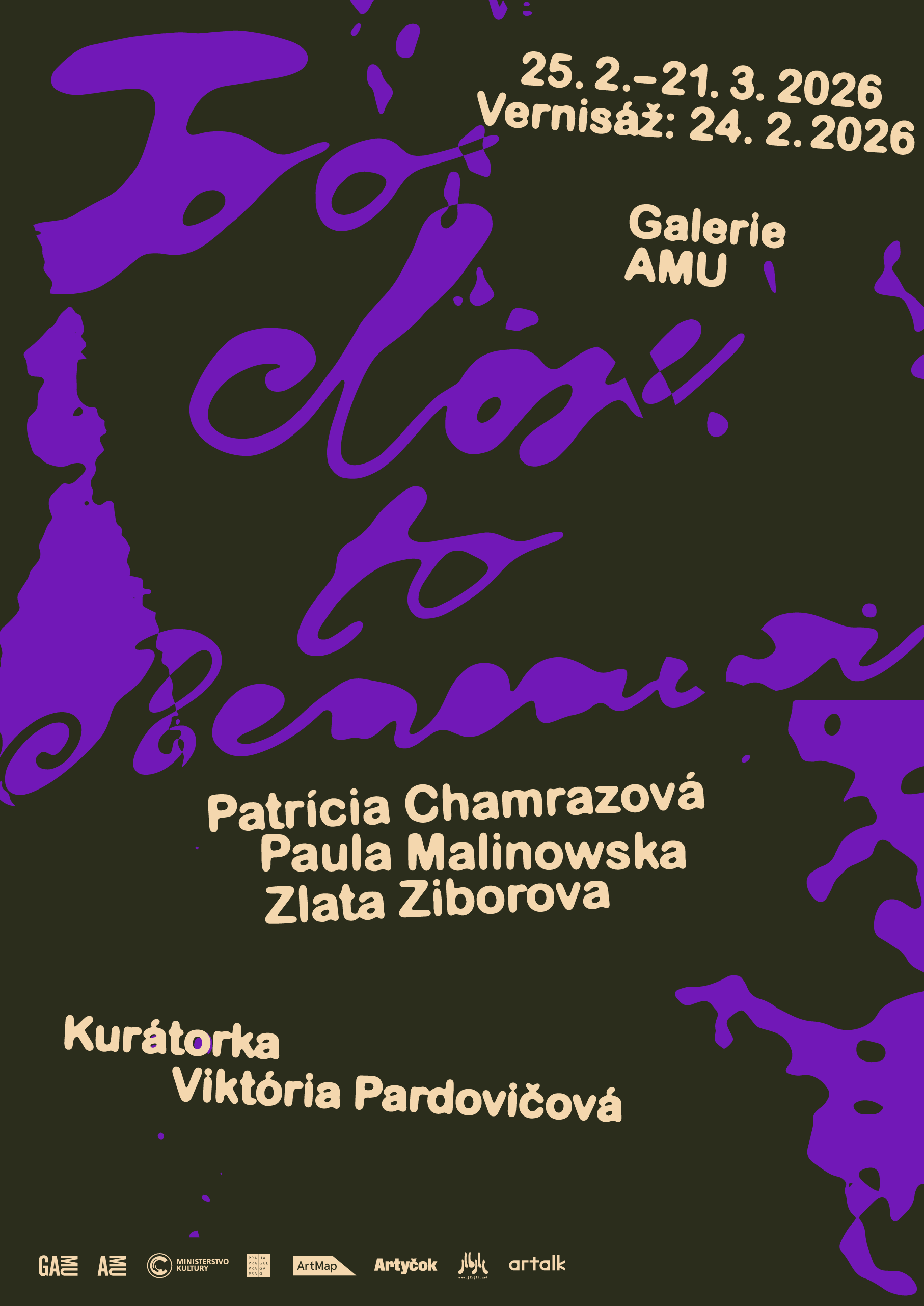
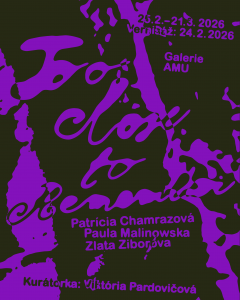
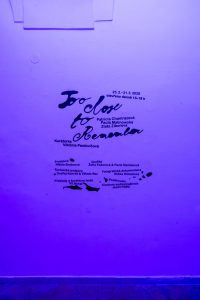
25. 2. – 21. 3. 2026 (opening: 24. 2. 2026, 18:00)

Patrícia Chamrazová, Paula Malinowska, Zlata Ziborova

curator: Viktória Pardovičová
production: Nikola Brabcová
graphic design: Žofia Fodorová a Pavla Nečásková
technical support: Ondřej Konrád, Villads Rex
photo documentation: Eliška Klimešová

translations and text editing: Vít Bohal

Acknowledgement: Center for Audiovisual Studies FAMU

Facebook event

Opening hours: Wednesday – Saturday 13:00 – 19:00

11. 3. 2026, 17:00 FAMU Guest Talks: Paula Malinowska / FAMU U1, Smetanovo nábř. 2, Praha 1

20. 3. 2026, 17:00 Giuded tour and finissage Facebook event

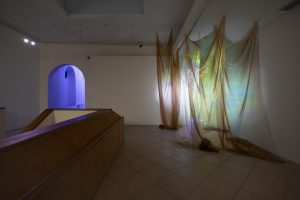
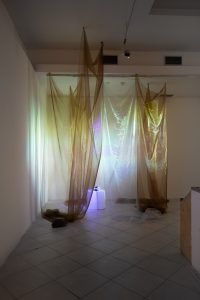
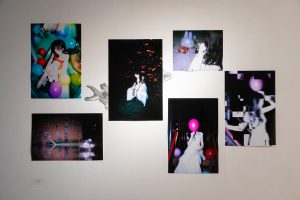
The exhibition explores the theme of synaesthesis – i.e. a reaction of the body and mind and an experience that melds the sensory modalities of diverse entities existing in the digital, posthuman and technological environments. The project develops the discourse on various approaches to perception, especially in reference to the crisis of authenticity of human sensory perception that finds itself under pressure from contemporary power structures, surveillance and production. It builds on the ideas of Maurice Merleau-Ponty who writes in his work Phenomenology of Perception that synesthesia offers proof that our perception is not formed by separate senses, but that it rather appears through their dialog and comprises the dynamic interaction of the whole body with its environment – i.e. reality. The exhibition does not aim to literally interpret approaches to neurological processes and their modifications. It rather becomes a situation, an opportunity for observation and encounter. The installations of the three featured artists aims to expand the frameworks of accepted alternatives and explores the often forcibly suppressed natural experiences of our sensory activity.


Moments that needn’t relate to particular situations describable in language, moments that have left an impression, emotion, an imprint in the mind, body, air. They seem too close while at the same time receding, becoming alienated, censored and purposefully reduced – it is important to be available, online and “up-to-date”. Do we allow ourselves to arrive somewhere between skin and mind, memory and dream, nostalgia and touch? Somewhere within the ecosystems of technologies, organic communities, bodies and intimacy that connect within the exhibition’s space-time, its situations and conversations? Microworlds that allow us to pause, lose ourselves among the memories which needn’t be positive or even human, memories that engage the contrasts between every-day life and imagination – all of them are relevant. Whether here and there, last Friday or at this very moment.

Amid the ongoing situations, processes and problems of crises, we find interweaving relationships dependent on social networks, the precarization of time, the private sphere, emotions and health. The rhythm of everyday living has become structured around pressures often connected to the drive for success, recognition or work productivity. This rhythm has furthermore converged into the toxic layers of virtual platforms. These platforms are also reminding us – often depending on our level of tolerance – that things are bad all over: self-monetization, climate grief, armed conflict and political practices that generate degradation and the spread of disinformation.

What happens to the memory of human senses and their receptors in an age when permanent simultaneity has become the norm, and to what degree are they still able to function properly? Who do we become when we lose control of the evolutionary patterns of our mind, emotions and senses in a society based around ceaseless production? These questions may be considered irrelevant and banal in the context of the catastrophes of armed conflict and many others; but aren’t our perceptions or psyches even more vulnerable during times of crisis than our physical corps, our skin and bodies? These (in)visible places hold promise, but they are also at risk in an era when the human race may be approaching a moment of global and long-term paralysis.

Synesthesia is a term derived from the Greek expression syn- = connection and aesthesis = feeling. From the neurological perspective, it can be understood as a process in which a stimulus of particular sense organs produces emotions or percepts for other sense organs. In this sense, we can consider the contemporary multi-sensorial perception and constant production of interactions (mediated by ubiquitous digitality) to be a state of oversaturation. Such oversaturation becomes a burden and can lead to gradual stagnation and disorientation. Franco Bifo Berardi speaks about a “sensorial regime” in which our perceptions are connected to technologically mediated stimuli and our addiction to them also assumes colonization by economic interests.

The mesh of stimuli in which senses are forced to operate as an interconnected system of mediated stimuli is interwoven with both dystopian and utopian states, and speaks about the occasional voluntary loss of existence in the present. The authenticity of these moments depends on our individual situation, endurance and ability to accept their problematic layers. They require constant evaluation of their potential pathology and mechanisms of control; yet they have at the same time become absurd and naturalized. We can mention here the ontological frame of Rosi Braidotti who references the contemporary reconfiguration of sensory existence: from this perspective, we can understand synesthesia as a basic and natural characteristic of posthuman perception in which the senses do not operate separately but rather as an interconnected field of affective, technological and environmental relationships.

The exhibition expands, interweaves and challenges human perception and ponders the sensing ability of diverse entities that harbor potential for facilitating alternatives and a more sustainable and shared existence. Despite their synthetic and speculative, or – on the other hand – overtly natural and non-conforming origins, appearance and behavior, these organisms index the value of layered sensory experience and existence that often get lost in contemporary approaches to synaesthesis – i.e. the melding of perception but also of our activity and emotions. They turn into a state of awe – anesthesia, the loss of human sensitivity in the drive to resistance. Alternately, this situation opens onto a perspective that accepts multisensorial experience and the undervalued characteristics of inhuman lives as a reality that merits not only critical reflection but also the search for methods of understanding. The three installations provide a close encounter – they offer images of interspecies co-existence and sensitivity that beg discussion about the possibilities of overcoming the hierarchical system of contemporary power structures and self-destructive modes of human-controlled experience.

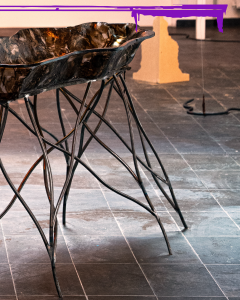
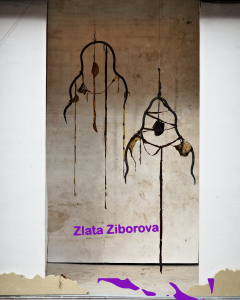
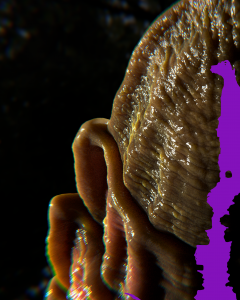
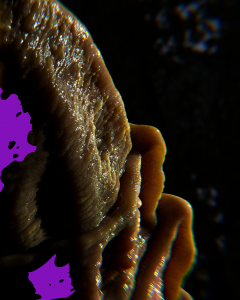
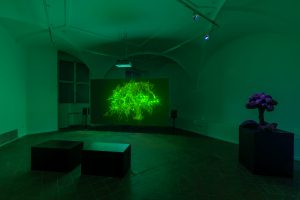
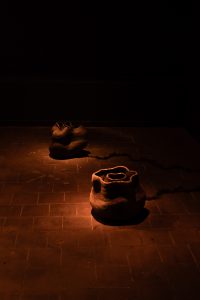
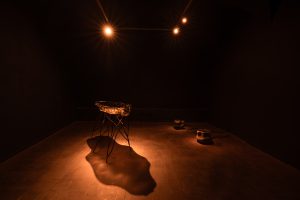
The environment created by Zlata Ziborova builds on her graduate project CorpUs SCOBY that engages the entities of bacterial cellulose (created during kombucha fermentation) and other organic waste within an intermedial situation. The artist works with the participative and symbiotic aspects of inhuman life; these become co-actors in her work and the protagonists of new relationships. The glass object and ceramic sonic vessels represent a womb – a place for life and growth of beings that are best poised to test multi-sensorial sensitivity and the degree of acceptance of their non-conformity. Live bacteria reference the human microbiome that undergoes changes and challenges, as well as faces threats. This creates a dialog and partnership that facilitates the co-existence of human microbial life that must navigate compromise in its striving towards cooperation.

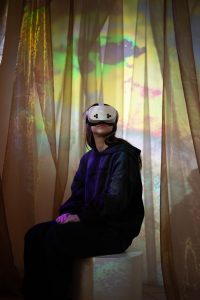
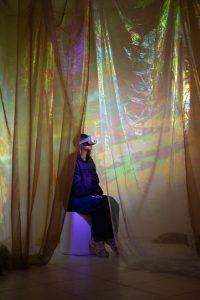
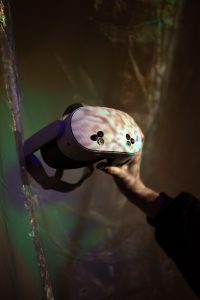
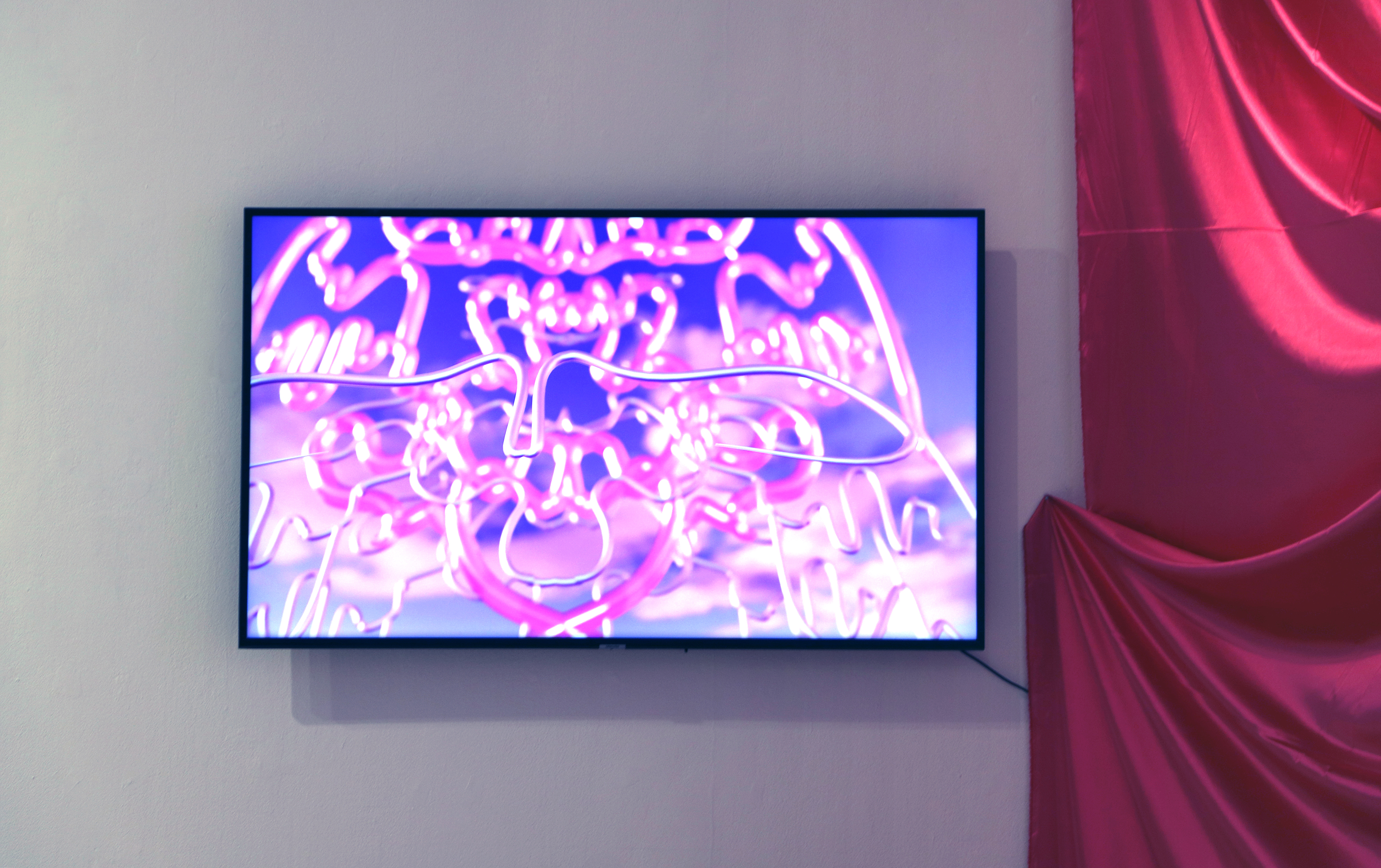
The digital layer titled Permeable Becoming presents an immersive experience in virtual reality where Patrícia Chamrazová works with the (im)possibility of empathy and understanding of inhuman entities. The narrative of the video references research on the most primordial records of life on Earth and takes us through the geological, biological and temporal layers that at first exhibit visual poetics and harmonic moments, while in the second part they lead to absolute loss of control. The fiction is based on fragments of known biological environments and develops ideas that challenge human domination and explore the need for the reconfiguration of anthropocentric structures. The artist strives to transform human sensory experience and uses the example of micro-organisms to show the potential of a newly discovered interspecies sensitivity.

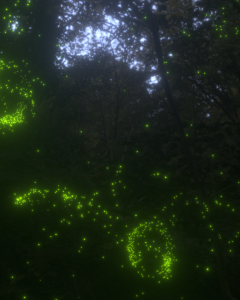
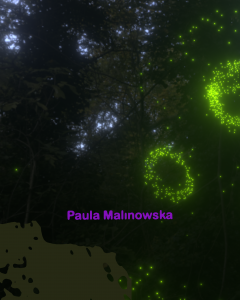
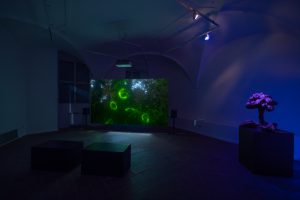
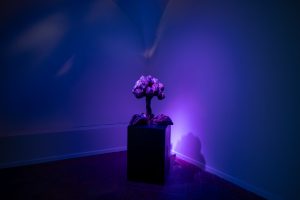
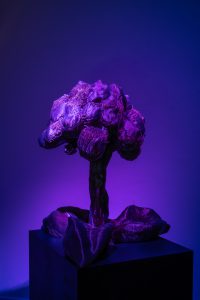
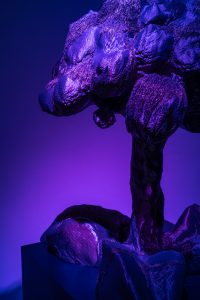
The exhibition’s third part shows the film Vetviace sa svetlo a záblesky úsvitu (Branching Light and the Flickers of a Dawn) and the object from the series (Non)Botanical Bestiary. Paula Malinowska processes findings and data from scientific research and speculative fiction to present a story of a fly and a firefly. The perception of light and the reception of movement and relationships with animals whose sensory abilities remain a mystery to people offer basis for a narrative that challenges the potential of science and offers alternative scenarios that disrupt human rationality. The installation communicates with the large-format sculpture of a hybrid entity. Its corporeality in the form of a 3D print develops from botanical naturality – a study of an ivy berry – and original handiwork, opening space for dialogue about the authenticity of perception, the symbolism of a vegetal being’s resilience, as well as aspects of collaboration between artificial and organic structures and bodies.


Patrícia Chamrazová

Patrícia Chamrazová focuses on contemporary ecological issues, accelerating technological development and interspecies forms of receptivity. She works with digital media, holding a degree in transmedia from the University of Applied Arts in Vienna and in intermedia from the Academy of Fine Arts in Bratislava, where she is currently pursuing her doctoral studies in the Department of Digital Arts. Her practice uses the fluidity of artistic media; her work includes audiovisual installations with XR elements that she often expands with textual expressions and objects. She works on the border between the abstract and the organic, the conceptual and the intuitive, between science and metaphysics. Her approach is characterized by immersivity and a subtle digital aesthetic aiming at transformation, both in the physical as well as the digital spheres. She draws inspiration from posthumanist philosophy, microbiology and the study of new technologies. Her works have been part of exhibitions such as Sensing the In-Between (Šopa Gallery, Košice, SK, 2025), Leaving Traces (Vektor VR Section at Verzió Film festival, Budapest, HU, 2025) or Resensing – Beyond Symbiosis (Vašulka Kitchen Brno, CZ, 2024) and others. She has completed residencies at Foreign Objekt – Posthuman symposium (online, 2024), Kair rezidencia (Košice, SK, 2024) and Feral Artists in Residence at Schmiede (Hallein, AT, 2023).

Paula Malinowska

Paula Malinowska is a digital media artist and photographer. She graduated from the Department of Intermedia at the Academy of Fine Arts in Bratislava where she currently works, and is also a doctoral student at the Department of Digital Arts. Her artistic practice includes CGI audiovisual works, 3D printing techniques and photography that she further develops into multimedia installations. Her research is based on studies in the fields of biology, climatology and the development of digital technologies, which she connects with elements of speculative fiction and fantasy. She often focuses on the life cycles of beings (organisms) that provide inspiration for the creation of stories transcending the hierarchies established by human society and offering alternative perspectives on the possibilities of empathetic relationships and communication. Her work has been presented at many exhibitions, including More Than Human (Light Art Museum, Budapest, HU, 2025), Sentience (Voloshyn Gallery, Miami, Florida, US, 2024), Whoever settles in a perfect home will have to move (GLASSBOX, Paris, FR, 2023), and others. She has completed residencies at MuseumsQuartier in Vienna (2023), Residency Unlimited in New York (2024), and Plato Gallery in Ostrava (2025).

Zlata Ziborova

Zlata Ziborova builds on her research into substances and raw materials of organic origin that appear in everyday life or are often considered waste. In 2024, she graduated from the Academy of Fine Arts in the New Media 2 studio and currently works in Prague. Her intermedia projects often address bodily materials such as hair or blood that she further transforms, creating poetic reflections on the relationships between corporeality, intimacy and artistic production. She works with organic waste and develops collaboration with entities such as bacteria, yeast and other organisms. She is interested in ecofeminist theory, interspecies relations and topics of production and sustainability. Since 2021, she has been working on the project My Body Is a Factory, where she strives to reuse and work with the productions of her own body. Working with corporeal substances and the more-than-human world, she uses media such as photography, video, participatory performance and object creation while emphasizing the need for sensitivity towards interspecies communities. Her exhibition projects include Feastopia (Industra Art Gallery, Brno, 2025), The Polymorphs Between Us (Světova 1, Prague, 2024) and Spheres of Intimacy (Pragovka Gallery, Prague, 2023). She has completed residencies at the Fundacja Inicjatyw Kulturalnych Potok in Poland (2025), Brno Artist in Residence at the Brno House of Arts (2025), Macro-biotopes in Bihać in Bosnia and Herzegovina (2024) and others.

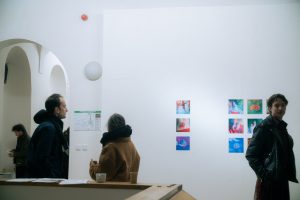
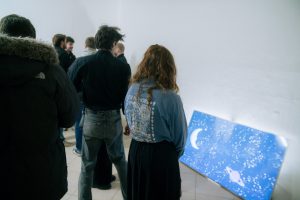
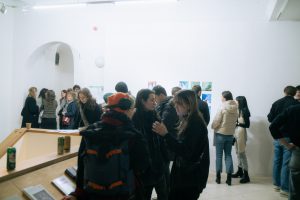
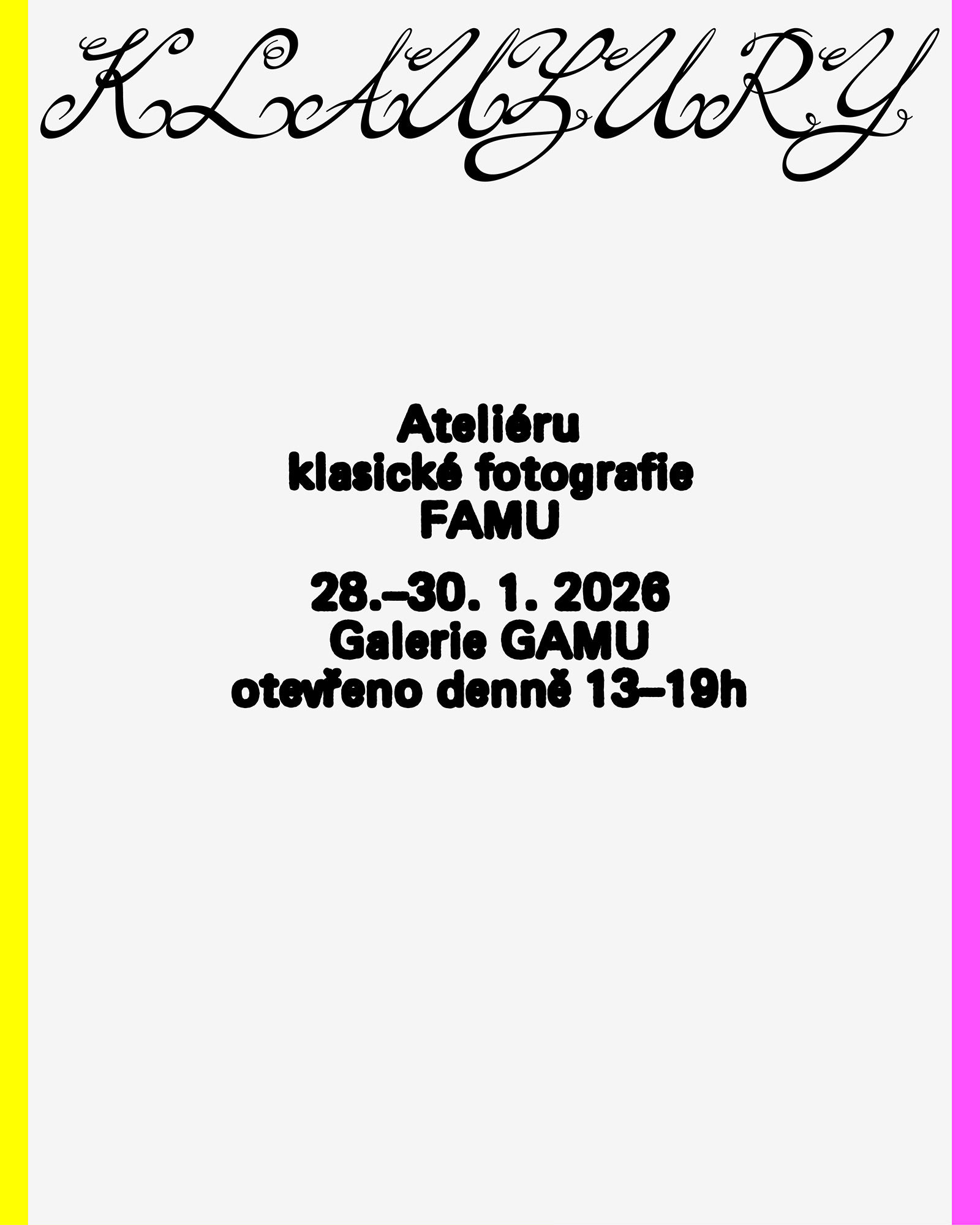
28. - 30. 1. 2026 (opening: 27. 1. 2026, 18:00)

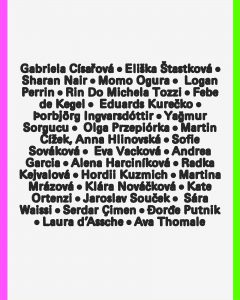
Eliška Šťásková, Sharan Nair, Momo Ogura, Logan Perrin, Rin Do, Michela Tozzi, Febe de Kegel, Eduards Kurečko, Þorbjörg Ingvarsdóttir, Yağmur Sorgucu, Olga Przepiórka, Martin Čížek, Anna Hlinovská, Sofie Sováková, Eva Vacková, Andrea Garcia, Alena Harciníková, Radka Kejvalová, Hordii Kuzmich, Martina Mrázová, Klára Nováčková, Kate Ortenzi, Jaroslav Souček, Sára Waissi, Serdar Çimen, Đorđe Putnik, Laura d’Assche, Ava Thomale

graphic design: Pavla Nečásková & Žofia Fodorová


✺ Opening: 27. 1. 2026, 18:00
‣  Exhibition: 28 – 30. 1. 2026
❄︎ Open daily: 13 – 19h

Facebook Event

Photo credit: Eliška Klimešová

23. - 25. 1. 2026 (opening: 22. 1. 2026, 18:00)

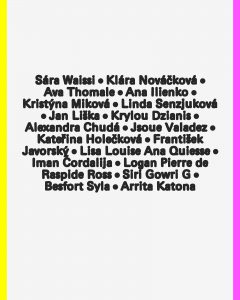
Sára Waissi, Klára Nováčková, Ana Ilienko, Kristýna Miková, Linda Senzjuková, Jan Liška, Krylou Dzianis, Alexandra Chudá, Jsoue Valadez, Kateřina Holečková , František Javorský, Iman Ćordalija, Logan Pierre de Raspide Ross, Siri Gowri G, Besfort Syla, Arrita Katona

graphic design: Pavla Nečásková & Žofia Fodorová


❅ Opening: 22. 1. 2026, 18:00
❆ Exhibition: 23 – 25. 1. 2026
❄︎ Open daily: 13 – 19h

Facebook Event

Photo credit: Eliška Klimešová

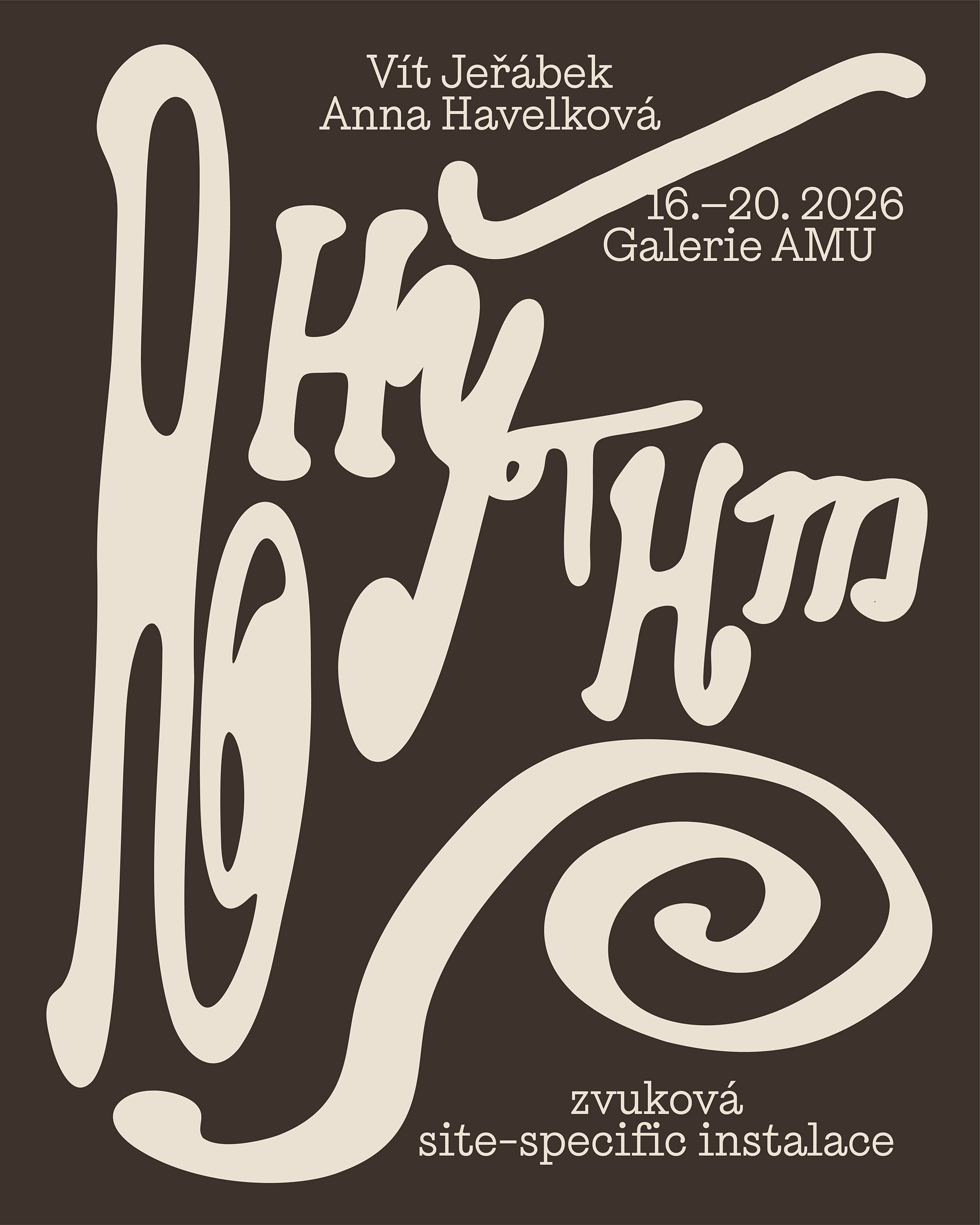
16. - 20. 1. 2026

Sound design: Vít Jeřábek

Scenography: Anna Havelková

Technological support: Antonín Melenovský, Adam Jeník

Graphic: Pavla Nečásková & Žofia Fodorová

Opening: 15. 1. 2026, 18:00

Open daily:  13 – 19h

FB event

The cyclical rhythm of nature, the flowing rhythm of time, and the changing rhythm of each individual meet, diverge, clash, and harmonize. The installation endeavors to create a safe space for slowing down and changing perspectives at a time when natural rhythms seem increasingly hidden.

Vít Jeřábek, Sound designer and musician, currently finishing his master’s degree at the Department of Sound Design at FAMU. In his professional practice, he has participated in the creation of a number of short films. In addition to film sound, he is currently intensively focused on game audio, sound installations, and his own musical production, for example as a member of the band jj dobry.

Anna Havelková, Costume designer and graduate of Scenography – Costume and Mask at DAMU. In her creative work, she focuses on drawing and graphic art. She is currently collaborating on stage productions for the Prague City Theaters with director Tomáš Ráliš and is also involved in projects with the JEDL theater company.

https://rhythms.bandcamp.com/track/mood-sketch

Photo credit: Eliška Klimešová

Finissage of the research exhibition Jedna, 2, tři (One, 2, three) by Anna Chrtková and Natálie Rajnišová, together with the guided tour and a launch of the documentation zine titled 1/2/3: Research, Display, Outcome.

Programme: 

18:00 – guided tour – Roman Poliak, Natálie Rajnišová, Anna Chrtková

19:00 – zine launch 1/2/3: Research, Display, Outcome [zine will be in czech language only]

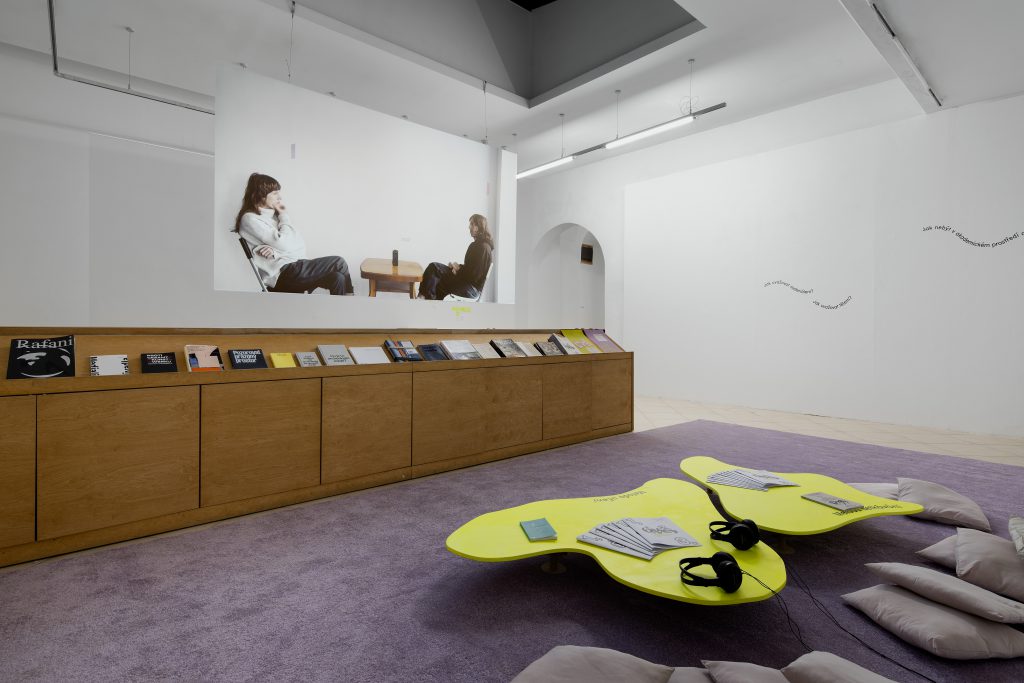
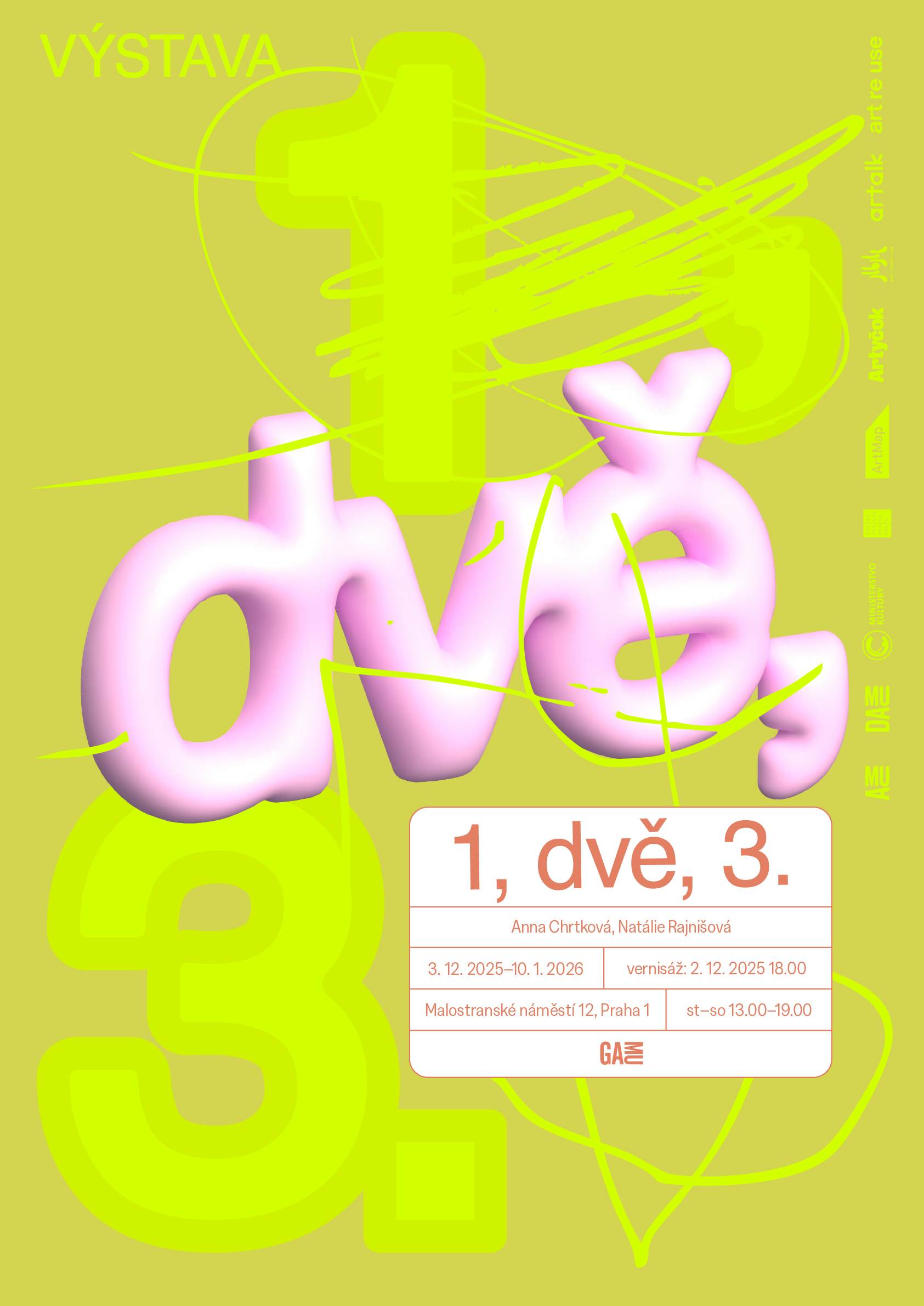
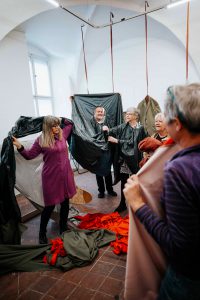
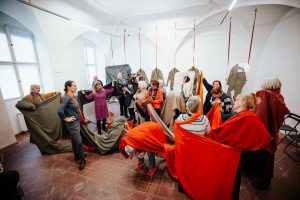
One – as an individual, a single person wandering at the intersection of art and academia. Two – as Natálie Rajnišová and Anna Chrtková, two artistic/scenographic research projects, mutual support and consultation. Three – as the smallest unit of a collective, entering into new relationships, perspective, feedback. An exhibition of two artistic research projects that look at collectivity, materiality, relationality, and community from two different perspectives (collective costume and relational scheme of space). A space for work, meeting, and mutual support in an individualized academic and artistic world.


3. 12. 2025 - 10. 1. 2026 (opening: 2. 12. 2025, 18:00)

Anna Chrtková, Natálie Rajnišová

graphic design: Žofia Fodorová a Pavla Nečásková


Opening hours:  Středa – sobota / Wednesday – Saturday, 13.00 – 19.00

SYMPOSIUM: 10. 12. 2025, 9:00 – 18:00

Zine launch: 7. 1. 2026, 18:00

FB event: https://fb.me/e/8Y5ttRHFs

Dramaturgy:  Roman Poliak

Technical support: Ondřej Konrád

Překlad / Translations: Vít Bohal

Photo: Eliška Klimešová, Jank Kolský, Jakub Pavlík

One – as in an individual. Two – as in Natálie Rajnišová and Anna Chrtková, two artistic research projects, mutual support and consultation. Three – as the smallest unit of a collective, fostering new relationships and perspectives, providing feedback.

We have been studying a PhD program together, both of us graduated with an MA in scenography, and we consider ourselves scenographers. We help each other out, yet we are still lacking something. Although both our fields (Natálie Rajnišová – Collective Costume, and Anna Chrtková on the Performability of a Scenographer) prototype and test a collective engagement with the world, with ourselves and each other by means of research in scenography, we feel alone in the academic field. Our work builds on Bruno Latour’s relation networks, and we are conscious of more-than-human assemblages, exploring methods for conscious experiencing of human and more-than-human forms of collectivity.

We observe our outcomes through the prism of science. And just like other academics, we move through a temporality structured by research grants whose rhythm follows the logging of outcomes into the Registry of Information on Results (RIV) and, in our case, the Register of Artistic Outcomes (RUV). The quality of our outcomes is measured and evaluated through a point-based system and then cast onto the open market where the number of publications and citations determines the value and significance of the creators-researchers who produced it. And throughout all this, we are plagued by doubt – who is going to read our work, really? Is there a specific audience for artistic research?

The exhibition 1, two, 3 is our highly practical answer to the problem of the intersection of art and academia. In the world of academia, we will always be the actors who are difficult to measure, categorize, and whose modus operandi perhaps remains too open. We present the exhibition as a sort of fissure which allows us to set our own rules in the world of indexing tables and citation impact. We are formulating the very support base we are currently lacking. GAMU thus becomes a space for creating temporary installations, expert encounters, a studio and laboratory, a place for generating feedback, exchanging knowledge, sharing, exercising mutual influence, being together, and maybe even “just” relaxing. We are able to orient ourselves here much better than in the world of academia.

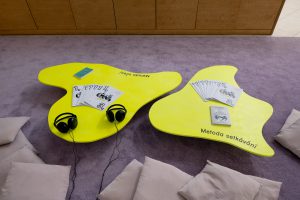
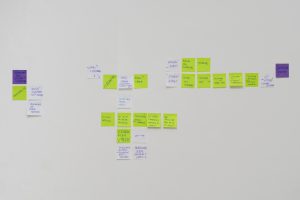
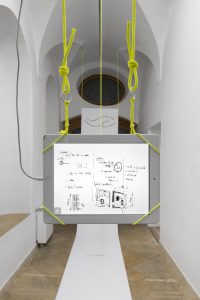
In contrast to performances or theatre shows, the exhibition is defined in the Methodology of Evaluating Research Organizations as a relevant academic outcome. We have repurposed the first part of the gallery as a particular study room where we present our research method. The methods for learning – dialog, meeting, sketching, mapping and touching, sensing and materials – function as access points for reading the individual research projects presented in two separate rooms in the gallery’s second space. The research of Collective Costume is represented by a textile object (Naše kůže dýchá stejný vzduch / Our Skin Breathes the Same Air, 2024), an installation (Opakování 1–7 / Repetition 1–7, 2025) and a series of photographs (1,2,3,4,5,6,7, 2025), while the Performability of a Scenographer is represented by numerous schemas (Uživatelské manuály Y Events / Y Events User Manuals, 2019–2025, Anna Chrtková) and three situational models (My tři: situace, and Bitva o libidinální prostor I and II / Us Three: Situation, Battle for Libidinal Space I and II, 2023-2025).

The exhibition 1, two, 3, presents the audience with an opportunity to engage with those methods which allow us to better understand the world and experience it more consciously.

Anna Chrtková (1994) is a scenographer, curator and artist. She graduated with a scenography degree from Brno’s Janáček Academy of Performing Arts and the Theory of Interactive Media at the Faculty of Arts of Masaryk University. She works as a scenographer for various theaters in Czechia and Slovakia (e.g. West Bohemian Theater in Cheb, Goose on a String, HaDivadlo, Ludus Theater). She collaborated with the Intelektrurálně collective on the acclaimed student project Praha není Česko (Prague Is not Czech, 2019). In the same year, she became curator of the Y Events series of events which took place in Prague’s X10 Theater. She is a member of the Monika tired artist collective (Logika růstu / Logic of Growth, MUD Benešov, 2023; The Great Burnout, TIC Gallery, Brno, 2025), and she has been active as a PhD student and external teacher at DAMU in Prague. Her artistic research titled The Performability of a Scenographer: Scheme, Model, and Meeting as Tools of Curatorial Action focuses on the methodological potential of scenography as a practice for creating events and presenting visual art by scenographic means (schema, model, meeting).

Natálie Rajnišová (1994) is a scenographer, costume artist and musician. In 2020, she finished her MA studies at KALD DAMU, and she is now a PhD student focusing on the art research of Collective Costume – i.e. the role of fabrics as a connecting material in performance. She focuses on the scenographic and dramaturgical approaches to textiles, their materiality and their potential to create collective situations. She has also been teaching externally at DAMU. Her work engages with theater bordering on fine art and installation. In 2022, she co-founded the Laguna Resort performative platform which explores theater renditions of ecological topics, as well as the potential of fabrics and costume. Over the last years, she has collaborated on exhibitions and performances for MUD Benešov, Umakart, Fait Gallery, INI Gallery and Fotograf Gallery. She has also been involved with theater projects in the spaces of the National Theater’s New Scene, Alta, Alfred ve Dvoře, Malé Divadlo, Minor theater, Dejvice Theater, Venuše ve Švehlovce, Palác Akropolis, and others. She is also member of the TAMARA music group which in 2022 was nominated for the Anděl, Vinyla and Apollo Awards for their debut album Anderson.

The symposium EXPERIENCE, ENCOUNTER, KNOW: Artistic Research Between Material, Body and Space.

Accompanying program for the 1, two, 3 exhibition. An experimental conference format focused on embedded and embodied knowledge transmission. The symposium will feature PhD students and artists of Czech universities, as well as invited international guests.

Presenters: Ricardo Basbaum (BR), Martina Hajdyla Lacová, Lukáš Hofmann, Hana Chmelíková, Anna Chrtková, Valentýna Janů, Kryštof Kočtář, Tomáš Moravanský, Natálie Rajnišová, Judith Seng (DE)

6.1. 2026 WORKSHOP Dance Well by DanceConnected with Natálie Rajnišová. Photo credit Eliška Klimešová

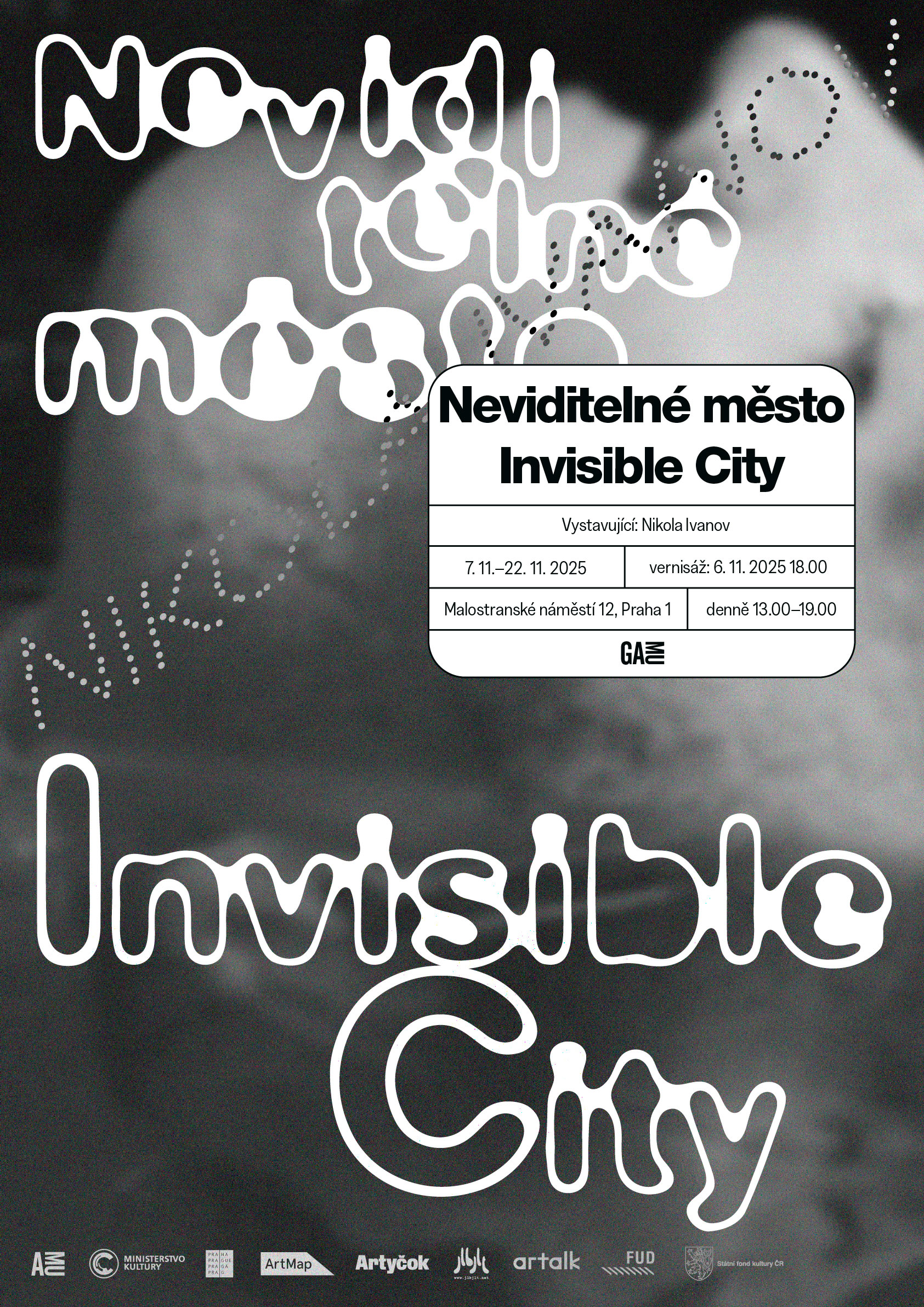
7. 11. - 22. 11. 2025 (opening: 6. 11. 2025 18:00)

curated by: Vojtěch Märc

graphic design: Žofia Fodorová a Pavla Nečásková

Open daily: 13.00 – 19.00

Guided tour: 20. 11. 2025 18:00

FB event: https://fb.me/e/1QUEzNYYJL

“Each man bears in his mind a city made only of differences, a city without figures and without form, and the individual cities fill it up.”

Italo Calvino

Over the last few days, the Wiesbaden Museum has been unusually busy. People have come to see the more than century-old painting of a drowned Ophelia drifting among lotus flowers, painted by Friedrich Heyser. This is because fans of Taylor Swift have noticed the reference to this painting in the first track of her recently-released album. In the music video, Swift is seen coming out of the water and out of the image; in her own words, Swift is rejecting the fate of Ophelia. 

And the protagonist of Nikola Ivanov’s new film is similar to Ophelia. She, too, is coming alive and shedding her fate, as if she were averting the artistic male gaze and curatorial mansplaining. Who, then, is the addressee of Ivanov’s love and farewell letter which blends a strangely undramatic melodrama, a monologue full of reproach, as well as the motivational speech of an imaginary coach? 

In Ivanov’s film, the parallels between sorrow for love lost and the mourning for a shambled climatic stability seem almost leading. And leading the viewer in this way may obfuscate the fact that in artistic work, the domains of the personal and political need not always overlap. They are not so much identical – as we see in the famous feminist slogan – but are rather analogous. One cannot be transferred to the other without leaving a remainder. This is not about toeing the line of regressive patriarchy but rather about understanding the irreducibility of the personal sphere which may, or may not, become political. 

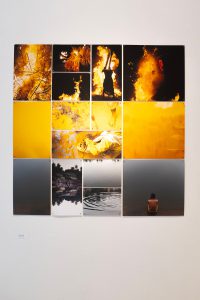
The relationship between the psychological and environmental dimension is also developed in two of Ivanov’s photographic series. The first shows a Swiss glacier covered in canvases which are supposed to protect it from sun rays and thus slow the irreversible melt. The second was created in the Bulgarian city of Varna and shows the draining of reservoirs in the shape of the Black Sea, on whose coast the city stands. 

The exhibition title helps wedge Ivanov’s work between the invisible cities described in the novel by Italo Calvino of the same name, most likely in the section “City and Memory.” The relationship between an architectural or urban space with memory has been well-documented. But Ivanov is not building palaces to memory. His city rather adopts an anti-mnemonic function – it does not help the remembrance of things, but aids in their forgetting. 

This also applies to the exhibited model composed of various cities which submerge and bleed into one another. The individual cities are as interchangeable as their occupants. Alienation here merges with something strangely familiar. A generic testimony naturally does not offer the option to identify with it, nor does it provide a sensible outcome. This can only result from the presence of random singularities and unexpected returns, which can only be duly noted over a generic background. 

The spheres of individualities and of personal features are in no way strictly separate. After all, as noted by Roland Barthes, no love is quite original, and Anne Sauvagnargues adds that we never love another in their entirety, as a whole. Sociologist Eva Illouz adopts a different stance to the fragmentary nature of romantic utterances: According to Illouz, western culture notably lacks the representation of situations in which we fail to fall in love or cease to love. She identifies these partial rationalizations with the fact that we live in and through dramatic representation, while “unloving” does not offer a clearly structured narrative. 

Such an opinion perhaps finds more general validity without having to necessarily reference our inability to terminate the toxic relationship with industrial, capitalist modernity. A visit to Ivanov’s invisible city can be understood as a form of submersion within a potentially productive melancholy. 

Vojtěch Märc

Nikola Ivanov is an intermedia artist who works primarily with photography, video, and text. He is interested in the themes of time, memory, night, sleep and biopolitics, and the current exhibition sees him approaching the theme of disappearance on an environmental and personal level. He studied at FAMU and the Academy of Arts, Architecture and Design in Prague. He has participated in numerous solo and group exhibitions and residencies in the Czech Republic and abroad. He is the editor of the anthology Odpočinek v neklidu (2022) which focuses on the biopolitics of sleep, and the author of the book Oslepeni jasem (2025), which deals with the colonization of the night and the history of diverse plans to illuminate night areas using mirrors placed in orbit. Since October 2024, he has been co-director of the Applied Photography Studio at the Faculty of Art and Design of the Jan Evangelista Purkyně University in Ústí nad Labem. He also works as a methodologist at the Department of Graphic Design at the Academy of Arts in Prague.

Acknowledgement:

Velké poděkování všem, kdo se na výstavě podíleli / Special thanks to everyone who contributed to the exhibition: Lenka Janíčková, Josef Majrych, Karel John, Mikuláš Karpeta, Alžběta Malá, Kryštof Hlůže, Tomáš Merta, Ian Mikyska, Ondřej Konrád, Nikola Brabcová, Jan Maštera, Miroslav Kněz, Nathan Fields, Mingle Film, Štefan Iľko, Jan Kořan, Richard Janeček, Josef Šlapák, Tereza Vejvodová etc.

The exhibition has been supported by the grant program of the Ministry of Culture of the Czech Republic, the State Cultural Fund of the Czech Republic and by an internal grant from the Faculty of Art and Design of the Jan Evangelista Purkyně University in Ústí nad Labem.

Photographs of the installation: Eliška Klimešová

Photographs from the opening: Lenka Janíčková

Photographs from the guided tour: Ondřej Konrád


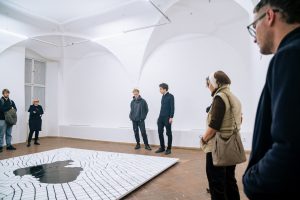
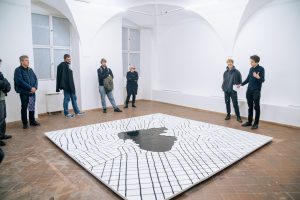
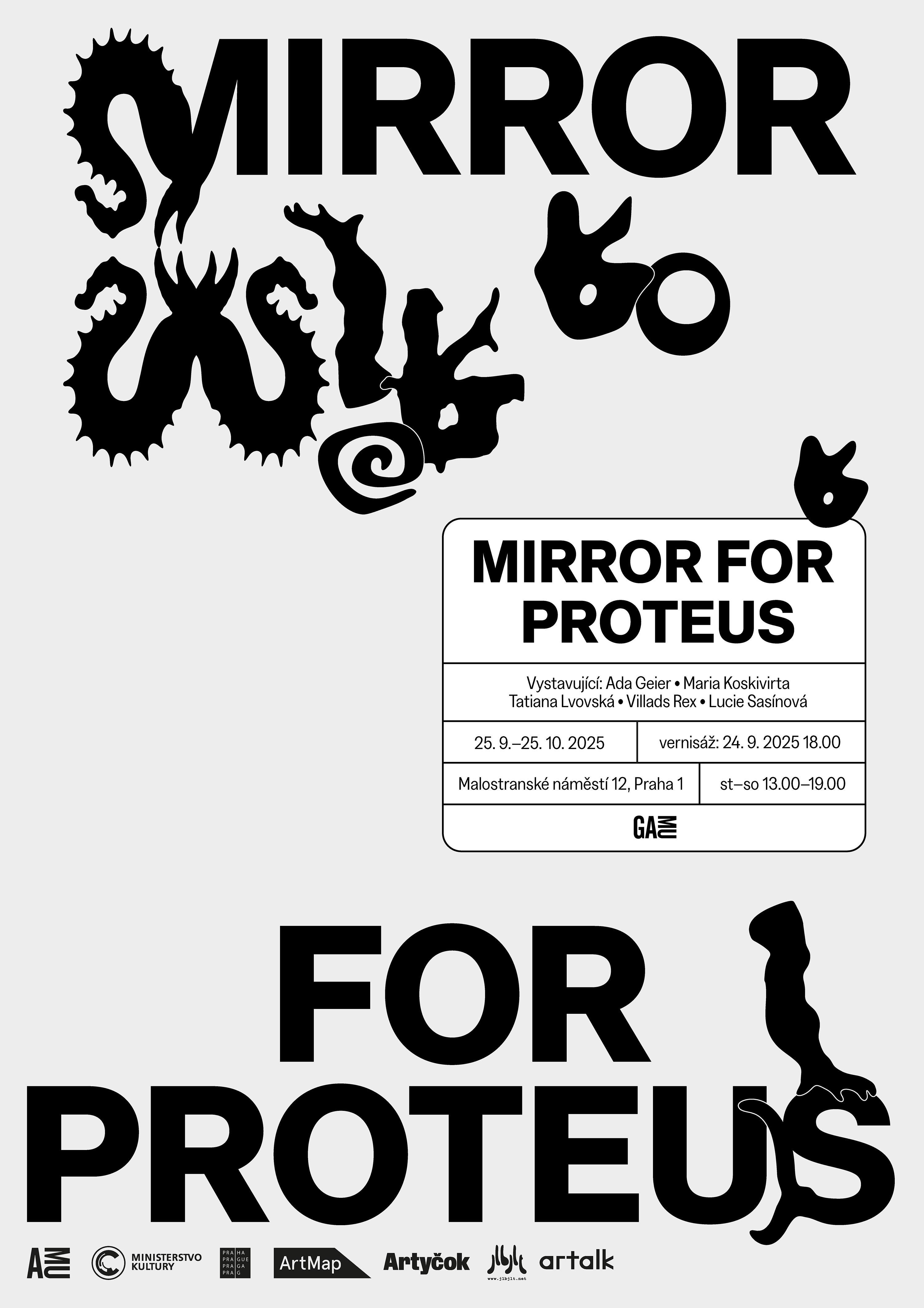
25. 9. – 25. 10. 2025 (opening: 24. 9. 2025, 18:00)

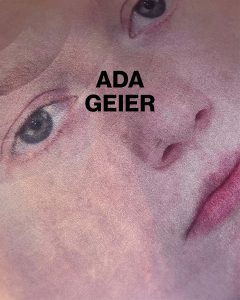
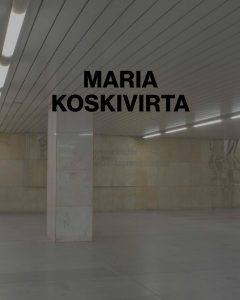
Ada Geier, Maria Koskivirta, Tatiana Lvovská, Villads Rex, Lucie Sasínová

curated by: Martin Netočný

exhibition architecture: Trang Erika Nguyen Thu

graphic design: Pavla Nečásková

Accompanying programme: 

Prague Art Week: 25. 28. 9. 2025

Curator’s tour: 25. 9. 2025, 17:00

Facebook event

If we were to visit the archive of the Department of Photography of the Film and TV School of the Academy of Performing Arts in Prague (FAMU), and if we thumbed the books which the students developed over the years as part of their two-semester course called “Face and Body,” we may be surprised that they are very similar to one another. The works coming out of this course – which focuses on teaching the studio lighting of a human figure – are usually done with a white background and shot from similar angles, and they usually share very similar material parameters. This is especially the case for the books which were compiled soon after the department’s founding in 1975. The male and female nudes are bound in books with a spine length of 28cm maximum which, according to some, was the perfect height for fitting into the shelves in which the books were to be archived after being marked.

If we were to adopt a critical stance toward this micro-historical sample (as, for example, proposed by Allan Sekula in his book The Body and the Archive), with a bit of hyperbole we could state that the works contained therein reflect certain aspects of the school’s actual regime and operations. Rather than being a document of the identities of the photographed and photographing subjects, they provide a window into a particular institutional bias. It must also be noted that “Face and Body” primarily focused on a technical task, so its outcomes are not intended to provide some purely original testimony but rather show a certain standardized regime of seeing, one which owes much to the modernist approach to photography. The identity of the person depicted melds into their bodily proportions and becomes a typified attribute of the image – or, alternately, the archive – rather than something which would exceed it.

From today’s perspective, it is striking how intensely this pattern of power – which has been a staple of technical images since the 19th century – also influenced the curricula which were taught at FAMU. It is quite possible that this was due to the institution’s close relationship with the film industry or teacher Ján Šmok’s focus on cinematography. Whatever the cause may have been, the medium was conclusively approached through a technicist lens, meaning it was rather about thinking through the camera than theorizing the camera itself. As part of this exhibition project initiated on the occasion of the 50th anniversary of the department’s founding, we would like to distance ourselves from these early attempts connected with the objectification of the body, and rather aim to offer a few methods through which to reflect the categories of corporeality and identity in a more complex manner and within the context of the contemporary media sphere.

The methods of controlling society and individuals have significantly changed over the last few decades. Whereas in the past power used to be external, repressive and centralized, today it has become ever more disseminated. As Bernard E. Harcourt writes in his book Exposed, the advent of the social network has made public space one great data supermarket whose visitors no longer hide from systemic oversight but rather voluntarily perform for it. It is no longer viable to normatively control identity, as with the help of the new informational infrastructures it can now be effectively capitalized and shaped. The sharing of personal details used to be taboo, while nowadays it seems to offer an unprecedentedly attractive, even inevitable, method of acting in the world.

The newly formed relationship between the real and the so-called virtual world is, however, deeply reciprocal. For a long time, we have been seeing that digital identities significantly impact the actions of users also beyond the limits of the social network itself. The avatars which represent us in these spaces function as beta-versions of our identities on which we test all those expressions we would be too shy to perform elsewhere. When one of the virtual images resonates with the user base, its features are integrated into action in real life. This increases the number of identitarian frames circulating within society. Psychology conceptualizes this as the “Protean effect” in reference to one of the minor gods of the classical pantheon. Proteus was a herder of seals, and he was able also transform into any living or non-living entity. In Greek culture or the plays of Shakespeare, this figure is presented as essentially unstable and usually appears during a narrative’s turning point.

Without necessarily implying that the massive increase in protean entities is leading us towards a historical turning point, we may consider this phenomenon one of the central drivers of the ongoing social transformation, certainly making it worthy of artistic reflection. That is why we ask whether the character of this fluid classical god may also play a role in the formation of values, for example in the sphere of labor. In the virtual sphere, the formerly physical activity of work has become notably similar to affect and play. Much like Proteus could turn into a tree, snake or lion, the world of social networks amplifies phenomena such as gender stereotyping and misogyny, and this in turn impacts people’s interactions in real life.

This short text presents some of the dynamics which have informed the works of the featured artists and aims to show that if we wish to speak about the body and identity today, we need to start with the afore-mentioned data supermarket where these representations multiply, expand, and are sold every day. The plethora of digital avatars ultimately leads us to another type of body whose existence stands beyond any power system – the body which falls apart and rots; the body which will never again work, play or be affected. The body which has left behind only a media index, ready to be cataloged in the archive. Whether seen as imprints of a rigid school task within the standardized dimensions of the archive shelf, or as an expanded toolbox, they both have one thing in common – they are like a body which has been spent and harvested by the reigning status quo and its surveillance apparatus. As hopeless as this situation may seem, this exhibition shows that it can be subverted by placing a mirror before it and making present the ways in which the media sphere’s structure projects itself into the minds of the very people who are helping to form it.

Photo credit: Jan Kolský

Text editing / Redakce textů: Viktorie Vítů, Vít Bohal

Translations / Překlad: Vít Bohal

Production / Produkce: Nikola Brabcová, Martin Netočný

Technical support / Technická podpora: Ondřej Konrád, Jiří Kaňák, Trang Erika Nguyen Thu

Acknowledgement / Poděkování: Galerie hlavního města Prahy

8. - 14. 9. 2025

Opening: 7. 9. 2025 18:00
Exhibition: 8. – 14. 9. 2025 Open daily 13:00 – 19:00

Realization: Světlana Silič, Veronika Svobodová
Concept: PYL collective – Maryia Kamarova, Světlana Silič, Anna Romanova

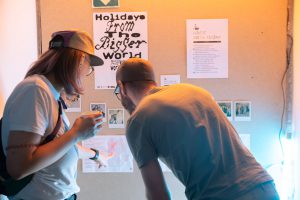
Would you like to experience what it is like to be a flying insect approaching a soft drink? Or perhaps how to transform into an alternative fur seal? Or alternatively an alternative grasshopper? In Holidays From the Bigger World, the PYL collective offers these very possibilities to anyone who is tired of inhabiting a confined human body. 


Audiences of all ages are invited to set aside rational logic and dive headfirst into a new reality co-created with a plethora of unexpected species. By accepting the terms and conditions of this game, you can witness the sudden metamorphosis of a mobile phone box into a dolphin’s fin, or declare your affection to a futuristic Talking Swamp (in which you cannot drown). On this occasion, a gallery space becomes a playground on which you can create your own meaning. 


The project aims to discover possibilities of engagement with daily materials through embodiment and close interactions involving haptic, visual, and sonic senses. Its main focus is formulated around the materiality and the participative aspect of spectatorship in installation art. In this project, PYL collective explores scenographic settings that reduce the distance between the potential audience and the artwork. This is achieved through the use of interactive technologies, scores, and simple objects whose appearance prompts curiosity and provokes action.

Graphic: Žofia Fodorová

Photo: Ondřej Konrád

Acknowledgement: Theresa Schrezenmeir, GAMPA, Terén – pole performativního umění

Project supported by the Ministry of Culture of the Czech Republic and Prague 7 – Art District 7

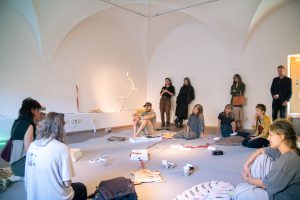
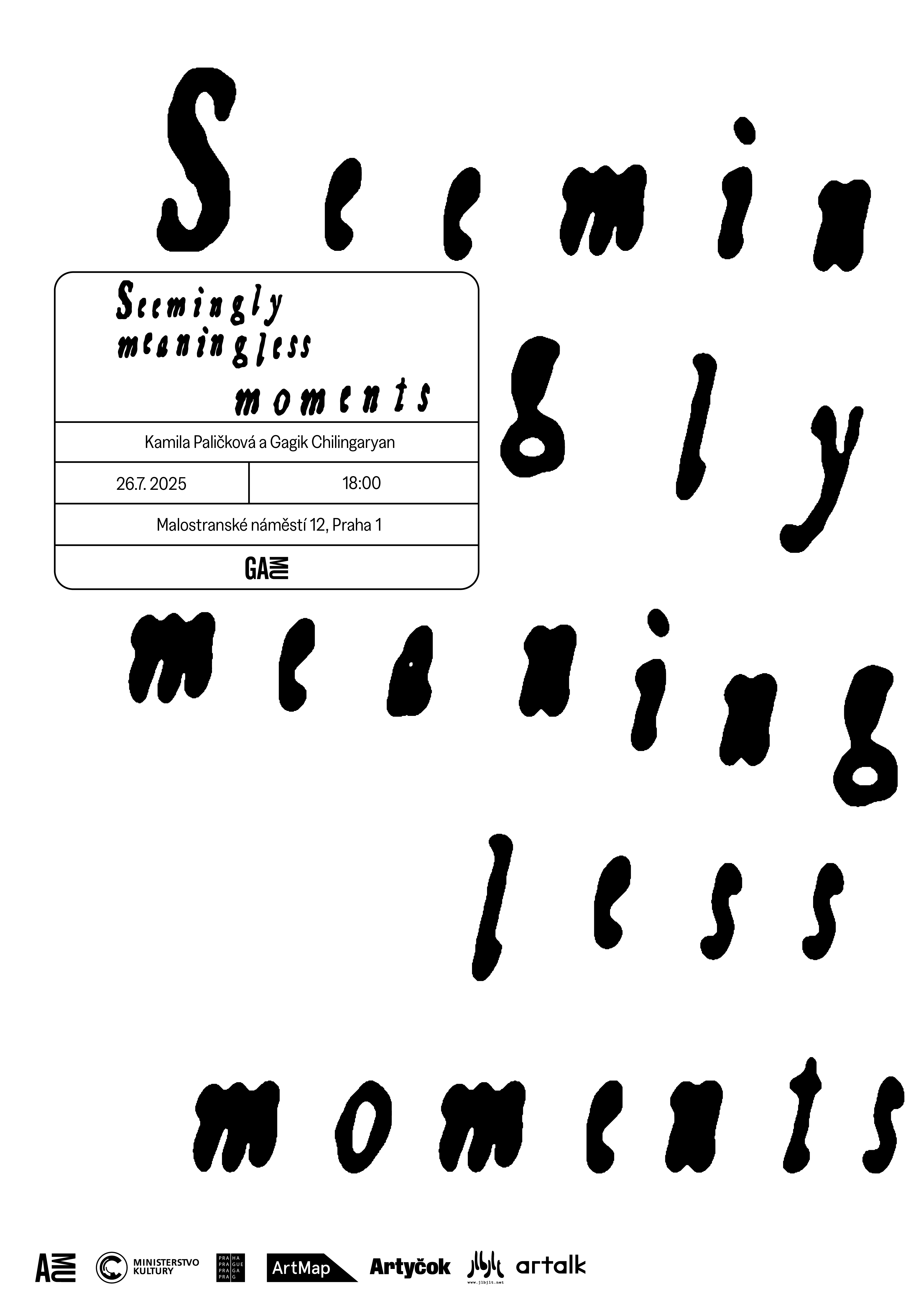
26. 7. and 3. 9. 2025 19:00

A movement laboratory at the intersection of physical theatre and object manipulation.

Concept and interpretation: Kamila Paličková and Gagik Chilingaryan
Dramaturgy: Johana Jurášová
Costumes and puppet design: Alica Mikócziová
Sound design: Eva Mart’ák
Light design: Dominik Šimurda

What constitutes a stoppage in a time of continuous motion? Perhaps it is not a breaking point, but a smooth slowing down – a change in the rhythm of perception that allows a silence to be heard that carries weight. A stone, as an archetype of duration, becomes a metaphor for time, which does not move but deepens. It fascinates with its silent memory, the layers of events it has witnessed, and its ability to be – just be – without the need for change.

This project lies at the intersection of physical theatre, object manipulation and existential reflection. It is based on a personal experience of the Nordic landscape, where the subject encounters the elemental – nature, solitude, stone – and finds in it a space to redefine the present. Through the body, object and rhythm, we explore the concept of the “banal moment” as a gateway to deep experience.

Does it take a grand gesture to make room for depth? Or is simplicity the most radical response to the complexity of the world?

As Dostoevsky remarked, “We do not reveal the absurd in order to fall into the temptation to write a manual of happiness.” Perhaps it’s just a return to what is already there – only seemingly insignificant, but essential.

Graduation performance by Kamila Paličková, a 2nd year Master’s student at the Department of Nonverbal Theatre at HAMU.

The performance will take place on July 26 and September 3, 2025.

Graphic: Žofia Fodorová

Photo credit: Lenka Janíčková

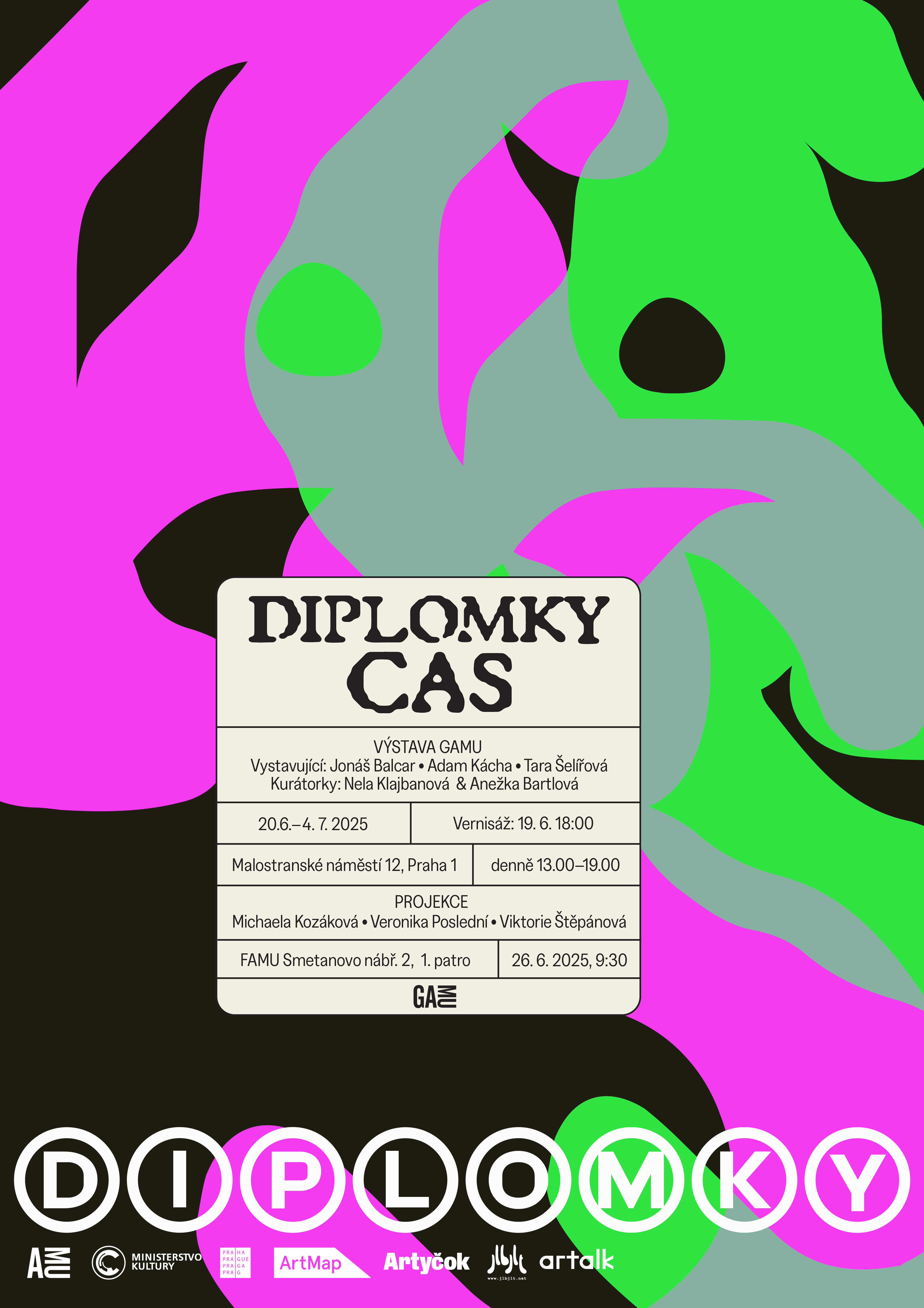
20. 6. – 4. 7. 2025 (opening: 19. 6. 2025 / 18:00)

Jonáš Balcar, Adam Kácha, Tara Šelířová

curated by: Nela Klajbanová & Anežka Bartlová

graphic design: Žofia Fodorová

Photo credit: Eliška Klimešová

11. - 15.6. 2025 (opening: 10. 6. 18:00)

Max Čuhel, Emma Erben, Kindred Haller, Yana Kadurina, Petr Klíma, Agáta Kučerová, Denisa Müllerová, Veronika Olejárová, Jáchym Ozuna, Eri Pelikánů, Thea Pfeffermannová, František Šimek, David Šourek

curated by: Anežka Bartlová & Nela Klajbanová

graphic design: Žofia Fodorová a Šimon Vlasák

30. 5. - 5.6. 2025 (opening: 29. 5. 2025)

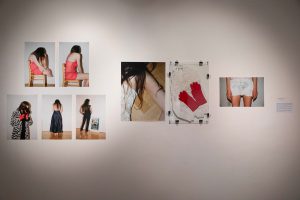
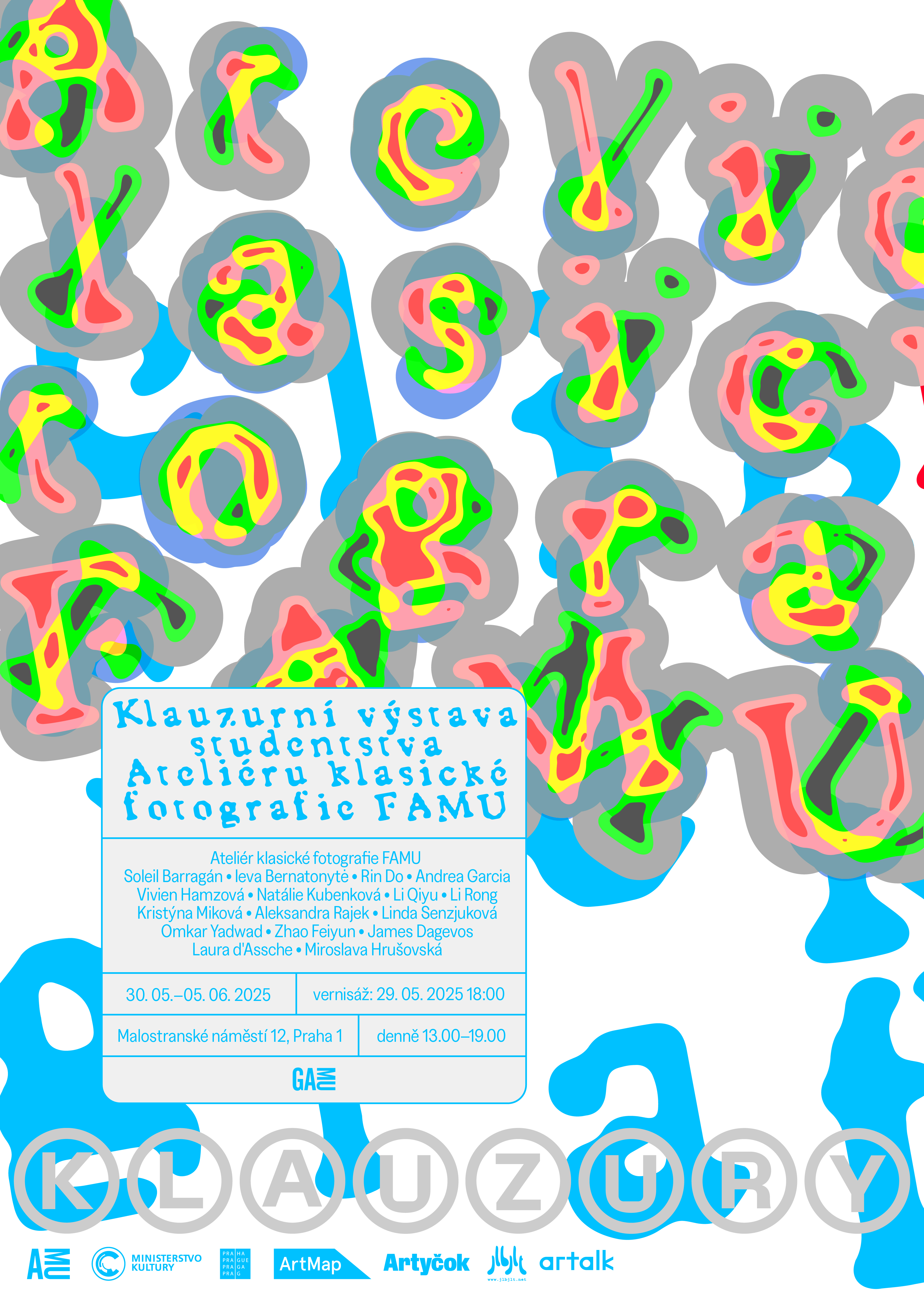
Soleil Barragán, Ieva Bernatonytė, Rin Do, Andrea Garcia, Vivien Hamzová, Natálie Kubenková, Li Qiyu, Li Rong, Kristýna Miková, Aleksandra Rajek, Linda Senzjuková, Omkar Yadwad, Zhao Feiyun, James Dagevos, Laura d’Assche, Miroslava Hrušovská

Pedagogical support: Martin Stecker, Jan Douša

Photo: Vivien Hamzová

Open daily 13 – 19h

Graphic: Žofia Fodorová a Šimon Vlasák

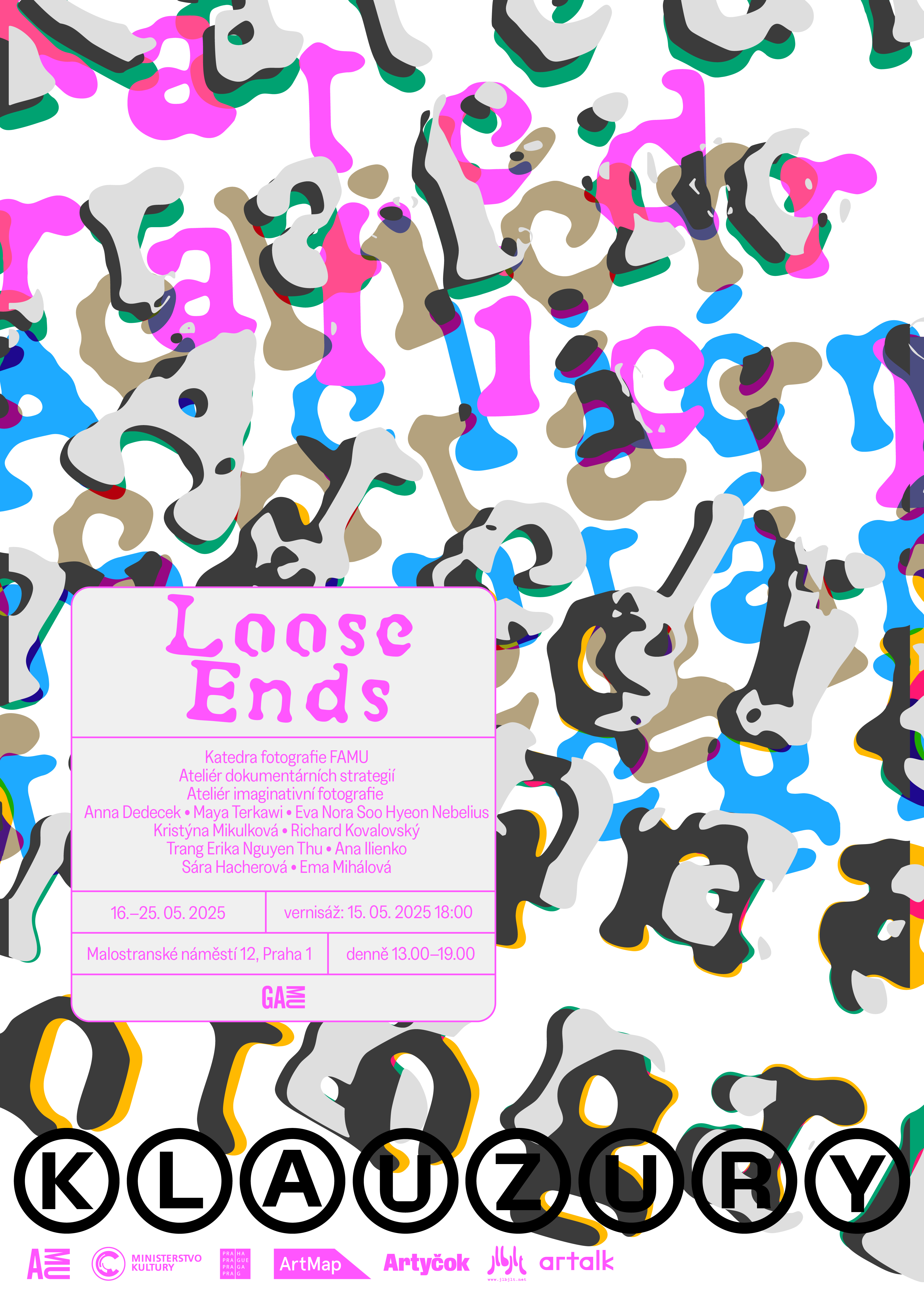
16.- 25. 5. 2025 / open daily (opening: 15. 5. 2025 )

Anna Dedecek, Maya Terkawi, Eva Nora Soo Hyeon Nebelius, Kristýna Mikulková, Richard Kovalovský, Trang Erika Nguyen Thu, Ana Ilienko, Sára Hacherová, Ema Mihálová

graphic design: Žofia Fodorová a Šimon Vlasák


Pedagogical support: Veronika Daňhelová, Markéta Kinterová, Rudo Prekop, Nina Šperanda

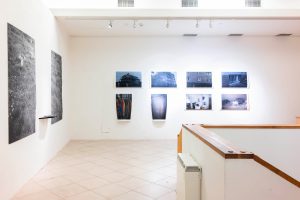
Annual exhibition of students of the FAMU Studio of Documentary Strategies and the Studio of Imaginative Photography

Photo credit: Eliška Klimešová


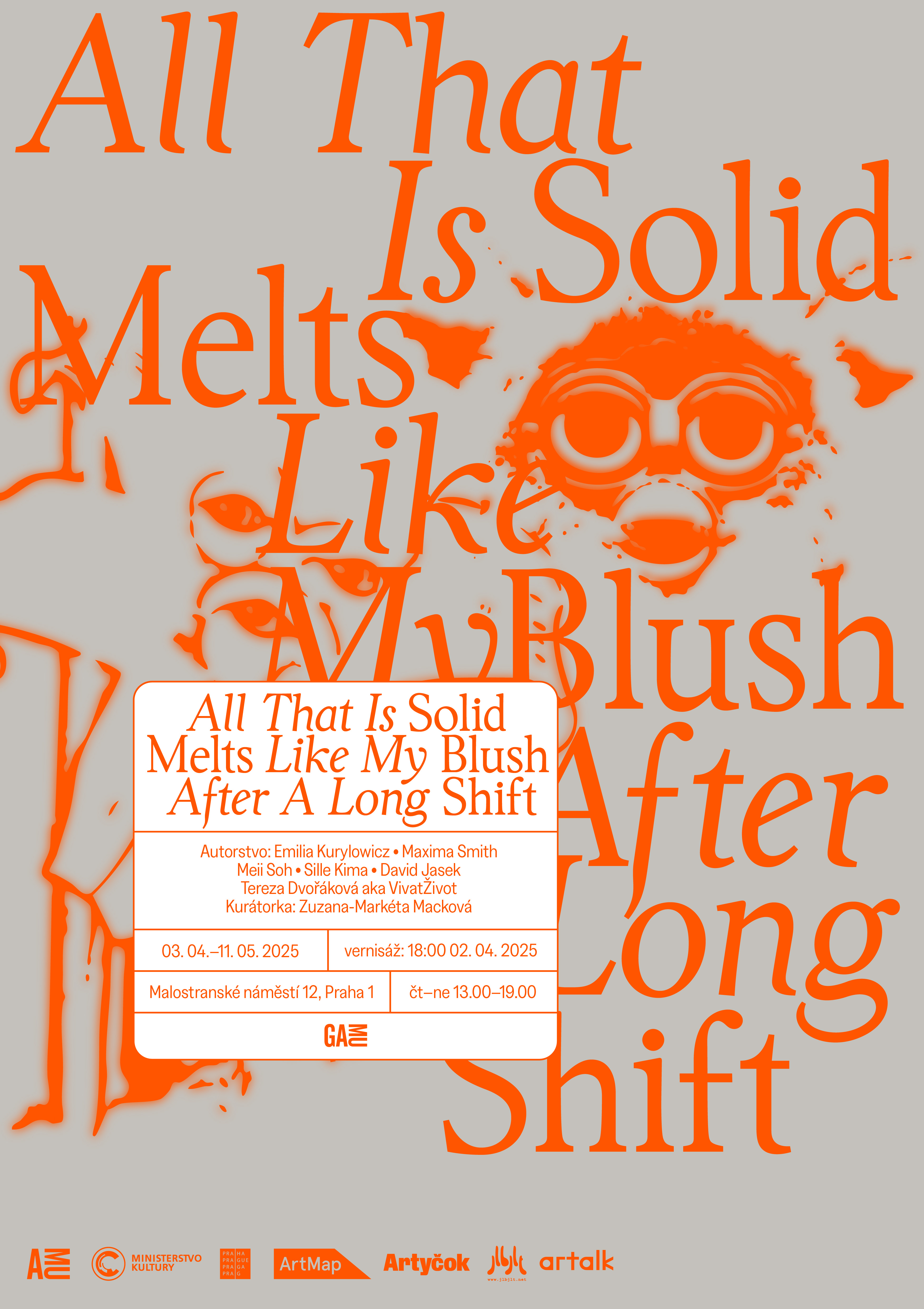
3.4. - 11.5. 2025 (opening: 2.4. 18:00)

Emilia Kurylowicz, Maxima Smith, Meii Soh, Sille Kima, Tereza Dvořáková aka VivatŽivot & David Jasek

curated by: Zuzana-Markéta Macková

graphic design: Žofia Fodorová a Šimon Vlasák

production: GAMU


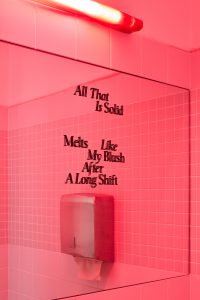
The group exhibition All that is solid melts like my blush after a long shift explores the dynamics of burnout, alienation, and representation in the context of late capitalism. Through various artistic approaches, it focuses on the processes forming subjectivity within an environment where authenticity is not a given essence, but rather a constantly negotiated construct. Identity thus becomes transformed into a transaction commodity which gradually dissolves the boundaries between self-presentation and adaptation. 

The neoliberal narrative of productive self-development promises success by ceaselessly working on oneself, through strategic self-regulation and optimization – but in fact, such an approach generates a permanent state of expectation. The idea of progress is based on a constantly receding, conditional horizon. The exhibition takes this paradox as its focus: burnout is not a side effect of capitalist logic, but its direct product. The body, the mind, and affective economics remain subject to rhythms oscillating between overload and emptiness, projection and disillusionment. 

Instead of merely representing crisis, the exhibition explores ways in which the aesthetics of such an experience change, and the ways in which they can be visually articulated. It explores how previously subversive codes gradually become part of cultural and market-inflected environments. Gestures of resistance and critique often transform into stylized artefacts whose original power is dulled by repetition and aestheticization. Here, nostalgia is not a form of sentimental regression but rather a symptom of exhaustion where the future remains locked within recycled images of the past. 

What options open up when imagination churns within a closed loop of familiar patterns? How to overcome the boundary between authenticity and performance? If the old world is falling apart and the new has not yet been born, can this liminal moment open a space for change? The exhibition does not approach such antitheses as firmly separate categories, but rather shows the ways in which they mutually overlap and merge. It focuses on liminal moments when authenticity is not just a matter of identity but also a survival strategy within the economy of affect. 


Emilia Kurylowicz – Watching Porn with My Mom (Rubber Ghost), (13 min, audio)  

Rubber Ghost is an anecdotal poem about one of the artist’s experiments, in which they are exposing their parents to awkward or controversial situations in order to break the conditioning, (re-)build the connection, and perhaps administer microdoses of non-normative ways of living. The artist is offering their mother to watch an art-porn film (on the set of which they worked as a talent manager). Dissecting the awkwardness of the moment, stretched into “infinity,” becomes a self-inflicted boundary test enacted through broken taboo, porn vocabulary, family memories, and reverences of paradise-like states. 

Here presented as an audio work, the text is accompanied by a soundtrack made with their mouth (smacking and slurping), an ambient musical background, and the amplified sound of squishing rubber gloves. 

 Maxima Smith – Kopykat (Kardashian Triptych), (5 min. loop, video) In Kopykat (Kardashian Triptych)

Smith shadows the Kardashian sisters’ movements through painstaking repetition. Their projected image sits on top of the artist’s grey skin, enacting a form of moi-peau, a double-sided hide shared between Smith and the Kardashians, with the eyes and the mouth becoming abject portals to the fleshy body beneath the digitised surface. Smith shadows their movements over and over, the repetition emphasising the performativity of the moment, and through mimicry, she begins to un-do the Kardashians’ subjecthood, reinforcing the drama of femininity that is at play within these moments. The tracing of their gestures by the artist’s body becomes strangely uncanny, and as Smith’s body tires, they slip in and out of each other’s movements. 

 Meii Soh – We might need some sleep, (20 min, video) 

A fictional essay unfolds from an unrequited love story between the self and their soul. In search of closure, photographs become portals to fantasy. As daydreams take shape, sandy landscapes reveal a secret aperture – leading deep into the camera’s lens. 

Sille Kima – Brilliance, (10 min, video) 

Brilliance is a wet and bright film, a scattering dream of a coming-of-age among the ruins of empires, a firing of synapses, a remembrance song, and that moment when you close your eyes in the warmth of the sun. 

Starting with the fictional character of a teenager Agathe, living on the outskirts of what used to be Prague, the film blends autofiction with dreamscapes, living memories with futures hovering without time, along with archival footage from my family’s amateur film archives in Estonia, spanning throughout the changing statehoods and recording mediums from 1960s to 2000s. 

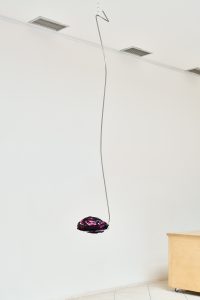
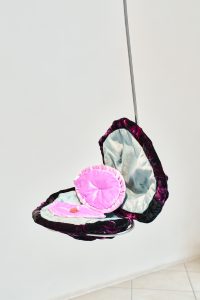
Tereza Dvořáková AKA Vivat Život & David Jasek – Silence of Answers (textile, digital print) 

What if the only thing we can rely on today is uncertainty? This reliquary does not contain fragments of the material world but rather those things we remain unconscious of – feelings of doubt, being adrift, opening to endless possibilities, to plasticity. It is a vessel for a sense of “I don’t know” – but not as lack but rather as a positive quality. It captures the fragility of knowledge and the awareness of its mutability. It reminds us that understanding is not the ultimate goal, but rather a constant movement between a question and its answer. The emptiness of the reliquary invites us to walk through it; it tempts us to reevaluate stable paradigms and open up to the unfathomable. The reliquary is made in pseudo-renaissance style and is decorated with techno-fossil features, connecting historical references with modern technologies, and indicating the connection between past and future. The present constantly expands, endlessly shaping new ways of life. 

 Tereza Dvořáková AKA Vivat Život – Life Is a Mystery (textile, embroidery, sound device) 

A stone, a core, a seed – the symbolic flash disk contains the entire potential of its kind. The attractiveness of Madonna’s singing does not take us to the here and now. Our sense of introspection leads us through timeless vistas, kept in perspective by the greater whole. Layers of impossibility become a force, the essence of life. 

The embroidered surface contains fragments of stories which cannot be completely deciphered. Sound is neither a part of the past nor the present but remains somewhere between, in their ungraspable interval. The stone becomes a holy item. 

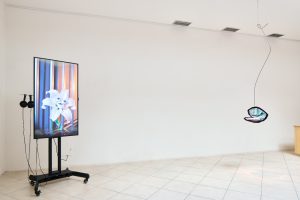
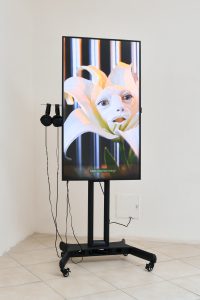
 Zuzana-Markéta Macková – Tralalily (4 min, video) 

The Tralalily video was produced for this exhibition and acts as a mood setter, initiating the audience into their expectations. It follows the life of a virtual lily imprisoned in an indeterminate environment – a club aesthetic. Uncontrollably transforming every few seconds, the flower sings, expressing her alienation and frustration from the situation. 

This endless cycle of instability illustrates Gramsci’s idea that “The old world is dying, and the new world struggles to be born: now is the time of monsters.” The lily can never become fixed in one form, nor can it move through the threshold towards real transformation. Its existence oscillates between dissolution and constant adaptation. And lilies are present not only in the video, but also in the exhibition’s physical space. While the digital lily remains imprisoned in the cycle of endless change, her real counterparts undergo the natural process of dying. 


Artist bios: 

David Jasek BIO: 

David Jasek is a graphic designer whose work straddles the boundary between digital design, generative design, and textile work. His work experiments with visual approaches, such as generating graphic design through coding, thus shifting the boundaries of our traditional understandings of what design can be. Typography plays a key role in his work, which he connects with motion design, allowing him to create dynamic visual projects and unique graphic concepts. He focuses on the relationship between the digital environment and the individual, explores the connection of physical and virtual identity, and searches for new methods of visual expression. His conceptions reflect technological and social changes, and his work asks about the ways graphic design is able to react to them. His work exists somewhere between visual art and design, constantly discovering new possibilities of connecting aesthetics and technologies. 

Emilia Kurylowicz BIO: 

Emilia Kurylowicz aka aemlx (pronounced emil) is a transdisciplinary performer, music producer, and organizer from Lodz, Poland, currently living in Berlin. Their work operates in liminal spaces between art and entertainment, playfulness and mourning, awkwardness and pathos. By subverting genres, creating alter egos, and using humor as a mode of knowledge production, they attempt to devise tools for navigating the world in the reality of system collapse. They are also a co-creator of the platform @sabbath.berlin dedicated to amplifying the voices of artists and communities from Eastern-Europe, the Balkans, Baltic regions, ex-Eastern Bloc, as well as the manager/mc of a queer wrestling platform @liminalbeastofprey____ 

Maxima Smith BIO:

Maxima Smith’s work, primarily based in moving image, examines the mediation of the camera, somatic processing, and is influenced by the slippage between sincerity and absurdity. She questions feminine archetypes and roles, critiquing gendered acts such as mimicry to reinforce the performativity of gender. Smith situates much of her work in the 

blurred boundary between ‘on’ and ‘off-stage,’ where questions arise of how we act and perform ourselves. In parallel, Smith holds a position on the board of executives of Artists Union England. She earned her MA from the Dutch Art Institute in 2023 and obtained her BA from the Slade School of Fine Art in 2016. She has exhibited nationally and internationally, including: Crocodile Tears (Solo), Asylum Studios Gallery, Suffolk, UK (2024); Mirroring, Theater De Uitkijk, De Sloot, De Appel & Theatre Bellevue, Netherlands (2024); Crying with My Family (Solo), LADA, London (2024); Where the Moon is Up, Centrales Fies, Trento, Italy (2023); Invisible Goddess, Venice, Italy (2023); Visions in the Nunnery, The Nunnery Gallery, London (2022, 2020, 2018); Pixelache2019, Oranssi, Helsinki (2019); Ode to a Window Cleaner (Solo), The People’s Palace, London (2019). 

Meii Soh BIO: 

Meii Soh is a researcher, performer, writer, and dog-sitter whose work examines the intersection of human and non-human storytelling. They mediate presence and space through disassociation, speculation, poetry, and sonic materialism, re-imagining friendship, love, and parasitism as complex methods of co-existence and co-habitation. As such, Meii’s work challenges audiences to enter immersive dialogues on the obscure, camouflaged, and invisible connections between beings. 

Their work has recently been presented in the context of Nieuwe Instituut, Cashmere Radio, SEA Foundation, pocoapoco, Centrale Fies, Solipsism Magazine, de appel, among others. 

Meii holds a bachelor’s degree from the University of Fine Arts of Lisbon and Sint Lucas Antwerpen, where they engaged in critical studies. Recently, they graduated with a master’s in Artistic Research from the Dutch Art Institute. Presently, Meii curates at GROTTO in Berlin as part of their interest in programming and eagerness to counter-individualism and capitalistic forms of gathering. 

Sille Kima BIO: 

Sille Kima is an artist and a musician whose work is rooted in the haptics of the sonic. Their work ascribes to the poethics of embodied practices, both of the places they are from and where they hover. She uses her vocals as her main instrument for making spatiotemporally located sound installations, live performances, radio plays, spoken word, writings, and artist films in support of a work of nonlinear and speculative worldbuilding around the crooked grammars of affection – from intimate relationships to the social and political. Recently, their work has been dealing with light – an element holding the possibility of both enormous violence and nourishing warmth simultaneously. 

They have played live shows at Sabbath (90mil Berlin), UNM festival (Reykjavik), and Daylight Project (Tallinn) and collaborated for radio shows on Dublab LA, Montez Press New York, radio Alhara, Lyl radio, and Radiophrenia Glasgow. Their performances and installative work have recently been shown at Dammweg & Para/text (Berlin), Water Tower (Viljandi), Kanal (Võru), Centrale di Fies, NIDA Art Colony, and Salina, and they have been to residencies at Mustarinda, pAIR, Kordon, and NART. She also occasionally teaches at the intersection of land justice and solidarity at the Estonian Academy of Arts and is one of the founders of Kreenholm Plants in the border town of Narva. 

 Tereza Dvořáková (AKA Vivat Život) BIO: 

Tereza Dvořáková’s textile works explore the tension between sign, text, and meaning. She uses abstract forms to create connection between imagination and the symbolic order. She translates culturally-specific references into a universal language by transforming them through materials, shapes, and words. Her work reassesses the import of cultural heritage, reflecting an eclectic present which prompts a redefinition of the status quo and fosters an active approach to the formulation of meaning. Utility is a very specific feature of her artistic work, allowing her viewers to grasp her meaning and develop a connection by means of their own identity and through personal intervention. She calls deadstock and second-hand materials “materials with history,” and they form an integral part of her style and her striving for sustainability and plasticity. She combines traditional work processes with digital tools and flat images with plastic ones, and her work presents a visual rendition of the contemporary approach to the relationship between history and the future. Tereza is a member of the Fuga artistic society. 

 Zuzana-Markéta Macková BIO: 

Zuzana-Markéta Macková is a Czech artist and curator who lives and works between Berlin and Prague. She works with video, audio games, LARP, and immersive performance, through which she explores topics such as hypercapitalism, Eastern European identity, and conspiracy theories. Her work manipulates the viewers through humor, pop-cultural references, and a meta-modern approach. Zuzana-Markéta often critiques the authenticity of human actions during the era of late capitalism. She received an MA at the Dutch Art Institute (2021–2023), where she focused on hauntology and Lacan’s analysis of Capital. She has a BcA from FAMU (2019–2021) from the Department of Photography and the Studio of New Aesthetics. Her work has been presented at 90mil (Berlin, DE), BACO (Bergamo, IT), Centrale Fies (Dro, IT), DOCK (Basel, CH), Fotopub (Novo Mesto, SL), GHMP (Praha, CZ), Mustarinda (Hyrynsalmi, FI), and NIDA Art Colony (Nida, LT). She is a member of Display – Association for research and collective praxis, and part of the ACUD space in Berlin. She used to be a curator of Galerie Panel, co-founded the Until Further Notice experimental audio collective, and currently works with Simona Binko from the Tschechisches Zentrum Berlin on the series CCAiB, which maps the networks of Eastern European artists active on the German art scene.

Translation: Vít Bohal

Technical support: Ondřej Konrád

Installation photos: Jan Kolský

Performance photos: Eliška Klimešová

24. 3. - 30. 4. 2025

graphic design: Žofia Fodorová


AMU Gallery announces an open call for exhibition projects to complement the gallery’s program for 2026. 

The call is intended for both Czech and foreign artists and curators, applications may be sent both in Czech or in English.

Due to the wide spectrum of subjects taught at AMU (The Academy of Performing Arts in Prague) we prefer thematic, curatorial exhibition projects with interdisciplinary overlap, or exhibitions based around artistic research. 

The projects can be registered until the 30th of April, 2025 at gamu@famu.cz

Required application materials:

  • a detailed description of the project, including visual documentation which takes into account the gallery’s spatial dimensions (max. three standard pages of text)
  • a structured CV/bio of the applicant
  • brief CVs/bios of the exhibited artists, including a showcase of their work / links

to online portfolio

  • the exhibition’s budget (possibly with proposed additional sources of funding)

The AMU Gallery provides:

  • oversight at the exhibition
  • technical support
  • graphic processing and printing of accompanying materials 
  • basic PR 
  • production costs up to CZK 40,000 (fees, material), depending on the gallery’s budget for the given year

The gallery’s blueprint and photo documentation of the exhibition space can be found on the gallery’s website.

here

21. - 27.3. 2025 / Open daily 13 - 19 h (opening: Thursday 20.3. 2025)

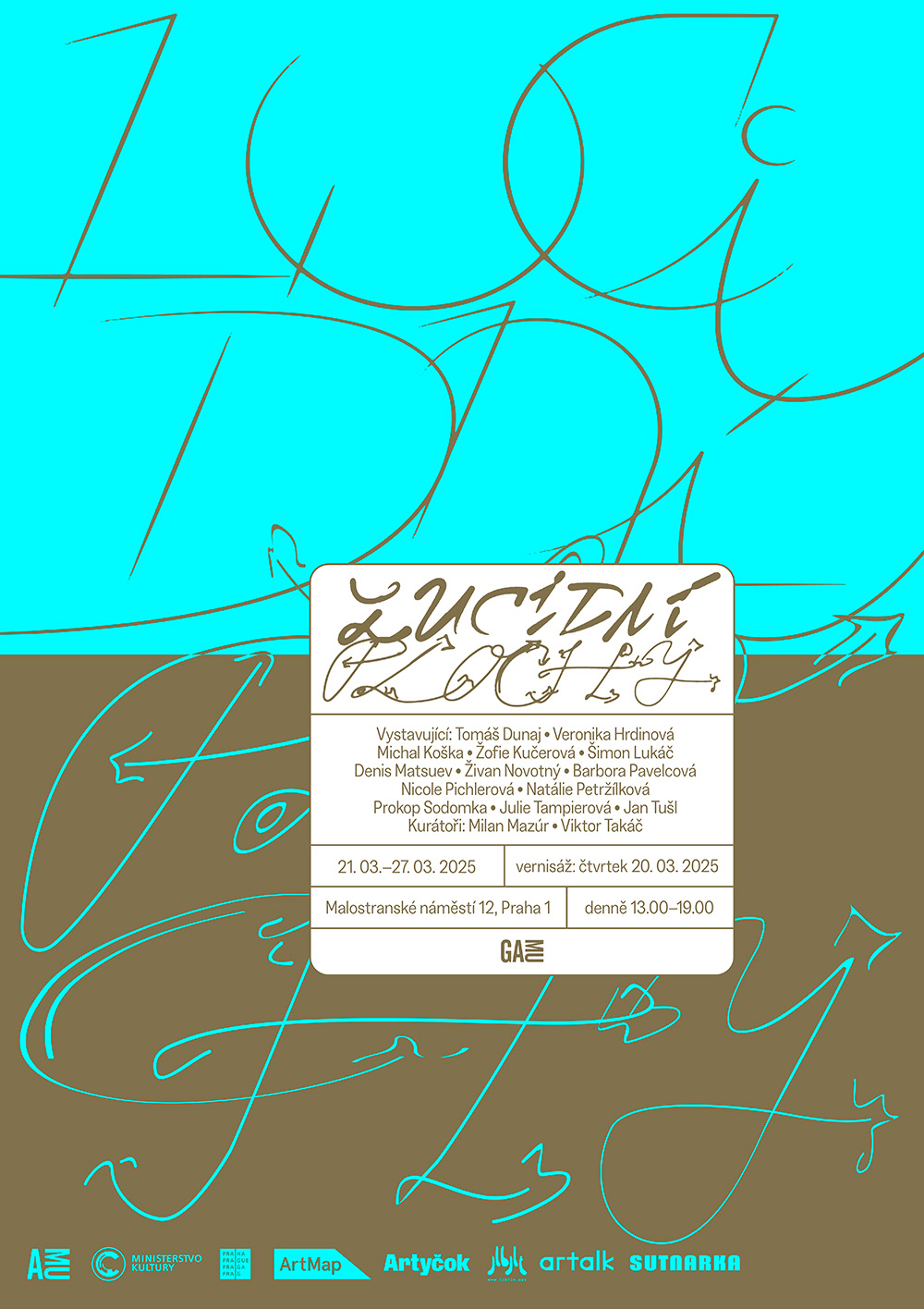
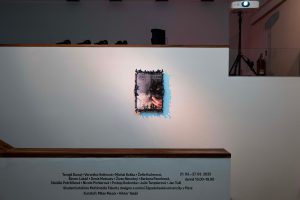
Tomáš Dunaj, Veronika Hrdinová, Michal Koška, Žofie Kučerová, Šimon Lukáč, Denis Matsuev, Živan Novotný, Barbora Pavelcová, Natálie Petržílková, Nicole Pichlerová, Prokop Sodomka, Julie Tampierová, Jan Tušl 

curated by: Milan Mazúr & Viktor Takáč

graphic design: Žofia Fodorová a Šimon Vlasák


Students of the Multimedia studio of the Faculty of Design and Art at the University of West Bohemia in Pilsen.  

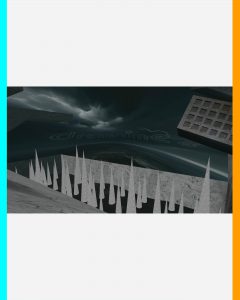
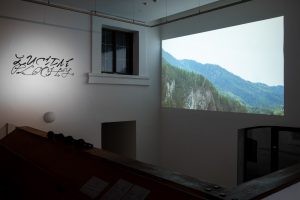
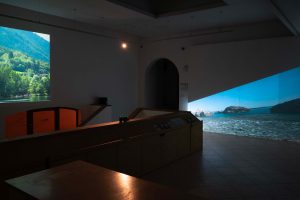
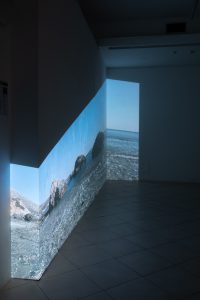
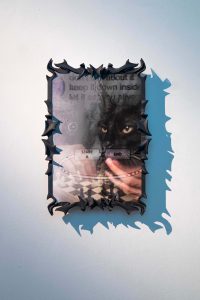
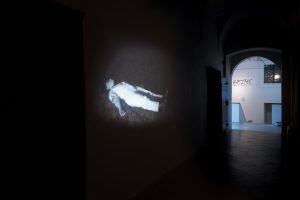
The exhibition at AMU Gallery focuses on the strategic “fracturing” of the projected images and their smooth transition into space. The curatorial concept moves beyond the traditional frame and transforms video into the exhibition architecture, formulating new “planes of refraction” and perspectives. 

The series includes works made by students based on their own original concepts, and presents night as its main theme. It was the phenomenon of night and its socio-cultural implications that inspired these videos which show not only a taste for formal experimentation with the medium of the image but also reflect the theme of night in all its ambivalent meanings. 

Long held under suspicion as the domain of outcasts and phantoms, the night has come under pressure to extend the horizon of work and production. 

What faith, the state, and capital fear are the perils and promises of the dark’s formlessness: to withdraw into the pure solitude of sleep and dreams’ unreason; to blush with the pure elation of dance and a rave’s ephemeral friendships; even to have one’s edges undone by the murmurs of ghosts or a celestial sign.

Need a break from the tyranny of the sun? Then light a candle, a headlamp, a flare – anything but your phone – and grab your copy to follow us into the possibility of the night.” (Spike, no. 78) 

The exhibition develops the day situation as an inversion of the night: the first part invites visitors to contemplate the ambient background of the day cycle while the last part is positioned as a simulated kino situation. The space between provides a threshold, a murky boundary, a hybrid situation. As the audience, we enter into dialog between the representative plane and an immersive, spatial experience – diving into it, dreaming, waking.

Photos: Eliška Klimešová, Ondřej Konrád, Jan Tušl

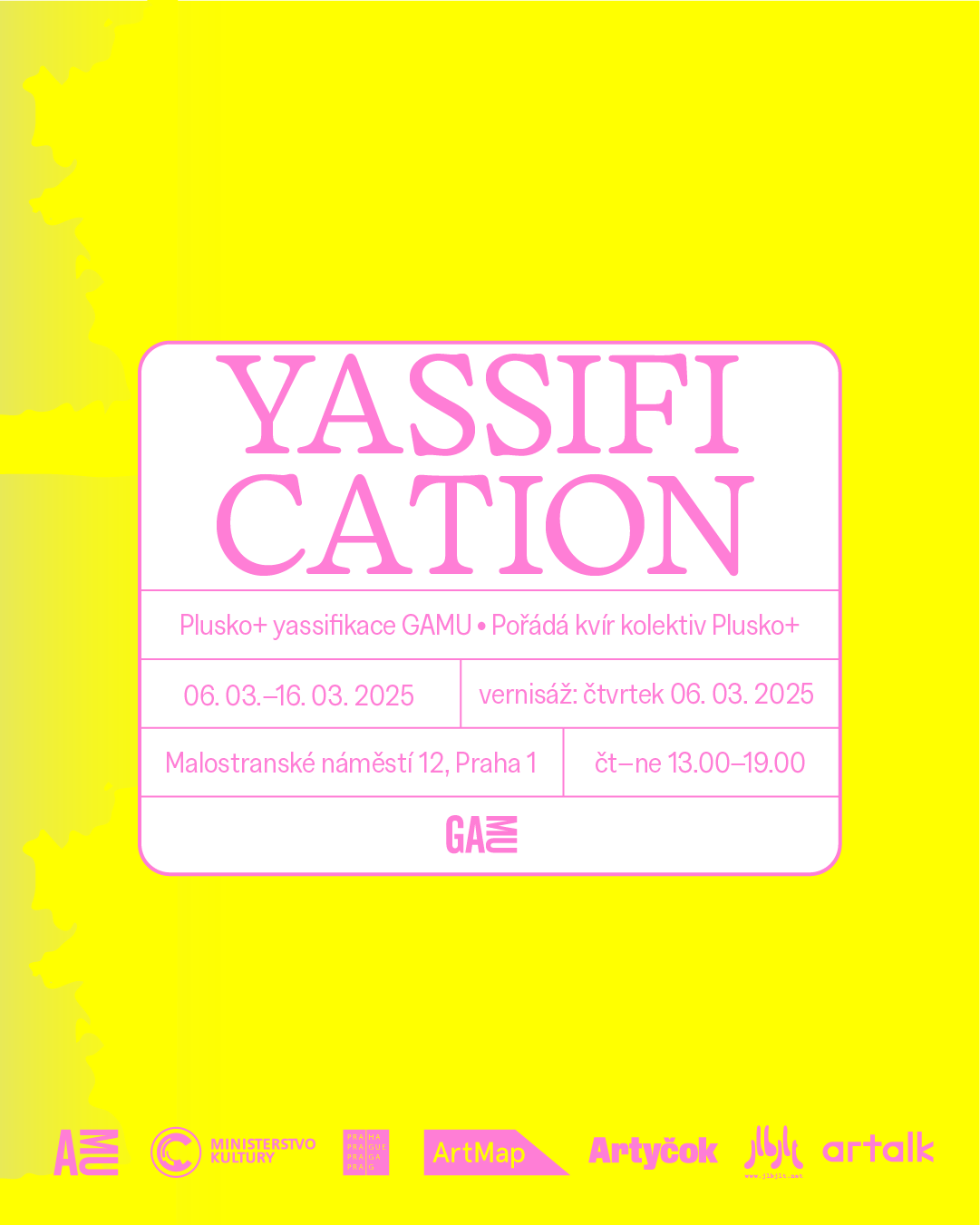
06. 03. – 16. 03. 2025 (opening: Thursday 6.3. 2025 18:00 / Open: Thu-Sun 1-7pm)

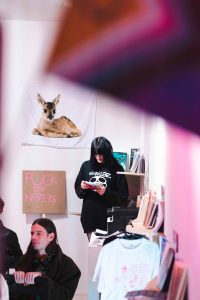
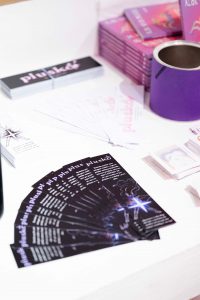
Kolektiv Plusko+, a Brno-Prague-based queer group, was born out of an urgent need for a safe place to meet regularly for all trans*, intersex, asexual, queer and bisexual people, gay and lesbian people, as well as for all those who are the “plus”, for all those who are finding themselves, and for true allies. Plusko+ strives to actively expand and strengthen the Czech queer community scene through weekly educational and caring activities organized according to D.I.Y. and free culture principles.

Accessibility information:


  • The space is wheelchair-accessible, but it may be necessary to unlock the second entrance – just ask someone present or contact us once we are at the space.
  • If not indicated otherwise, the program is usually accessible for both Czech and English speakers.
  • Entrance is free, but you can support Plusko+ collective’s activities with a voluntary donation.
  • There are gender-neutral toilets available, drinking water, ear plugs and respirators, and vegan food which will be prepared at certain phases of the program. If you feel at all sick, please use a respirator.
  • We provide quiet relaxation zones with comfortable lighting conditions for everyone. All proposals aiming to create a more comfortable space for all people present are welcome and we will do our best to make them happen.
  • Providing a safe space for everyone is Pluskolektiv+’s priority – we will not tolerate any form of queerphobia, xenophobia, racism or other forms of hatefulness. The organizers reserve the right to expel from the premises anyone who disrupts the safe space.
  • The organizers will be visibly marked. In case of any questions, please approach us personally at the space or online on our Instagram @pluskolektiv.


PROGRAM

Thursday–Sunday, 6–16 March 2025, 13.00–19.00 / GAMU, Malostranské náměstí 12, Praha 1

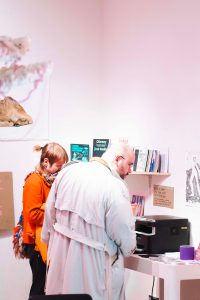
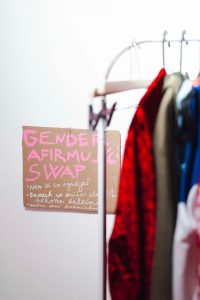
Swap circle: more than just second-hand clothes

A space for the circulation of textiles, accessories or whatever you don’t need anymore and which may bring joy to someone else. The opportunity to leave behind something you don’t need and pick up something you want. Trading is not mandatory.


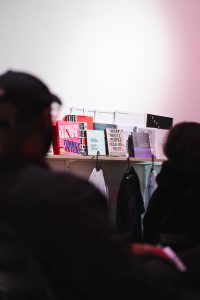
Queer library

A space for communal reading, browsing and discovering queer literature, poetry, and zines. The selection includes both theoretical and artistic publications. Facilities for copying and printing select excerpts will be available. The space also invites people to bring their own original books and share them.


Compiling collective queer archives

An interactive form of collective writing in thematic diaries. The option to leave your thoughts, feelings, and messages for other visitors.


Queer listening room

An open space for listening to both your original and others’ music, watching videos or playing video games. This open space provides the technologies for sharing diverse multimedia content.

OPENING NIGHT: QUEER SOUND, VOICE AND MUSIC

Thursday, 6 March 2025, 18.00–21.00 


18.00 – Opening remarks

18.30 – Open mic and synth voice play

An open stage for anyone who wants to present their original works, sing, recite, read a part of their favorite book… There will be a synth which will transform everyone’s voice!

20.00 – DJ set: poison ivy


CREATIVE Z!NE AND STICKER UTOPIA

Friday, 7 March, 13.00–19.00 


14.00–17.30

Linocut, Collage, Binding, DIY Stickers

As part of the Plusko+ workshop we will cut, print, glue, compose, and combine various methods of putting our thoughts to paper. All steps will be explained during the event, from the initial printing to the final binding, so no previous experience is necessary. We will create zines, diaries and stickers. Materials will be available, but if you have your own images, texts or something you would like to include in your work, definitely bring it along. You can work alone or collectively, improvise and play.


18.00 – Live online lecture – An International History of Queeruption: a free DIY radical queer gathering 1998–2010 (ENG)

From squats and their community centers to autonomous workshops – Queeruption created temporary spaces of resistance, community and celebration. Cyber Shanahoy will provide an overview of the radical history of DIY culture from the perspective of an international anarchist festival which thrived in the first decade of the 21st century.

Cyber Shanahoy is a genderqueer femme dyke, independent filmmaker and subculture nerd currently living in New York.


TO TRANSFORM IS TO SURVIVE

Saturday, 8 March, 13.00–19.00 


14.00 – The big upcycling workshop (This outfit was a mistake and that’s what makes it perfect!)

Do you have some clothes at home you no longer wear? You can breathe new life into them in our upcycling workshop. Paint it, retailor it, spray it, cut it up and make it into patches, tear it up and use it as yarn for a new sweater, color it with beet juice and use it at home as a tablecloth. Materials will be available in the space, but you are also invited to bring your own clothes and retailor them.

17.00 – Miss GAMU 2025

The first and last year of an untraditional beauty pageant – the best chance to be iconic, dramatic, or totally confused. Ideally all at once! No particular gender, age or experience required, it’s all about presence, wit and the ability to step out of your comfort zone. The categories are open, the rules fluid, but one thing is certain – the winners will make hertory and will forever have a special place in all our hearts. We invite the competitors, the audience and the jury to take part.


GAMU OVER

Sunday, 9 March, 13.00–19.00 


13.00–19.00

Playing video games, board games and card games

Playing games isn’t just about having fun – it is a way to try out new roles, create new worlds and shake up the rules. We nominate Sunday afternoon as the best time for sharing a game! Various games will be made available, but don’t hesitate to bring your own favorite one.


17.00 – Pub quiz (CZ)

Whether you are a walking library of obscure knowledge or want to try your luck, come to the Plusko+ pub quiz in the gallery. Our strict but fair moderator once said, “It’s not about winning, but taking part” – and she is always right. We invite both groups and individuals to this intellectual showdown.


18.00 – Screening of the Czech Television Show – Queer: Men in High Heels I., II. (CZ)

Czech drag in the ‘90s? A time when queer entertainment in the Czech Republic emerged from underground clubs into the spotlight. A sudden euphoria, the thrill of visibility, shock and fascination from the mainstream – followed by the inevitable disillusionment. What remained after the explosion of freedom?

The groundbreaking show Q (Queer) was unique not only for bringing queer topics to public television but also for documenting the evolution of the Czech queer scene over time. The two selected episodes dive into the world of Czech travesty and drag performance – from intimate private parties to grand stages, from improvised acts to meticulously crafted artistry.

Come watch archival footage that captures a moment when everything seemed possible – yet everything was constantly on the edge. A story of queer visibility in the Czech Republic, where glamour meets reality, applause comes with uncertainty, and sequins mix with sweat that was never quite enough for full recognition.


QUEER SCHOOL

Tuesday, 11 March, 10.00–13.00 


An open encounter with the New Media 2 studio (AVU)

What is it like studying a program where working by error is not a mistake but rather the method? Transformations in the education system are not just a question of planning for the long term – they can’t ever stop. What is it like studying art in a studio working to queer academia from the inside? What if art weren’t taught by evil, self-obsessed and sexist studio heads, but rather by the three Norns? The New Media 2 studio at the Academy of Fine Arts in Prague comes together as a community which often asks one question – how to create something which doesn’t exist yet?

The meeting is open to all who wish to sneak a peek, join in, pose a question or just stay a while.


HER QUEER STORIES

Thursday, 13 March, 13.00–21.00 


14.00 – Workshop: How to write a speech for a demonstration

“Your silence will not protect you.” (Audre Lorde)

How to write so that the words don’t dry on the page, but touch the bodies and the street, and spur people to action? How to write in a language which does not parrot the language of power structures, but rather disrupts them? This workshop is an invitation to find one’s voice which needn’t be loud to be heard – a voice that works with rhythm, silence, and emphasis. A writing which isn’t just words but also gestures, emotions, memories, and intention.


16.00 – Book club

What book should get more recognition? The book club provides opportunity to share your favorite texts, read an excerpt, show an illustration or just listen and discover new authors, theories and stories.


19.00 – Intersectional Circle

The Intersectional Circle is a collective platform which connects queer and feminist thinking with social praxis. It develops from the tradition of reading circles where theoretical texts are not considered closed system but rather as food for discussion and critical reflection. Through shared reading and analysis, we ask how theories relate to real experiences, how they form our world view and how they can be developed into tools of change. This time, the Intersectional Circle will discuss the text Community Care and Relationship-Building, available online on the Cosmic Anarchy Substack, and feature a shared discussion. Dr. Ayesha Khan, scientist, activist, and author, explores community care in a clear and accessible way, presenting it as a key tool for building sustainable relationships and breaking free from the individualistic, capitalist mindset that shapes society.

Familiarity with the text is not mandatory but recommended.


SLEEPOVER: WARM AND TIRED

Friday, 14 March, 13.00 – overnight! 


14.00–17.00

Crocheting stim toys

Come crochet something soft, squishy and soothing! Together, we will create stim toys which will please the hands and soul. All levels of experience are welcomed.


17.00 – Tea and gossip (about the cistem)

Living in the cistem means constantly being confronted with a hostile, often unbearable, reality. The exhaustion of living in constant defense mode is not a side effect, but a targeted mechanism of oppression.

Come relax to a place where you can share your thoughts and even mix your own custom-made tea infusion to give you warmth and strength.

18.00 – Evening yoga session

We invite you to a peaceful yoga session with Innes and Jula where you can stretch your body and relax your mind. Come relax, get in tune with yourself and get energized!

Yoga mats are a plus.

19.00 – Cooking and shared dinner

21.00 – Premiere of the film Ranní ptáče dál nedoskáče (The Morning Bird Does Not Get the Worm)

Two people who have been close in the past but have drifted apart meet again in waking life and in dreams. The performance society has driven them apart and one of them has fallen prey to the late-capitalist world. The other person embodies the metaphor of a dream and wants them to become close again. A manifesto about sleep and the existential sense of the pervasive and often absurd “time hunting” which robs us of our relaxation time.

22.00 – Ambient set: M.K.

The ambient tracks from M.K.’s original album Usínání v ambientu (Ambient Sleep) are like sound essays unbounded by any firm limits of reality. They combine field recording, synthesizers and sound destruction.

22.00 – Sleepover

Shared sleepover at the gallery on World Sleep Day. All you need is a sleeping bag, a sleeping mat and some comfortable clothes.


YASSIFICATION OF GAMU

Saturday, 15 March, 9.30–19.00 


9.30 – Morning meditation with Chapell Moan

Like Chapell Roan, only penniless and ‘ezo.’ She just wants everyone to feel HOT TO GO! The amazing and luscious diva Chapell Moan will walk us through the morning ritual which will cuddle and coddle our body and soul. Getting up on time has never been this sexy.


10.30 – How to make breakfast

Also under the guidance of Chapell Moan, who will be particularly generous this time. Bread and marmeslayed or perhaps some vegan eggs-travagance? She will definitely serve the best on the menu.

12.00 – Drag, make-up and fashion corner

Time to glam! We will glam up, make-up, dress up, make costumes and transform into our most decorative selves.

14.00 –

Sunbathing at Petřín

See and be seen. Spring is coming and we are taking it to the streets again. As the most beautiful flowers, we grow through the soil and need some of that sweet vitamin D. Join us for a very short walk and sunbathing at Petřín with the best-dressed group ever.

16.00–19.00

Queer prom! Karaoke and day rave

Dress code: evening gowns and fancy footwear. This ball is for dancing and singing, and you can still come home early and sleep! Fun will be served by DJs California Bitch and Angelo+Eizola. A day rave for all those who want to turn in nice and early.


PLUSKO+ CENTER: IT’S HAPPENING!

Sunday, 16 March, 13.00–19.00 


14.00 – Sharing skills and knowledge

DIY: do it yourself! The event offers an open space for the non-hierarchical sharing of knowledge, offering a workshop, a lecture, and discussion on any chosen topic. Expect to see skills both special and completely mundane, academic insight, art experiments, and methods for resisting the pressure of the system. Take part in the organization, join the discussion or just let yourself be inspired by what happens. If you have any questions on the topic, don’t hesitate to contact us on our social networks.


Thanks!

Galerie AMU for the space, production, and financial support.

Vít Bohal for the translation.

Žofia Fodorová a Šimon Vlasák for the graphic design of the event.

Ondřej Konrád for technical support.

Photos: Eliška Klimešová
Galerie Světova 1 for lending us titles for the queer library.

All the performers, artists and communities, and all those supporting the activities of Plusko collective.


NO ONE IS FREE, UNLESS WE ARE ALL FREE

Pluskolektiv+

www.pluskolektiv.cz

@pluskolektiv

16. 1. – 23. 1. 2025 (opening: 15.1. 2025 / 18:00)

Jan Cestr, Sára Hacherová, Vivien Hamzová, Marika Hradilová, Anna Ilenko, Natalie Kubenková, Kristýna Miková, Linda Senzjuková, Tobiáš Suchánek, Maya Terkawi, Huyen Trang Do, Soleil Quilago Barragán García, Ieva Bernatonyte, Jazmin Alejandra Gonzalez Ayala, Qiyu Li, Anna Dedecek, Aleksandra Natalia Rajek, Yifan Yan, Feiyun Zhao, James  Dagevos, Laura d`Assche, Natálie Hájková
Exhibition of semestral works of the 1st years students of Studio of Classic Photography. Exhibition set “Transience in Photography” and outputs from the long-term project “Soutok”, exploring the urban landscape.

16. 1. – 21. 1. 2024 (opening: 15. 1. 2024 v 6pm)

Exhibition of semestral works of the 1st years students of Studio of Classic Photography and outputs from the long-term project Soutok, exploring the urban landscape.

authors:

Barbora Nosková, Ema Mihálová, Filip Doležal, Adéla Geierová, Jan Liška, Krylou Dzianis, Anna Smutná, Eliška Suchá, Rosalie Tomková, Viktória Weiszová, Feiyun Zhao, Kuba Nowak Mikolaj, Katarzyna Serwatka, Antoni Wojciech Swark, Jsoue Aguiniga Valadez, Ashir Singh, Lucie Hradecká, Natálie Hájková, Sabina Můráňová, Michaela Stehlíková, Barbora Vyhnálová
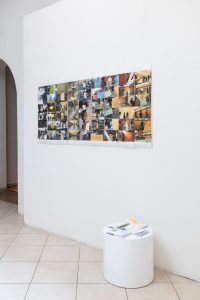
14. 4. - 20. 5. 2023 (opening: 13. 04. 2023 from 6pm )

Louisa Havránková, Ava Holtzman, Eliška Klimešová, Adam Rolex, Tereza Šimoníková, Jakub Tulinger, Šimon Varaus

curated by: Jiří Ptáček

graphic design: Magdalena Konečná, Šimon Vlasák, Pavla Nečásková, Žofia Fedorová
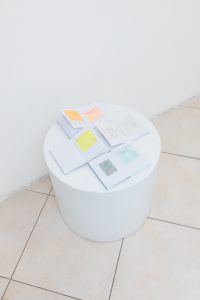
In geology, the term drunken forest refers to vegetation growth growing on a slowly slumping hillside. The tree trunks grow in all sorts of crooked ways and the forest looks disorganized. For geologists, this signals that the bedrock is moving. In the exhibition’s title, where students from the studios of the FAMU Department of Photography in Prague will meet, the drunken forest refers to the instability of the conditions in which these young people grow up and to artistic creation as repeated attempts to maintain balance. Through their works, however, the exhibition also points out how the tool we generically call photography and its department; reacts to these movements

closing and guided tour: 19. 5. at 6pm

till 31.5.2023

Call for projects

AMU Gallery hereby announces an open call for exhibition projects to complement the gallery’s program for 2023.

The call is intended for both Czech and foreign artists and curators; applications may be sent both in Czech and in English. Due to the wide spectrum of subjects taught at AMU (The Academy of Performing Arts in Prague) we prefer thematic, curatorial exhibition projects with interdisciplinary overlap, or exhibitions based around artistic research (especially in the field of photography and new media).


The duration of exhibitions in GAMU span from three to six weeks.

Required application materials:

  • a detailed description of the project, including visual documentation which takes into account the gallery’s spatial dimensions (max. three standard pages of text)
  • a structured CV/bio of the applicant
  • brief CVs/bios of the exhibited artists, including a showcase of their work/links to online portfolio
  • the exhibition’s budget with proposed additional sources of funding

The projects can be registered electronically until the 31th of May, 2023 at veronika.danhelova@famu.cz

The AMU Gallery provides:

  • oversight at the exhibition
  • technical support
  • graphic processing and printing of accompanying materials (invitations, posters, banners)
  • basic PR
  • opening night (vernissage)
  • some of the production costs (material, installation, de-installation), depending on the gallery’s budget for the given year

The gallery’s blueprint and photo documentation of the exhibition space can be found here

Contact person:

Veronika Daňhelová | veronika.dahelova@famu.cz | +420 603 425 057
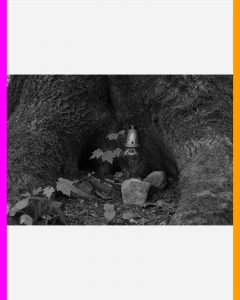
17. 2. – 25. 3. 2023 (opening: 16.2.2023)

Aika Akhmetova, Ella CB, Sarah Dubná, Natasja Loutchko, SPIT (Marta Orlando, Clémentine Roy, Natasja Loutchko), Hana Garová, Mary Neely and Mika Bar-On Nesher

curated by: Natálie Kubíková
Each approach is represented in the exhibition as an intimate observational tool with which to collectively consider the concept of queerness within constructs such as family, friendships, relationships and other social interactions. Issues of family, neighborhood or cultural stereotypes are presented in a group exhibition of international female and non-binary authors. The works on display focus on artistic practices without explicitly recognizing contemporary queer culture and refer to more intimate levels of communication and transmission of information, resistance or background. The exhibition refers predominantly to the more intimate level of depicting female homosexual narratives and addresses the eclipse of lesbian presence in the collective imagination.

Opening: čt 16. 2. 2023 od 18:00

Opening hours:
thu – sat 1pm – 7pm

7. 2. – 9. 2. 13:00–19:00 (opening: 6. 2. v 19.00)

Tomáš Rampula, Gabriela Palijová, Martin Dušek, Žil Julie Vostálová, Tereza Chudáčková, Eva Rotreklová, Viktorie Štěpánová, Eliška Lubojatzká, Karolina Hnětkovská, Jáchym Ozuna, Klára Kacířová, Lucie Myslíková, Matěj Martinec, Tara Šelířová, David Šourek, Jonáš Balcar, Nea Cindr, Adam Kácha, Michaela Kozáková, Veronika Poslední

Foto: Martin Blažíček

17. – 27. 1. 2023 (opening: 16.1. v 19:00)

Adam Mička, Lucie Hradecká, Varvara Gorbunova, Tianning Deng, Ashir Singh, Andrea Olsen, Kaczmarczyk Zofia, Zuzanna Bielecka, Wiktor Robert Marcinkowski, Mercer Breitenbach, Irma Brifordová, Černická Anna, Havránková Louisa, Krisztina Kocsis, Vojtěch Kůrka, Lucie Sasínová, Tereza Šimoníková, Barbora Švejnochová, Selinšek Maja, Aleks Herc, Helen Mountaniol, Maria Elisa Koskivirta
10. – 13.1. 2023 (opening: 9.1. v 18.00 )

Michael Lozano, Jakub Prašivka, Jonathan-Antonín Machander, Raphael Taterka,Tatiana Lvovská, Radim Hořelka, Lisa Philippon, Yutong Xie, Quoc Vinh Tran, Jakub Tulinger, Sarah Kidder, Swati Indeera Parwani

The Studio of Documentary Photography offers a short-term yet unique opportunity to peer into the minds of those sensitive to the world around them – whether that’s gender inequality, climatically arrogant grand gestures on Kralický Sněžník, the Vietnamese community’s view of life as grocers, American wrestling culture, the garden and community of one’s home, creatures awaiting their army-style book, responses to the meaning of art, images cultivated with yeast, a dialogue between two Indian women over the cultural erasure of their identities, the bent backs of people hypnotized by their phone screens, the happiness and safety of one valley in China’s Xinjiang province, or the inherent hierarchies in public spaces such as Bohnice’s psychiatric hospital. We don’t have to scream to be heard, so now we whisper — You won’t see this anywhere else.