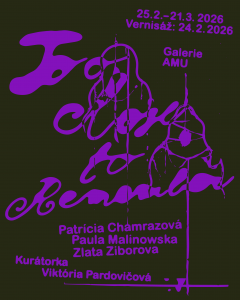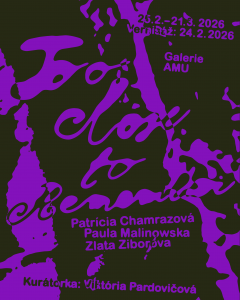
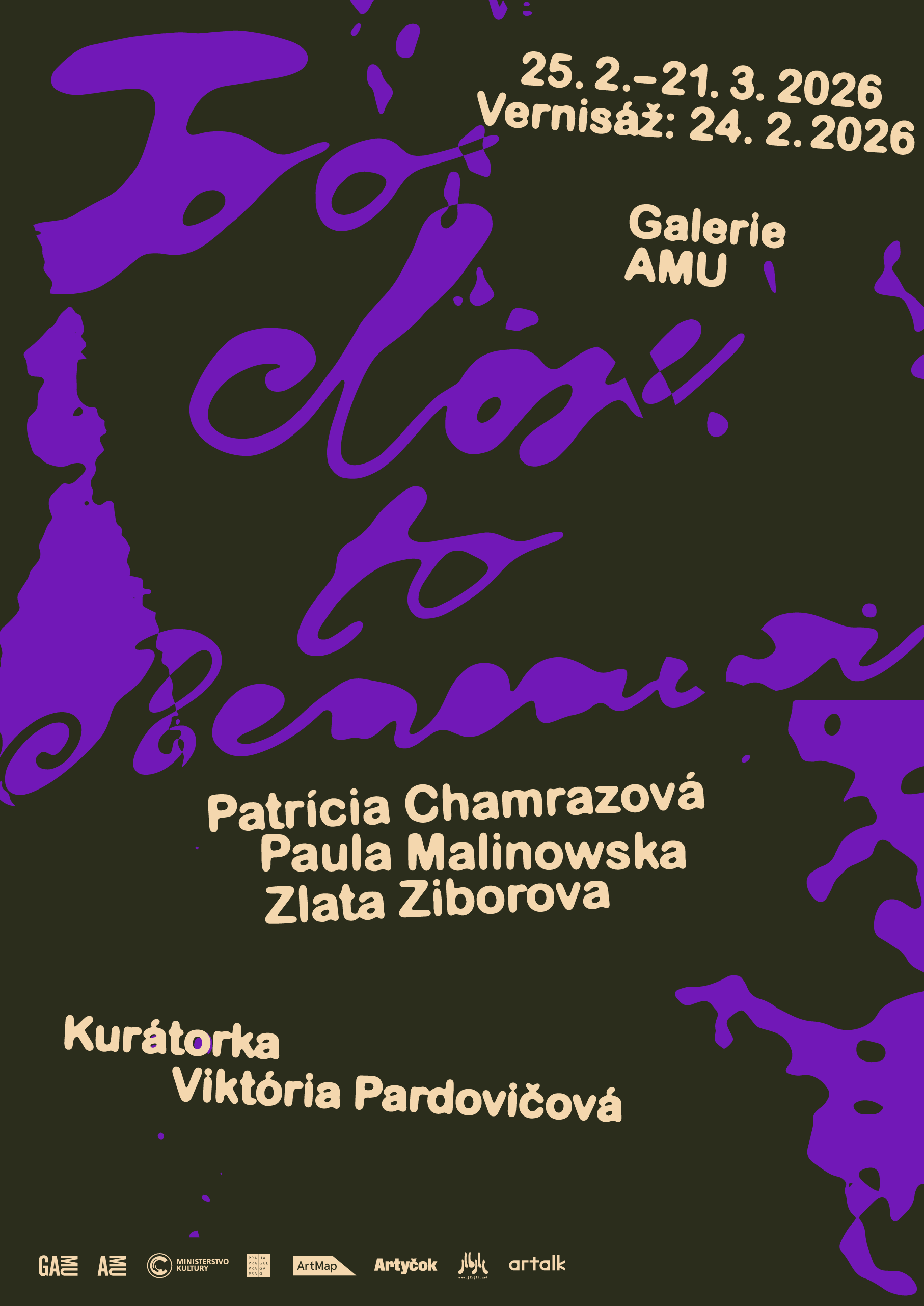
25. 2. – 21. 3. 2026 (opening: 24. 2. 2026, 18:00)
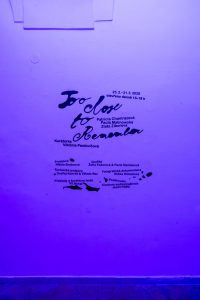
Patrícia Chamrazová, Paula Malinowska, Zlata Ziborova
translations and text editing: Vít Bohal
Acknowledgement: Center for Audiovisual Studies FAMU
Opening hours: Wednesday – Saturday 13:00 – 19:00
11. 3. 2026, 17:00 FAMU Guest Talks: Paula Malinowska / FAMU U1, Smetanovo nábř. 2, Praha 1
20. 3. 2026, 17:00 Giuded tour and finissage Facebook event
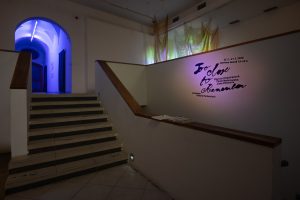
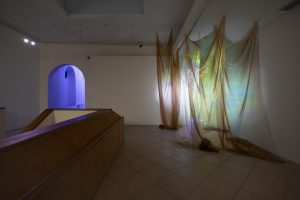
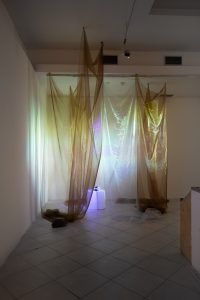
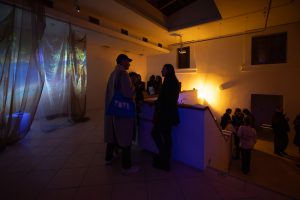
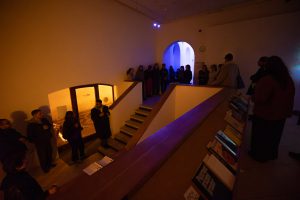
The exhibition explores the theme of synaesthesis – i.e. a reaction of the body and mind and an experience that melds the sensory modalities of diverse entities existing in the digital, posthuman and technological environments. The project develops the discourse on various approaches to perception, especially in reference to the crisis of authenticity of human sensory perception that finds itself under pressure from contemporary power structures, surveillance and production. It builds on the ideas of Maurice Merleau-Ponty who writes in his work Phenomenology of Perception that synesthesia offers proof that our perception is not formed by separate senses, but that it rather appears through their dialog and comprises the dynamic interaction of the whole body with its environment – i.e. reality. The exhibition does not aim to literally interpret approaches to neurological processes and their modifications. It rather becomes a situation, an opportunity for observation and encounter. The installations of the three featured artists aims to expand the frameworks of accepted alternatives and explores the often forcibly suppressed natural experiences of our sensory activity.
Moments that needn’t relate to particular situations describable in language, moments that have left an impression, emotion, an imprint in the mind, body, air. They seem too close while at the same time receding, becoming alienated, censored and purposefully reduced – it is important to be available, online and “up-to-date”. Do we allow ourselves to arrive somewhere between skin and mind, memory and dream, nostalgia and touch? Somewhere within the ecosystems of technologies, organic communities, bodies and intimacy that connect within the exhibition’s space-time, its situations and conversations? Microworlds that allow us to pause, lose ourselves among the memories which needn’t be positive or even human, memories that engage the contrasts between every-day life and imagination – all of them are relevant. Whether here and there, last Friday or at this very moment.
Amid the ongoing situations, processes and problems of crises, we find interweaving relationships dependent on social networks, the precarization of time, the private sphere, emotions and health. The rhythm of everyday living has become structured around pressures often connected to the drive for success, recognition or work productivity. This rhythm has furthermore converged into the toxic layers of virtual platforms. These platforms are also reminding us – often depending on our level of tolerance – that things are bad all over: self-monetization, climate grief, armed conflict and political practices that generate degradation and the spread of disinformation.
What happens to the memory of human senses and their receptors in an age when permanent simultaneity has become the norm, and to what degree are they still able to function properly? Who do we become when we lose control of the evolutionary patterns of our mind, emotions and senses in a society based around ceaseless production? These questions may be considered irrelevant and banal in the context of the catastrophes of armed conflict and many others; but aren’t our perceptions or psyches even more vulnerable during times of crisis than our physical corps, our skin and bodies? These (in)visible places hold promise, but they are also at risk in an era when the human race may be approaching a moment of global and long-term paralysis.
Synesthesia is a term derived from the Greek expression syn- = connection and aesthesis = feeling. From the neurological perspective, it can be understood as a process in which a stimulus of particular sense organs produces emotions or percepts for other sense organs. In this sense, we can consider the contemporary multi-sensorial perception and constant production of interactions (mediated by ubiquitous digitality) to be a state of oversaturation. Such oversaturation becomes a burden and can lead to gradual stagnation and disorientation. Franco Bifo Berardi speaks about a “sensorial regime” in which our perceptions are connected to technologically mediated stimuli and our addiction to them also assumes colonization by economic interests.
The mesh of stimuli in which senses are forced to operate as an interconnected system of mediated stimuli is interwoven with both dystopian and utopian states, and speaks about the occasional voluntary loss of existence in the present. The authenticity of these moments depends on our individual situation, endurance and ability to accept their problematic layers. They require constant evaluation of their potential pathology and mechanisms of control; yet they have at the same time become absurd and naturalized. We can mention here the ontological frame of Rosi Braidotti who references the contemporary reconfiguration of sensory existence: from this perspective, we can understand synesthesia as a basic and natural characteristic of posthuman perception in which the senses do not operate separately but rather as an interconnected field of affective, technological and environmental relationships.
The exhibition expands, interweaves and challenges human perception and ponders the sensing ability of diverse entities that harbor potential for facilitating alternatives and a more sustainable and shared existence. Despite their synthetic and speculative, or – on the other hand – overtly natural and non-conforming origins, appearance and behavior, these organisms index the value of layered sensory experience and existence that often get lost in contemporary approaches to synaesthesis – i.e. the melding of perception but also of our activity and emotions. They turn into a state of awe – anesthesia, the loss of human sensitivity in the drive to resistance. Alternately, this situation opens onto a perspective that accepts multisensorial experience and the undervalued characteristics of inhuman lives as a reality that merits not only critical reflection but also the search for methods of understanding. The three installations provide a close encounter – they offer images of interspecies co-existence and sensitivity that beg discussion about the possibilities of overcoming the hierarchical system of contemporary power structures and self-destructive modes of human-controlled experience.
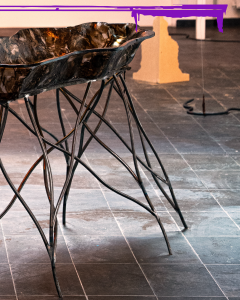
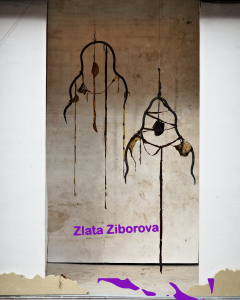
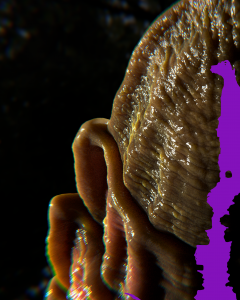
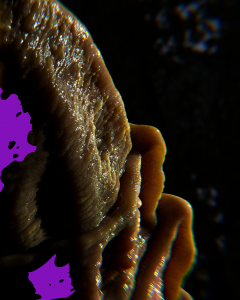
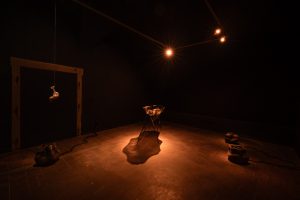
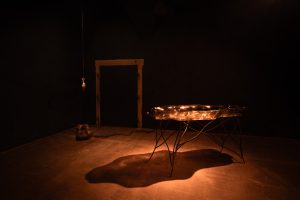
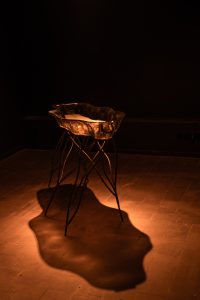
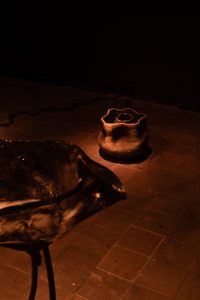
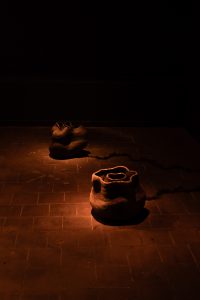
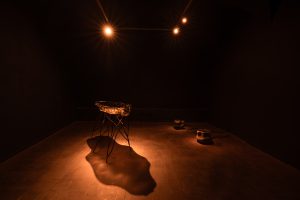
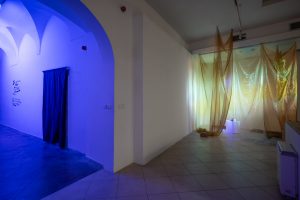
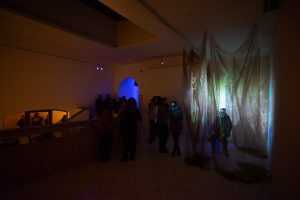
The environment created by Zlata Ziborova builds on her graduate project CorpUs SCOBY that engages the entities of bacterial cellulose (created during kombucha fermentation) and other organic waste within an intermedial situation. The artist works with the participative and symbiotic aspects of inhuman life; these become co-actors in her work and the protagonists of new relationships. The glass object and ceramic sonic vessels represent a womb – a place for life and growth of beings that are best poised to test multi-sensorial sensitivity and the degree of acceptance of their non-conformity. Live bacteria reference the human microbiome that undergoes changes and challenges, as well as faces threats. This creates a dialog and partnership that facilitates the co-existence of human microbial life that must navigate compromise in its striving towards cooperation.
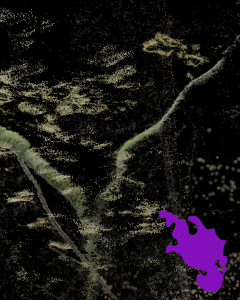
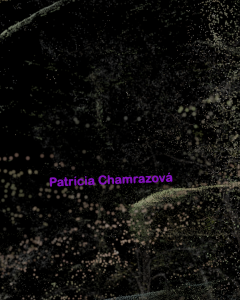
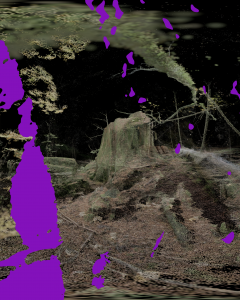
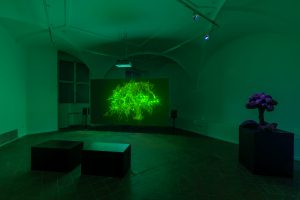
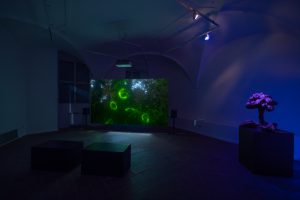
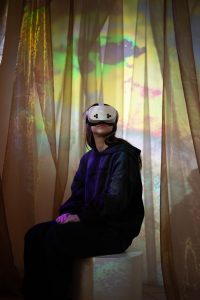
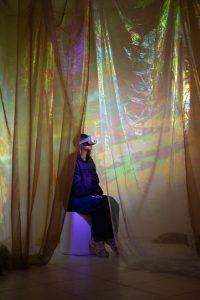
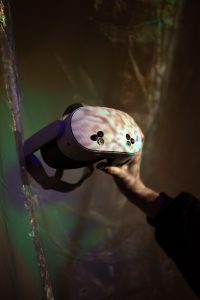
The digital layer titled Permeable Becoming presents an immersive experience in virtual reality where Patrícia Chamrazová works with the (im)possibility of empathy and understanding of inhuman entities. The narrative of the video references research on the most primordial records of life on Earth and takes us through the geological, biological and temporal layers that at first exhibit visual poetics and harmonic moments, while in the second part they lead to absolute loss of control. The fiction is based on fragments of known biological environments and develops ideas that challenge human domination and explore the need for the reconfiguration of anthropocentric structures. The artist strives to transform human sensory experience and uses the example of micro-organisms to show the potential of a newly discovered interspecies sensitivity.
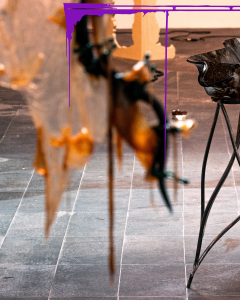
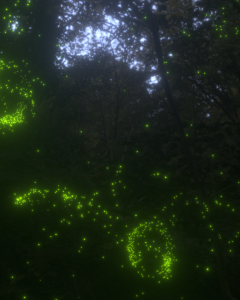
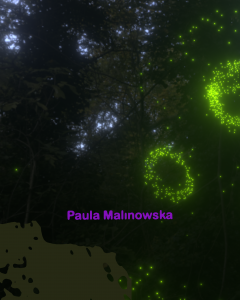
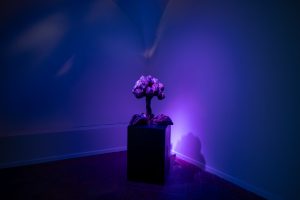
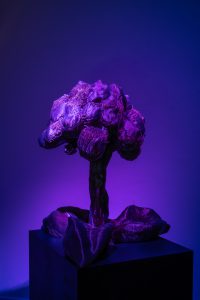
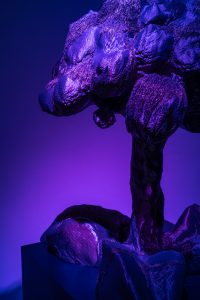
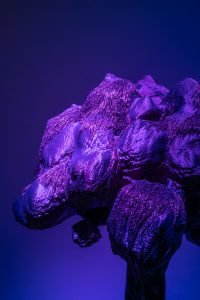
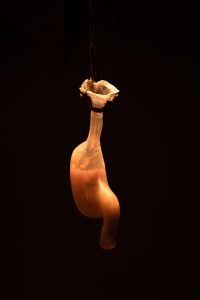
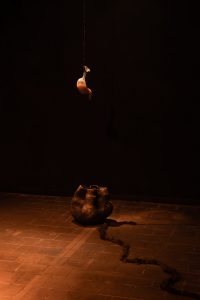
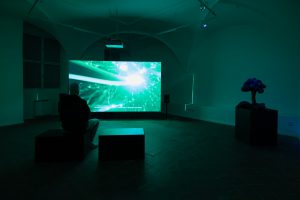
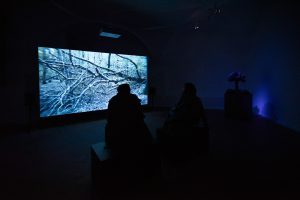
The exhibition’s third part shows the film Vetviace sa svetlo a záblesky úsvitu (Branching Light and the Flickers of a Dawn) and the object from the series (Non)Botanical Bestiary. Paula Malinowska processes findings and data from scientific research and speculative fiction to present a story of a fly and a firefly. The perception of light and the reception of movement and relationships with animals whose sensory abilities remain a mystery to people offer basis for a narrative that challenges the potential of science and offers alternative scenarios that disrupt human rationality. The installation communicates with the large-format sculpture of a hybrid entity. Its corporeality in the form of a 3D print develops from botanical naturality – a study of an ivy berry – and original handiwork, opening space for dialogue about the authenticity of perception, the symbolism of a vegetal being’s resilience, as well as aspects of collaboration between artificial and organic structures and bodies.
Patrícia Chamrazová
Patrícia Chamrazová focuses on contemporary ecological issues, accelerating technological development and interspecies forms of receptivity. She works with digital media, holding a degree in transmedia from the University of Applied Arts in Vienna and in intermedia from the Academy of Fine Arts in Bratislava, where she is currently pursuing her doctoral studies in the Department of Digital Arts. Her practice uses the fluidity of artistic media; her work includes audiovisual installations with XR elements that she often expands with textual expressions and objects. She works on the border between the abstract and the organic, the conceptual and the intuitive, between science and metaphysics. Her approach is characterized by immersivity and a subtle digital aesthetic aiming at transformation, both in the physical as well as the digital spheres. She draws inspiration from posthumanist philosophy, microbiology and the study of new technologies. Her works have been part of exhibitions such as Sensing the In-Between (Šopa Gallery, Košice, SK, 2025), Leaving Traces (Vektor VR Section at Verzió Film festival, Budapest, HU, 2025) or Resensing – Beyond Symbiosis (Vašulka Kitchen Brno, CZ, 2024) and others. She has completed residencies at Foreign Objekt – Posthuman symposium (online, 2024), Kair rezidencia (Košice, SK, 2024) and Feral Artists in Residence at Schmiede (Hallein, AT, 2023).
Paula Malinowska
Paula Malinowska is a digital media artist and photographer. She graduated from the Department of Intermedia at the Academy of Fine Arts in Bratislava where she currently works, and is also a doctoral student at the Department of Digital Arts. Her artistic practice includes CGI audiovisual works, 3D printing techniques and photography that she further develops into multimedia installations. Her research is based on studies in the fields of biology, climatology and the development of digital technologies, which she connects with elements of speculative fiction and fantasy. She often focuses on the life cycles of beings (organisms) that provide inspiration for the creation of stories transcending the hierarchies established by human society and offering alternative perspectives on the possibilities of empathetic relationships and communication. Her work has been presented at many exhibitions, including More Than Human (Light Art Museum, Budapest, HU, 2025), Sentience (Voloshyn Gallery, Miami, Florida, US, 2024), Whoever settles in a perfect home will have to move (GLASSBOX, Paris, FR, 2023), and others. She has completed residencies at MuseumsQuartier in Vienna (2023), Residency Unlimited in New York (2024), and Plato Gallery in Ostrava (2025).
Zlata Ziborova
Zlata Ziborova builds on her research into substances and raw materials of organic origin that appear in everyday life or are often considered waste. In 2024, she graduated from the Academy of Fine Arts in the New Media 2 studio and currently works in Prague. Her intermedia projects often address bodily materials such as hair or blood that she further transforms, creating poetic reflections on the relationships between corporeality, intimacy and artistic production. She works with organic waste and develops collaboration with entities such as bacteria, yeast and other organisms. She is interested in ecofeminist theory, interspecies relations and topics of production and sustainability. Since 2021, she has been working on the project My Body Is a Factory, where she strives to reuse and work with the productions of her own body. Working with corporeal substances and the more-than-human world, she uses media such as photography, video, participatory performance and object creation while emphasizing the need for sensitivity towards interspecies communities. Her exhibition projects include Feastopia (Industra Art Gallery, Brno, 2025), The Polymorphs Between Us (Světova 1, Prague, 2024) and Spheres of Intimacy (Pragovka Gallery, Prague, 2023). She has completed residencies at the Fundacja Inicjatyw Kulturalnych Potok in Poland (2025), Brno Artist in Residence at the Brno House of Arts (2025), Macro-biotopes in Bihać in Bosnia and Herzegovina (2024) and others.