27 March – 25 April 2026 (opening: 26 March 2026, 6PM)
curated by: Tereza Rudolf
exhibition architecture: Space for Relational Research
graphic design: Pavla Nečásková & Žofia Fodorová

Opening hours: WED – SAT 1–7PM
Guided tour: 23. 4., 5 PM
Monologue Texts: Klára Vlasáková
Graphic design: Pavla Nečásková & Žofia Fodorová
Translation: Vít Bohal
Acknowledgments: Miroslav Pazdera, Jonáš Richter
Despite mechanization, human work remains an integral factor in the smoothness and friction of all logistical movement.
The imprint of working bodies and their contact with the spaces of transshipment halls. Traces left in the system of moving goods. Repeating sequences and the order that hopelessly tries to push out all remaining chaos. These are some of the examples of themes addressed in the (not only) photographic works of Jan Kolský (CZ) who is currently working in tandem with the architectural project Space for Relational Research (DE).
Moving Parts
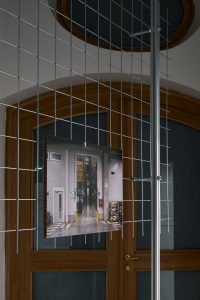
In Kolský’s photographs, the slowly rolling mass of consumer goods hidden inside cardboard boxes seems like a river full of ice floes. The ice breaks and glides on the surface, but in the critical places – bottlenecks and turns – the floes start bunching and jamming. One slides on top of the others, barring the flow and spilling onto the banks. Only warm weather dissolves this cold jam and releases the water’s current once more. But in logistic halls, such situations cannot wait for spring to come. The movement of packages must be smooth, constantly maintained and cared for by human hands. Despite mechanization, human work remains an integral factor in the smoothness and friction of all logistical movement.
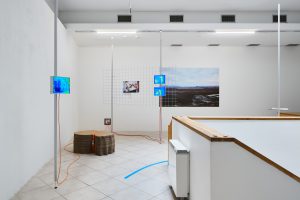
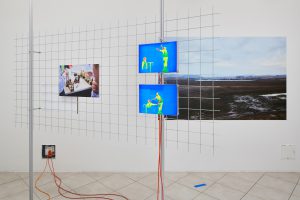
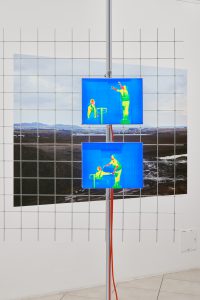
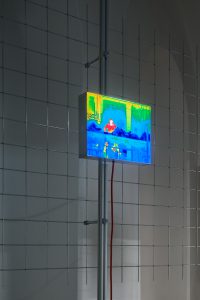
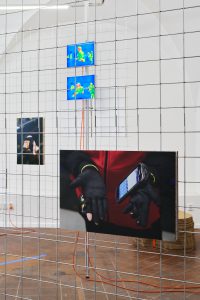
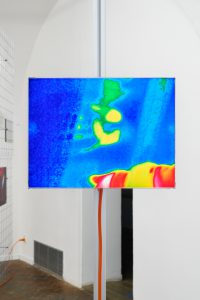
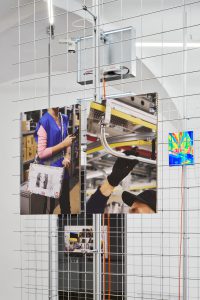
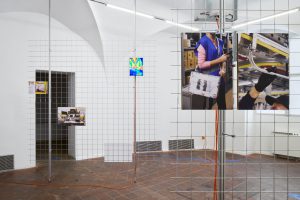
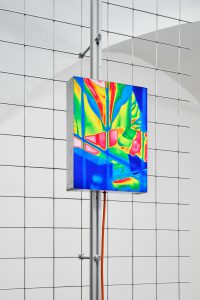
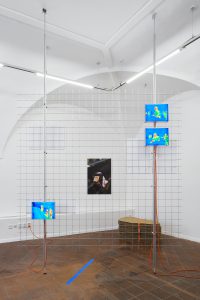
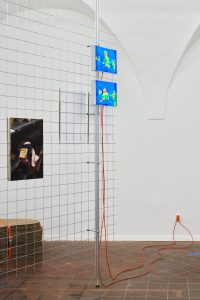
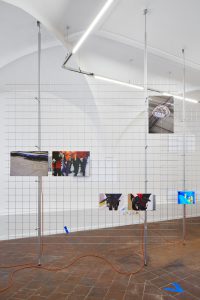
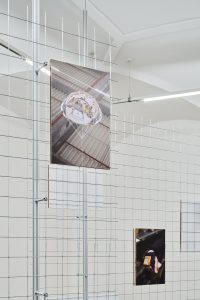
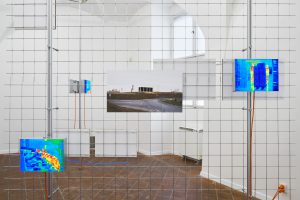
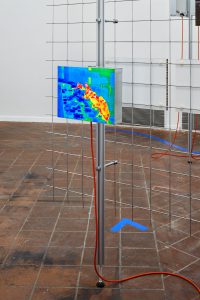
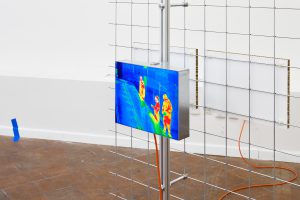
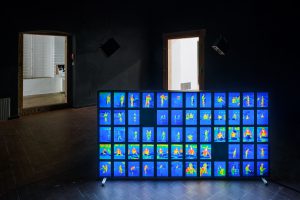
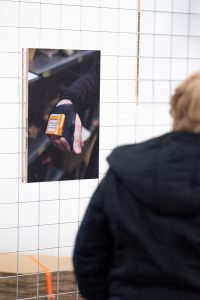
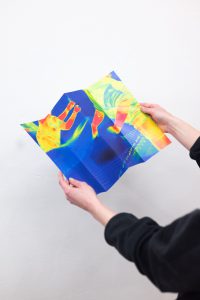
Logistic halls comprise critical nodes in logistics infrastructure, and they have become the focus of Jan Kolský’s work of the past years. Due to the constant surveillance to which the workers in the halls are subjected, it is not easy to take photographs or make any other documentary records within the operational spaces. But thermal imaging is standardly used in the halls as a means for the timely identification of potential malfunctions of the mechanical parts and conveyor belts. From the system’s perspective, the recording of thermographic records is an often used and less dangerous method for observing its own bowels. But instead of the overheating technical parts of the machine, Jan Kolský rather focuses on the heat emanating from human employees. Their repetitive gestures and attempts at guiding the cold mass of variously laden boxes in the right direction leave imprints on the cardboard. Photographs and thermographic images taken by Kolský in the shipment halls do not follow the movement of human bodies in a hostile environment but rather aim to record the proof their past presence. The touch of their hand, usually hidden from view, in fact remains on the cold surfaces and provides a homeopathic dose of tenderness in the otherwise maximally automated flow of goods being shipped from producer to consumer.
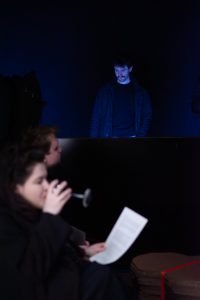
The exhibition presents only a fragment of Kolský’s overall oeuvre and focuses on documenting logistics halls, training rooms for new employees as well as a logistics trade fair. It does not include any views of the exterior. The massive blue boxes embedded into former fields completely silence the stories taking place within them. Allan Sekula, the American documentary photographer and theorist whose iconic work Fish Story (1996) followed the movement of transport containers, their shipments across the seas and the impacts of logistics chains on diverse places, has framed particularly important questions: “How do governments – and the actors who speak for governments – move cargo? How do they do it without stories being told by those who do the work? Could the desire for the fully automated movement of goods also be a desire for silence, for the tyranny of a single anecdote?” (Allan Sekula, Fish Story, p. 32, Richter Verlag, 2002). The view of the logistics hall from the outside provides us with just a single story: goods and the work force move in and out. In order to disrupt this singularity, Kolský uses the exhibition to platform narratives based on personal interviews with the employees of various operations, here loosely developed by writer and dramatist Klára Vlasáková. We hear the amplified voice of the soft and warm parts of an otherwise angular and cold system.
The ergonomization of spaces intended for the movement of packages thus converges towards the formulation of a singular being possessing all adequate characteristics and dimensions: an ideal being that is bald, without internal fluids, has a very stable posture, great strength in its strong arms and a clear, audible voice, one able to move quickly and safely between individual stations. The current work force is too human, too diverse. What is worse, it injects chaos into the smoothly revolving gears through variously bricolaging its work uniforms and protection gear, through its coughing or stuttering during the voice picking process, fatigue, emotions and occasional injuries.
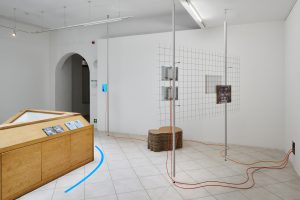
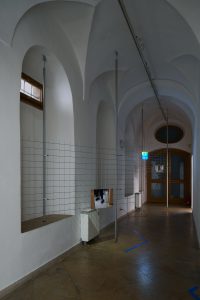
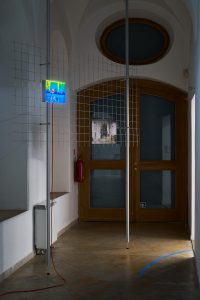
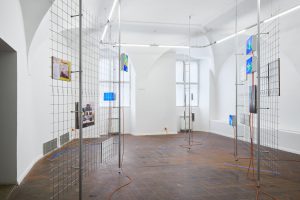
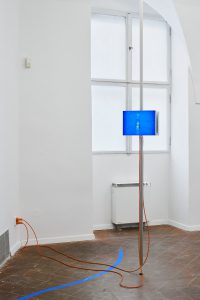
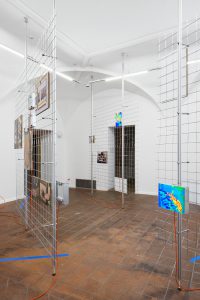
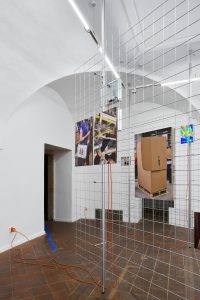
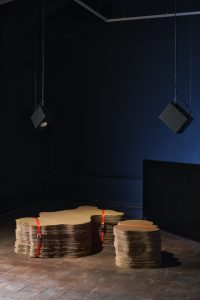
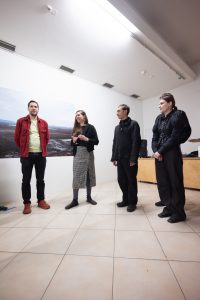
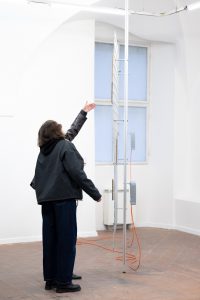
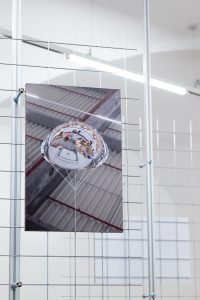
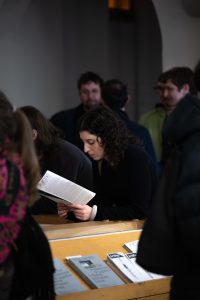
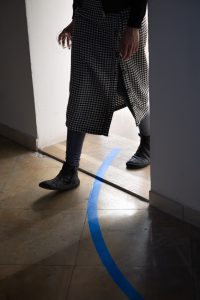
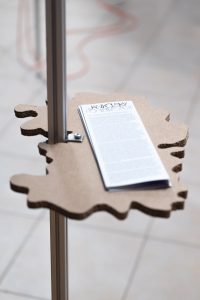
The relationships that are followed in the space of the logistics halls and subsequently translated into the spaces of the gallery led Kolský to approach the Berlin-based collective Space for Relational Research. Barbara Herschel, Kaspar Jamme, Felix Künkel and Justus Schweer use architecture in their work to aestheticize, politicize and transform spatial relations and established orders. The exhibition’s spatial solution relates to logistical halls as well as to relationships that take place within them. It is restrictive and instructive, tries to model the visitors’ movement and emphasize certain key moments of Jan Kolský’s work.
Jan Kolský is a Czech photographer focusing on the documentation of artistic projects and architecture. Apart from his professional practice, he also works on artistic projects exploring the overlaps between artificially created environments, work and technologies. Kolský graduated from the Academy of Arts, Architecture and Design in Prague with a project titled Here There Be Workers (2019) that was subsequently exhibited in the Fotograf gallery. The project focused on the organized employment of people within the grey zones of global digital network infrastructures as well as the topic of human work in automated systems. Kolský has been a long-term member of a collective research project focusing on the life and work of Ester Krumbachová that culminated in the exhibition Ester Krumbachová: Yeti – Wear the Amulet – Tangle Up the Archive (Tranzitdisplay, Prague, 2017) and the publication of an original book titled Green Fox Street. He was also member of the Extrasensory-Aesthetics Research Working Group that focused on the history and practice of Czech psychotronics in the 1970s and 1980s and was featured in 2020 as part of the Jindřich Chalupecký Award.
The project Moving Parts was realized by Jan Kolský in 2019 when it was initiated as part of the book Steel Cities: The Architecture of Logistics in Central and Eastern Europe (ed. Kateřina Frejlachová, Miroslav Pazdera, Tadeáš Říha, Martin Špičák, VIPER, Park Books, 2020) and the partial outcomes were published as part of the book Retail Apocalypse (F. Fischli ; N. Olsen ; A. Jasper eds., gta Verlag Zurich, 2021) and the ERA21 magazine (#01/2020 Krajiny logistiky). All documentary materials were made between 2019 and 2024 in the logistical centers in western and central Bohemia and the LogiMat logistical trade fair in Stuttgart.
Space for Relational Research is a Berlin based spatial practice interested in aestheticising, politicising and transforming spatial relations. Barbara Herschel, Kaspar Jamme, Felix Künkel, and Justus Schweer studied architecture at the Bauhaus University in Weimar and the University of the Arts Berlin. For them, relational research is based on an understanding of space as a network of relationships between different actors, materials, and processes, which produce space in interaction with one another. Creating space for relational research means critically examining the conditions of spatial production, blurring the disciplinary boundaries of architecture, and establishing new forms of cooperation and transformation. A central aspect of this work involves developing transdisciplinary working methods that mediate between perspectives from architecture, urban planning, ecology, civil society, and public administration. Space for Relational Research recently published the book Troubled! Architecture of Ruinous Landscapes with adocs publishing. Together with Atelier Le Balto and Miroslav Pazdera, they received 3rd prize for their competition proposal on the re-ecologisation of Chotkovy sady. Over the past years, they have organised several exhibitions on ruinous landscapes, among them Troubled! at Adlerhalle and at UdK in Berlin. They have published numerous articles including A Greenhouse for Berlin in Art of the Working Class, reflecting on acts of upkeeping and care at Tempelhofer Feld; Auf dem Glatteis – zur Krisenhaftigkeit des Raumes in protocol magazine; and Architektur ruinöser Landschaften in Forum Stadt. They have contributed to the Fluid Interdisciplinarities Festival at HU Berlin and the Swamposium at Floating University, were guest critics at TU Berlin, and taught at Berlin International University and Hochschule München. Their work has been recognised with the Otto-Borst-Prize and the Max Taut Prize.
The exhibition has been supported by the grant program of the Ministry of Culture of the Czech Republic, the State Cultural Fund of the Czech Republic and by the Deutsch-Tschechischer Zukunftsfonds.
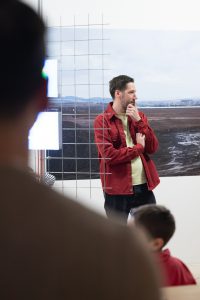
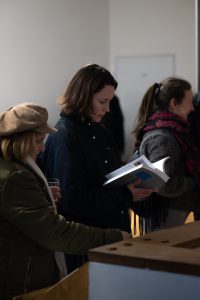
Installation photo: Jan Kolský
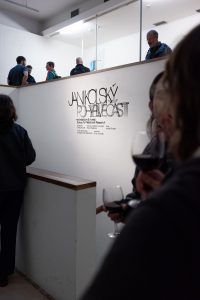
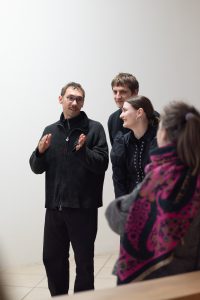
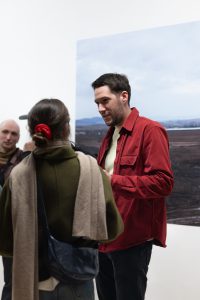
Opening photo: Eliška Klimešová